Showing posts with label body. Show all posts

Tuesday, March 25, 2008

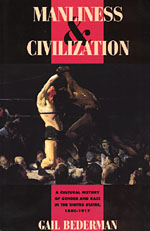
Manliness and Civilization: A Cultural History of Gender and Race in the United States, 1880-1917


Manliness and Civilization: A Cultural History of Gender and Race in the United States, 1880-1917 (1995)
By Gail Bederman

Synopsis: This book seeks to illuminate the ways in which "middle-class men and women worked to re-define manhood in terms of racial dominance, especially in terms of 'civilization'" (20). Focuses the bulk of the book on four different figures: Ida B. Wells (discussed race problem and lynching as "unmanly" and an act of barbarism, yet whites continued to link lynching with manliness); G. Stanley Hall (believed in "recapitulation" theory that each human lived entire evolutionary sequence, and that kids were going through "primitive/savage" stage, and this should be encouraged so they don't turn out as weak, overcivilized pansies); Charlotte Perkins Gillman (linked feminism to white supremacy of civilization); Theodore Roosevelt (obsessive view that white race was the manliest and most powerful, and that it would remain manly via the strenuous life and via imperialist expansion into Cuba, Philippines, and Puerto Rico; and that middle class whites must prevent "race suicide" by having more kids). Argues that race and gender are intricately linked, and that "gender - whether manhood or womanhood - is a historical, ideological process...[it's a] continual, dynamic process" (7). Because definitions of manliness are always shifting, we shouldn't see 1870-1910 as a time of "crisis" per se, but rather as another redefinition. The rise of leisure and the decline of self-employed men led to changing notions of "masculinity," and increased fears that the "feminine" Victorian era would emasculate men. Men basically felt that they were losing control. However, the rhetoric of "civilization" and "manliness" was so flexible that it could be used in an array of ways - often contradictory ways. At its core, "civilization" discourse was all about race, gender, and power. 1910 Jack Johnson (black)/Jim Jeffries (white) "fight of the century" all about "reclaiming" white male dominance (though Johnson won).

Interacts With:

Hope in a Jar, Houdini, Tarzan, and the Perfect Man, Terrible Honesty (with idea that certain eras can be "feminine" or "masculine" - "masculine" modernity as a reaction against "feminine" Victorian era), All the World's A Fair (for discussion of white male superiority and racial dominance)

Wednesday, March 12, 2008

Rabelais and His World


Rabelais and His World (1984 [1968])
By Mikhail Bakhtin

Synopsis: This book is an examination of the raw, folk-culture, laughter-infused aspects of Rabelais's work, mostly centering on the carnivalesque. It focuses on 1) ritual spectacles, 2) comic verbal compositions, and 3) "billingsgate" (curses, oaths, etc.). Both Bakhtin (post-Russian Revolution) and Rabelais (Renaissance), were writing during a time of revolution and renewal. Bakhtin looks at laughter, the language of the marketplace, festive images, banquet imagery, the grotesque body,. "material bodily lower stratum," and Rabelais' image in his own time. Bakhtin argues that carnival is all about "the feast of becoming, change, and renewal" - the suspension of all hierarchies. Much of Rabelais' imagery is about the lower regions - guts, ass, stomach, etc - and bodily functions and secretions - piss, spit, shit, etc. This can be called grotesque realism, and depicts humanity as a collective body. Whereas today we have privatized and individualized bodily functions, in Rabelais' time such functions were seen as connected to society and to the cosmos; universality and a body's interaction with the outer world. Laughter was seen as essentially human, and Rabelais saw moments of festival gaiety as utopian. Essentially, these scenes are all about bodily sensation and about material sensual bodily unity (but infused with some individual distinctions).

Interesting Specifics:

Bakhtin is a philosopher and literary scholar; a theorist of the novel.

Laughter is central to Rabelais, and during the Renaissance, laughter had a positive, regenerating, creative meaning (71).

"...in the atmosphere of Mardi Gras, reveling, dancing, music were all closely combined with slaughter, dismemberment, bowels, excrement, and other images of the material bodily lower stratum" (224).

In Rabelais' day, "excrement was conceived as an essential element in the life of the body and of the earth in the struggle against death. It was part of man's vivid awareness of his materiality, of his bodily nature, closely related to the life of the earth" (224).

"The carnivalesque crowd in the marketplace or on the streets is not merely a crowd. It is the people as a whole, but organized in their own way, the way of the people. It is outside of and contrary to all existing forms of the coercive socioeconomic and political organization, which is suspended for the time of the festivity" (255).

"Death from laughter is one of the forms of gay death" (408).

Interacts With:

I love the idea of a "collective body," and bodily fluids and the lower regions as expression of connectivity and union with the cosmos - cool man!
Connects with books that stress the importance of historical context.
Connects with any books that deal with the carnivalesque and inversion of "natural" order.
In Place/Out of Place

Tuesday, March 11, 2008

Bodies That Matter: On the Discursive Limits of "Sex"

Bodies That Matter: On the Discursive Limits of "Sex" (1993)
by Judith Butler

Synopsis: Asks, how do certain bodies come to matter at all? Butler examines the fact that "'sex' is an ideal construct which is forcibly materialized through time," and that "performativity "produces the phenomena that it regulates and constrains" (2). This is a mostly theoretical work which relies heavily of psychoanalytic Lacanian theory to postulate about power and hegemony and the heterosexual regime. Butler is very interested in "the body" and materiality and naming and heterosexist images. Basic argument seems to be that the heterosexual regime tries to impose itself on the materiality of bodies. She is interested in the "lesbian phallus" and all things phallocentric. She argues that the way things are named is imbibed with power and gender issues. "Performing" gender re-enforces some kind of heterosexist regime; performative acts as authoritative speech.

Interesting Specifics:

Performativity "produce[s] the phenomena that it regulates and constrains" (2).

When things are not clearly gendered, they seem almost "unhuman" (8).

"Matter" linked to "materiality" linked to productive capacity linked to womb linked to female.

"...there is no sexuality outside of power" (95).

Says she seeks in this book "to recast performativity as a specific modality of power as discourse" (187). She seems especially concerned with "the real" and with the construction of power relations.

"To the extent that gender is an assignment, it is an assignment which is never quite carried out according to expectation, whose addressee never quite inhabits the ideal s/he is compelled to approximate" (231).

Interacts With:

Honestly, this book was nearly impossible to understand, and I'm not sure if I even have a basic understanding of it yet. I realize basically that she is obsessed with gender in a fairly paranoid way, and is also obsessed with idea of "performing" gender.

Apparently, she takes a "poststructuralist" approach. According to some review in Gender and Society, Butler sees sex as "not simply a factual/natural category...rather, it is a normative one." Supposedly her theory is meant as an improvement on social constructionism.

Fit for America: Health, Fitness, Sport, and American Society

Fit for America: Health, Fitness, Sport, and American Society (1986)
By Harvey Green

Synopsis: This book is a history of the culture of American health reform, 1830-1940, and examines the ways in which ideas about health and fitness changed over the century and were tied to larger cultural events. Utilizes sources like catalogues, ads, diaries, letters, journals, medical books, and advice books, and divides health reform into three major periods: Part I: Millennial Dreams and Physical Realities, 1830-1860 (in which body/health reforms were strongly tied to religion and millennial beliefs that the second coming of Christ would only happen is people had reached a state of perfection); Part II: The Price of Civilization, 1860-1890 (reforms based on increased focus on nervous disorders and neurasthenia due to increased urbanization and brainwork; increased focus on "water cure" and "muscular Christianity" and athletics; U.S. increasingly strives to become world power); Part III: Regeneration, 1890-1940 (increased racism and nationalism and fears of race suicide and the decrease of vigorous manliness; leads to rise of "strenuous life"). Many reforms dealt with diet (especially meat-eating versus vegetarianism), and electricity and devises designed to increase energy/efficiency. There was a lot of concern with, even paranoia over, decreased energy and conservation of energy (within the person). Argues that all of these body reforms were acts of individualism, yet the popularity of sports shows our continued desire for community and emotional bonding.

Interesting Specifics:

Self-help books were big by the 1830s.

Some reformers warned against the dangers of spiced and salted foods, and of too many condiments.

Was a lingering fear that passions might get out of control, and that "stimulation" was harmful because it drained away the body's energy.

Sylvester Graham advocated a vegetarian diet of bran bread, water, and vegetables; "Grahamism" was popular among radical communities which sought to separate themselves from the great mass.

Argues that vegetarianism never really took off in U.S. because it is passive, an avoidance of something instead of an active use of something else (53).

By 1850s, children were seen as pure and not wicked, marking a big shift.

George Beard was the neurologist obsessed with neurasthenia.

John Harvey Kellogg another big advocate of the water cure, etc. Water cure involved lots of submersion, etc, and led to therapeutic spas and resorts.

Some thought that meat-eating was linked with human progress and "racial nationalism" (165) - i.e. idea that meat-eaters were more evolved.

Post-Civil War = increased focus on sports and calisthenics, etc.

Ideal male body type gets bulkier in 1880s (198).

View of the body as a machine (late nineteenth century), and need for internal cleanliness.

The Olympic games were reinstated in 1896.

By 1920, Bernarr McFadden's Physical Culture magazine was crammed with self-help and advice.

In the 1920s, there was a fear that blondes would decrease (i.e. due to floods of immigrants, etc.).

Horace Fletcher invents "Fletcherism" - way to lose weight by chewing food endlessly before swallowing it.

Interacts With:
Books dealing with perfectionism
Manliness and Civilization,
Seems very much a product of the 1980s, which were obsessed with body image and fitness.
This book is awesome, but it covers an impossible amount of stuff.

Saturday, March 8, 2008

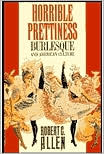
Horrible Prettiness: Burlesque and American Culture


Horrible Prettiness: Burlesque and American Culture (1991)
By Robert C. Allen

Synopsis: Asks how burlesque moved from a movement of bold female transgression to one of mere spectacle. This book traces the history of burlesque in the U.S. via a history of theatre in the 1820s-30s, the wild chaos of the "lower class" crowds with their participatory nature, to the bourgeois-ification of burlesque in the 1850-60s, to the relegation of burlesque back to the working classes 1880-1920s, to its last-ditch efforts by taking over failed legit theatres in Times Square which only brought it increased public scrutiny and the moral outrage that led to its demise in the 1930s. Burlesque is complicated and complex, and its "decline" into pure female sexual spectacle at the end partly silenced the transgressive nature it had earlier when female performers actually talked and joked too. In those days, burlesque was largely about the bottom-up inversion of social order, with a focus on the grotesque and on the mockery of the power system in place.

Interesting Specifics:

Burlesque in the U.S. was tied to the "spectacular female performer" and raised "questions about how a woman should be 'allowed' to act on state, about how femininity should and could be represented, and about the relationship of women on stage to women in the outside, 'real' world" (21).

Burlesque as monstrous, grounded in the "aesthetics of transgression, inversion, and the grotesque" (26) - in "the low other."

Ordination = "the exercise of power bound by the limits of discourse;" Insubordination = "resistance contained by discourse" (35).
Argues that struggles over burlesque are about ordination and insubordination rather than domination and resistance (35).

In the late 18th-early 19-century there were many anti-theatrical laws because theatricality was said to "disrupt" the natural order of things; that to disguise oneself and act as something else was seen as mocking nature and God's order of things (47).

The third tier of the theatre was always reserved for prostitutes and their clients.

1820s-30s, theatre gets popular in the U.S.; 1850s marked huge shift in theatre - it became increasingly "feminized" and respectable and less rowdy.

Lydia Thompson Troupe huge.

Dyed blonde hair very popular, and became popular with middle class by 1860s.

Burlesque paralleled and/or joined minstrelsy a bit in the 1870s.

Vaudeville combined most of the other show types one one stage and was appealing to the middle class (tried not to offend); 1890s. Became first place women really attended alone.

Benjamin Franklin Keith largely responsible for creating this brand of clean, family-friendly egalitarian vaudeville, and vaudeville banned any kind of humor that relied on difference (i.e. that caricatured or drew attention to otherness in any way - was the opposite of burlesque).

Burlesque was mostly an East Coast, Midwest, and San Francisco urban phenomenon.

Burlesque posters depicted huge, all-powerful women "playing" wealthy men (i.e. "gold-diggers" riding huge lobsters in mockery of the fancy lobster palaces of the day). This prob didn't offend its mostly working-class audience because the men being lampooned were wealthy men.

Cooch dance merges in 1890s (with the Chicago Expo), a direct precursor to striptease. Runways were invented in 1917, and stripping didn't become standard part until 1920s.

By the 1890s, female burlesque dancers were silent on stage, and was now just about the sexual display of their bodies.

Depression of the 1930s caused many "legit" theatres to close, allowing burlesque to move into those spaces. This however hastened its demise as those in power didn't like them and sought to shut them down.

Interacts With:
Bakhtin; Manliness and Civilization; Houdini, Tarzan, and the Perfect Man;