Showing posts with label modernity. Show all posts

Tuesday, March 25, 2008

Hope in a Jar: The Making of America's Beauty Culture


Hope in a Jar: The Making of America's Beauty Culture (1998)
By Kathy Peiss

Synopsis: This book is an examination of the rise of the cosmetics and make-up industry in the U.S., and the constantly reconfigured and renegotiated understanding of make-up use among women, and in American culture overall. Aim is to understand women's intentions as well as social and cultural forces surrounding them. She focuses mostly on imagery and general cultural trends, rather than on what individual women thought, and does this by analyzing the history of the cosmetics industry from the early nineteenth-century to today, with the bulk of the focus on 1900-1930. She shows the way the beauty industry evolved from a female-run business which ducked standard advertising and marketing efforts, to a big consumer culture phenomenon in the 1920s run by men. She also shows how make-up moved from the realm of hookers to average American women, and the way it ultimately came to be deeply connected to femininity and self-expression, identity and community. Argues that the beauty industry continues to be a contested thing - the African American side is especially political, i.e. what is the ideal beauty?
Peiss argues that beauty culture was a way for women to negotiate modernity - the artifice and performance aspect of it was appealing and appropriate for the modern era, yet men continuously had a hard time with this "artifice." Make-up as "skin improvement" vs. make-up as "paint" was an early and tight distinction. This is all still up for debate though - i.e. is this oppressive? "Hussy" outsold "Lady" by a lot, and these two types were seen as moods and not types of people (how postmodern!!) Transformative power of make-up. [The parts about failed attempts to get men to use make-up are fascinating - kind of reminds me of failed attempts to get people to drink coke for breakfast].

Interacts With:

Manliness and Civilization, Tarzan, Houdini, and the Perfect Man, Venus Envy, Where the Girls Are, Fraud in the Age of Barnum (for the discussion of artifice), anything that deals with the performance or charade aspect of Modernity/urban life: Confidence Men and Painted Women,

Monday, March 17, 2008

The Positive Thinkers: Popular Religious Psychology from Mary Baker Eddy to Norman Vincent Peale

The Positive Thinkers: Popular Religious Psychology from Mary Baker Eddy to Norman Vincent Peale (1988 [1965])
By Donald Meyer

Synopsis: This book is an examination of popular psychology and its intersection with health, wealth, and peace of mind. It is divided into three parts: Part One: Theology as Psychology (nineteenth-century life brings increased fragmentation/compartmentalization; rise of nervousness brought on by modern life; Mary Baker Eddy's mind cure Christian Science of the 1880s as feminine way of passively making best of situation via attempt to "think the thoughts of God;" ideal was for one whole mind, a total coherence of environment, a giving up of one's self); Part Two: Peace in the System: Sociology as Psychology (rise of business culture and rise of scientific efficiency and rational order/mechanization, Taylorism, rise of managerial elite and organizational psychology; desire for happy and smoothly-running everything); Part Three: Peace in Peace: Psychology as Psychology (liberal Protestantism's loss of touch with sensuality/art; obsession with work ethic; rise of Norman Vincent Peale and mass services exalting "positive thinking"). Although the overall argument is a bit unclear, one interesting point I got out of it is that self-help culture and positive thinking are logical extensions of Protestantism's rejection of all things hierarchical (as embodied by their rejection of religious authority); the only real power lies within the individual. This might pave way for religious Right.

Interesting Specifics:

1881 = George Beard's American Nervousness

The rise of clean houses as a value represented the need for something to do (49).

"Mind cure rejected personality" (114). Personality represented fragmentation and lack of unity with the big picture.

Interacts With:

Again, one of the main points is that the modern era caused increased compartmentalization/fragmentation. Was there ever a moment in the 19th century in which people said, Fuck this holism, let's compartmentalize things!?
Also interacts with anything that focuses on the primacy of the individual. I can honestly also seem some connection to Storming Heaven with it's focus on the enlightening of the individual; really falls in line with transcendentalists as well. Hmm, if U.S. had remained homogeneous for longer, I wonder if there would have been enough momentum to create a strong community-based culture that could have withstood the individualistic competition of capitalism.. Because it really was with the influx of different kinds of people that the colonists were forced to use pluralism as their new ideal (not that pluralism is bad, but if pluralism - in the guise of acceptance of differences - had come along a little later, when a more stable community-based society had taken root, I wonder if we would be such an individual-focused society. Hmm.)
Warning: I skimmed this book pretty quickly.

Sunday, March 16, 2008

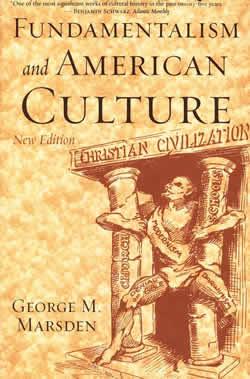
Fundamentalism and American Culture: The Shaping of Twentieth Century Evangelicalism, 1870-1925


Fundamentalism and American Culture: The Shaping of Twentieth Century Evangelicalism, 1870-1925 (1980)
By George Marsden

Synopsis: This book is a general history of the rise of fundamentalism in the U.S. from 1870-1925, and demonstrates the ways that cultural, religious, and intellectual currents transformed some American evangelicalism into fundamentalism. Argues that fundamentalism was essentially antimodernist, and could flourish in the U.S. because U.S. had a long history of religiosity. Fundamentalists ultimately came to feel that their worldview dominance was slipping away and threatened by the modernist paradigm, hence they sought to hold on to their "older" style, even though they felt outnumbered. Book is divided into four parts: Part One: Before Fundamentalism (U.S. in 1870 as "Christian Nation;" appropriateness of common sense philosophy); Part One: The Shaping of a Coalition (fundamentalists a very diverse bunch; they hated social gospel because it focused on social problems rather than salvation; WWI led to the decline of evangelicalism as a dominant force); Part Three: The Crucial Years: 1917-1925 (premillenialism seen as threat to national security as they did not believe political action or human efforts could solve the world's problems; 1920s-25 = rise of anti-evolutionism; fundamentalists all about unchanging truth, whereas modernists all about truth as shaped by cultural circumstances; Scopes trial of 1925 said to cement fundamentalism in the public mind as about the clash between rural and urban, 19th century and 20th); Part Four: Interpretation (post-WWII fundamentalists seen by many as anti-intellectual and paranoid, transferring good vs. evil dichotomous thinking to many realms; f not necessarily anti-science, but rather held to a different paradigm of science, a Baconian paradigm that was all about observation = proof, conflicted with modernist paradigm). Bottom Line: Fundamentalists believed in enduring truth, and this didn't fit with modernist belief in the influence of cultural circumstances.

Interesting Specifics:

Fundamentalism was in "fierce opposition to modernist attempts to bring Christianity into line with modern thought" (4).

William Jennings Bryan led the campaign to ban the teaching of Darwinism in schools (6). 1925 law in Tennessee had banned the teaching of Darwinism in any public school.

Finds three major themes within fundamentalism: Fs sometimes identified with the establishment, and sometimes with "outsiders;" is connected to earlier traditions and embodies ambivalence over the conflict between pietist and Calvinist traditions; fs embody a tension between trust and distrust of the intellect, and generally held to "common sense" views of the world (6-8).

Questions over whether to re-shape dominant culture or to separate completely from it (124).

Anti-evolution movement really kicked-off from 1920-25.

"By modernist definition fundamentalists were those who for sociological reasons held on to the past in stubborn and irrational resistance to inevitable changes in culture" (185).

Interacts With:
End of the World As We Know It, When Time Shall Be No More,

Saturday, March 15, 2008

Rudeness and Civility: Manners in Nineteenth-Century Urban America


Rudeness and Civility: Manners in Nineteenth-Century Urban America (1990)
by John F. Kasson

Synopsis: This book asks: "What...was the relationship of the symbolic system of economic exchange (money) to the symbolic system of social relationships (manners) in a democracy?" (6) Kasson investigates this question by looking at "the semiotics of everyday urban life" via etiquette rules, manners, etc., to get at how such practices bear "upon key questions about the nature of social conventions, social relationships, and individual identity in the supposedly 'free' market and democratic society of the nineteenth-century metropolis" (5). Includes a discussion of pre-nineteenth-century manners (pre-"modernity,"), etiquette books and gentility, reading the city, bodily management, emotional control, table manners, and "disciplining spectacle." This book is thus basically about the "transition from a rank-structured society to an impersonal 'class' society" (33). The rise of urban center populations led to an increased sense of fragmentation and confusion and a fragmented sense of self; this resulted in a need to create some kind of system of self-protection/cohesiveness. Etiquette and manners stepped-in to provide this system of semiotic guideposts. The more chaos ensued, the more people relied on the most minute signs and symbols as a way to "read" or understand others. Clothes, silverware, manner of walking, etc. all thus became increasingly emblematic of one's character. This increased restraint, control, and decorum, came at the expense of jovial togetherness, and this increasingly passive spectator style really paved the way for modern consumer culture. Meanwhile, the city itself was read from 1) the bird's eye view of "unity and progress," and 2) the mole's eye view of vice and shadows. Overall, this book demonstrates the intense need to develop some new system of ranking, status, and order in the face of immense change and fracturing.

Interesting Specifics:

** Excellent! Focus on! Lots of good info and specifics! **

The output of etiquette manuals surged from 1870 to t.o.c.

"In the name of civility and self-discipline, the bourgeois code of manners deflected the pressures and inequities of the society back on the individual" (6).

The Civilizing Process by Norbert Elias (from about 50 years ago) was one of the first to analyze manners and etiquette and study them as history.

Many of the changes associated with modernity include: rise of the nation-state, the rise of egalitarian spirit associated with Western democracies, modern capitalist economy, the rise of relations defined by the market, the rise of Evangelicalism, and the Enlightenment focus on rationality and tolerance, etc (18).

The rise of capitalism meant that gentility was now something to be purchased.

"As late at 1820, only one person in fourteen lived in a community of more than 2,500, and only twelve cities exceeded 10,000" (71). From 1860-1910, the urban population rose from 19.8% - 45.7% of the total American population (72).

By 1920, in cities of 100,000+, 58% were foreign-born or had foreign-born parents (72).

The 1850s saw a rise of "gaslight" tours in which the bourgeois would explore the horrors of those who lived in the slums (78).

There was an increase in agoraphobia in the 19th century due to "sharp discontinuities between public and private life" (113); also connected to an increased fear of embarrassment.

Increased focus on control at this time meant that emotional outbursts - especially of anger - were shunned.

"Private tastes, rather than public actions, became the crucial indicator of sincerity and authenticity" (169). "Privacy" also became increasingly desirable. [Hmm, would be interesting to do a history of privacy in the U.S. Very connected to current issues i.e. online communities. Can love of privacy be directly linked to xenophobia? Does its rise dovetail increased immigration? This book says yes, basically, I wonder if this pattern continues through history?]

Increased specialization of flatware mirrored increased specialization in the workplace.

The 1830s marked a huge revolution in cutlery and table-manners.

Astor Place Theatre represented a new era in refinement.

The term "confidence man" was coined in 1849, and referred to a well-dressed con-artist who pretended to be an old friend and then would say "Have you confidence in me to trust me with your watch until tomorrow?" and then would of course take off with the watch (103).

The increasingly demanding social rules of the time represented an attempt to defend a "solid self" in a fragmenting world (257). Says self-help books of today are the successors of etiquette books, and are still attempts to come to terms with our fragmented world/selves.

Interacts With:

Says that although material development of society is well studied, few have paid much attention to "vital but elusive changes in cultural practices, conduct and consciousness that attended this physical transformation" (4). I guess that is his intervention then.
Paul Boyer (Urban Masses and Moral Order - in attempt to deal with/adjust to the increasingly impersonal metropolis)
Rothman, The Discovery of the Asylum (need for order in the face of chaos)
Even the books from the jeremiad section, like The Culture of Narcissism (via the increased focus on tiny individual details as key parts of one's self)
Actually, a lot of the material culture books too, as related to the use of stuff to construct one's identity and sense of self (in Kasson's book, as done with clothing and overall personal "style").
Horrible Prettiness (as related to increased passivity and bourgeois-ification of theatre; what was lost with the rise of "gentility" and "polite" spectatorship).
de Certeau (for their shared focus on the "practice of everyday life;" the small gestures).
Books that deal with the separation of home from workplace.
With its focus on the "fragmenting self," it seems that this book is really about early strains of postmodernism - but then again, postmodernism really can just be seen as an extension of modernism, but without the faith in the potential of a "grand plan."

Tuesday, March 11, 2008

No Place of Grace: Antimodernism and the Transformation of American Culture, 1880-1920


No Place of Grace: Antimodernism and the Transformation of American Culture, 1880-1920 (1981)
By T. J. Jackson Lears

Synopsis: This book explores the origins and effects of American antimodernism - especially its "recoil from an overcivilized modern existence to more intense forms of physical or spiritual experience" (xv). Lears argues that the turn of the century was not marked by democratization and the decline of the elites, "but rather by the reinforcement of elite power in new corporate and bureaucratic forms" (xii). Utilizing Gramsci's notion of hegemony, Lears analyzes books, magazines, private letters, novels, poems, essays, and sermons to build his argument linking antimodernism with the rise of therapeutic culture. He feels that antimodernism was "both more socially and more intellectually important than historians have supposed" (xv), claiming that "the shift from a Protestant to a therapeutic world view, which antimodern sentiments reinforced, marked a key transformation in the cultural hegemony of the dominant classes in America" (xvii). Modernism (lit and art) and antimodernism share common roots in the yearning for authentic experience - physical, emotional, or spiritual (xix). The book is divided into the following sections: 1) Roots of Antimodernism (the increased rationalization and systematic organization of life for maximum productivity leads to an increased feeling of "unreal"-ness; increased focus on time; increased obsession with comfort; crisis of cultural authority; fears of overcivilization; neurasthenia and weightlessness); 2) Arts and Crafts Ideology (regeneration through handicrafts); 3) Martial Ideal (war as antidote to weightlessness; rise of boxing, football, and the "strenuous life"); 4) Medieval Mentalities (increased focus on childhood and fantasy and antirationalism); 5) Catholic Forms (increased interest in Catholic art/ritual); 6) Patriarchy to Nirvana (oscillation between autonomy and dependence; male versus female realm); Henry Adams (epitome of antimodernism, hated efforts to banish irrationality, deeply conflicted). Antimodernists feared a docile and complacent society. "By exalting 'authentic' experience as an end in itself, antimodern impulses reinforced the shift from a Protestant ethos of salvation through self-denial to a therapeutic ideal of self-fulfillment in this world through exuberant health and intense experience" (xvi). The cult of self-fulfillment was easily co-opted by consumer capitalists whose economy worked perfectly via constant generation of new individual wants and desire. In a way then, antimodernism paved the way for these new modes of cultural hegemony. The therapeutic worldview is thus both a symptom and source of the banality of modern culture.

Interesting Specifics:

* Focus on this one for exam * Tons of notes on this book *

Modernity led to "the systematic organization of economic life for maximum productivity and of individual life for maximum personal achievement...the reduction of the world to a disenchanted object to be manipulated by rational technique" (7).

An obsession with comfort and a decrease in pain, along with a focus on time, were key components of modernity. This was also linked to an increased sensitivity to suffering in general (i.e. slavery, animal abuse, etc).

Spencerianism = optimistic faith in progress.

Increased presence of capitalism leads to increased fracturing of the self.

Modern culture = weightlessness [Marx derivative]

"...most varieties of 20th-century militarism - at least in the West - share a common cultural origin in the late-nineteenth-century recoil from a weightless modernity" (98).

"Antimodern vitalists, for whom intense feeling was its own reward, stressed becoming rather than being, eros rather than agape" (162).

Henry Adams, son of John Adams: "Riven by tension between autonomy and dependence, doubt and faith, he rejected efforts to banish irrationality and contradiction in the name of social or personal harmony" (295).

"Under a twentieth-century regime which multiplied wants and sanctioned total gratification, the avant-garde cult of self-fulfillment sometimes only exaggerated the culture it set out to repudiate" (299).

This desire was all too easily usurped, as "intensity of feeling...became a product to be consumed like any other" (300).

"...the vision of a self in endless development is perfectly attuned to an economy based on pointless growth and ceaseless destruction" (307).

Interacts With:

Gramsci's notion of hegemony
Terrible Honesty,

Illuminations

Illuminations (1969)
By Walter Benjamin

Synopsis: This book is a series of essays that span about 15 years, and most are reflections on various cultural components or figures, including Baudelaire, Kafka, and Proust. Also includes a chapter on Benjamin's personal library. Book is most focused on the way history, memory, artifacts, and time together. Underlying all his work is the tension of modernity. In his most famous piece here - "Art in the Age of Mechanical Reproduction" - Benjamin argues that the shift from art as steeped in ritual and tradition, to art made solely for mechanical reproduction messes-up the concept of authenticity and also messes with the "aura" of the work. Benjamin is fixated on phenomena and "the wonder of appearance," and seems to be amazed by the way memory and history is embodied. There is a strong sense of loss and longing in his writing, and he seems very concerned with the way human relations and the artifacts between humans have been transformed by modernity. The nineteenth century seems to be more of his place than the twentieth.

Interesting Specifics:

Benjamin loved the flaneur; "To endow this crowd with a soul is the very special purpose of the flaneur" (195).

"The presence of the original is the prerequisite to the concept of authenticity" (220).

"All efforts to render politics aesthetic culminate in one thing: war" (241)

War is a way to mobilize all technological systems while still maintaining the property system (241).

Jew are forbidden in the Torah from investigating the future [is this why Benjamin is so obsessed with the past?].

Interacts With:

Anything on memory its link to material culture/artifacts
Kitsch: The World of Bad Taste

Thursday, March 6, 2008

All That Is Solid Melts Into Air


All That Is Solid Melts Into Air (1982)
By Marshall Berman

Synopsis: Basic question is: How can we learn from the modernisms of the past, and draw from their vital and exciting energies to re-ignite a world of connection, meaning, and vibrant understanding today? Defines modernism as "the struggle to make ourselves at home in a constantly changing world" (6). Modernism is both exciting in its maelstrom form, and potentially destructive, so we must learn how to make meaning from it, and one way of doing this is through analyzing modernism's pasts. Examines Faust; Marx as a guy fascinated by energy and potential of modern capitalism but angry that the result was only oppression and the chasing of money; Baudelaire and the excitement of the Parisian boulevard; St. Petersberg as an "underdeveloped" anti-modern modern place and the Nevsky Prospect - with its jumble of classes - as the embodiment of modernity; New York and Robert Moses (and his jackassery) and the optimism of Jane Jacobs. Each example highlights notion that modernity should be all about the maelstrom. This is a slight reworking of Marxist ideas, and shows Marx was excited about potential of modernist energy and creation. Berman perhaps has presentist concerns in mind, perhaps over how to reinvigorate our political culture of apathy and to reignite a vital sense of urbanism and public space. Tone is definitely romantic and optimistic and even utopian, and seeks to rescue us from postmodern ennui and cynicism.

Interesting Specifics:
Modernity promises both boundless adventure, growth, and transformation - and the threat to destroy all of this (15).

Boulevards created a powerful stage on which to be "private in public" (152).

Interacts With:

Sunday, March 2, 2008

The Condition of Postmodernity

The Condition of Postmodernity
By David Harvey (1990)

Synopsis: Asks: What is postmodernism, and are we indeed living in a postmodern age? His overall argument is that postmodernism builds on ideas of modernism (in its reaction to change, chaos, ephemerality, and time-space compression), but whereas modernism was all about the grand overarching plan that would make everything better, postmodernism represents the death of the grand narrative. Postmodernism instead embraces chaos and fragmentation and collage (and embraces the signifier rather than the signified), and was aided by the disembodied nature of capitalism itself. Though he celebrates the multiplicity of postmodernism, Harvey is afraid it may cause each specific group to remain in their own little ghettos, and a focus on surface and difference might lead to larger political inertia or disengagement from bigger picture (117-118). The late 1960s brought on a crisis of overaccumulation, as capitalism is a fetishizer and creator of new needs and wants.

Interesting Specifics:

Says postmodernism arose between 1968-72 as a result of the anti-modern movement of the 1960s (38).
1914 marks the rise of Fordism and ushering in of new way of life obsessed with mass production and functionalism.
Jefferson's homesteading project helped spatially set-up Enlightenment ideal in a utopian way (255-57).
Talks about the rise of image consultants as a fairly postmodern phenomenon (288).
Time-space compression (beginning around 1910 he says) is central to both modernism and postmodernism.

Geographical Imaginations

Geographical Imaginations
By Derek Gregory (1994)

Synopsis: This book details various episodes in the history of geography and does so by showing the ways they interact with other histories. It also focuses on "the problematic of visualization," or the way in which sight has come to dominate the modern era (15-16). By the end of the nineteenth century, it was common for "European ways of knowing to render things as objects to be viewed " (34), which basically served to create a distance between the observer and the observed - a main definer of modernity. His book focuses mostly on a history of different understandings of space. Spends some time on postmodern thinkers as well. Talks a lot about Harvey (actually seems to summarize a lot of his work) and criticizes him for being too Western-centric and lacking in feminist perspective. Talks also about Lefebvre and his view that the visual has taken over, leaving an absence of any bodily dimension (392). Ends with idea that we need to come up with a more holistic and true human geography.

Interesting Specifics:

Says David Harvey and others view Haussmann's redo of Paris as a triumph of bourgeois values, making the public spaces akin to bourgeois private spaces (222).

Saturday, March 1, 2008

The Production of Space

The Production of Space (1991) [1974]
By Henri Lefebvre

Synopsis: Wants to bridge the gap between mental space, real/physical space, and social space, and thus is looking for a unitary theory of mental, physical, and social space which would break down the barriers between the various kinds of spaces (21). Spatial practice, representation of space, and representational space all work to form the perceived-conceived-lived triad (40). Space is intertwined with social processes, and social space is "a materialization of 'social being'" (102). Capitalism has fucked things up because it has compartmentalized and separated the various types of spaces, following the logic of the way we separate the forms of labor and production. Dominated space = space transformed by technology and practice; appropriated space = space adapted to the needs of the groups; abstract space = reduces all space to signs and symbols, thus obscuring the reality of the space - it's a tool of domination and it's the logic of state-imposed, destructive force. Therefore, to transform society we must transform space; we must move from the production of things (capitalism), to the production of space (with a decrease in private ownership). He wants to increase a sense of holism and unity in a world that has been fractured and compartmentalized and fethishized, and wants an organic, bottom-up space of the people. This book is heavily influenced by Marxism, and today is loved by postmodern geographers like Soja and Dear. Is a critique of poststructuralism, structuralism, and logocentrism. Lefebvre was a communist and socialist and Situationist. Believes in the revolutionary potential of space.

Specifics:

Sight has nearly totally eclipsed all the other senses due to our obsession with and prioritizing of signs and language (logocentrism) (139).

"To change life we must first change space" (190).

Modern life has caused a fracturing of the body into separate, disconnected parts (205).

"...absolute space is located nowhere. It has no place because it embodies all places, and has a strictly symbolic existence" (256).

Parts of the city are sexualized, just as certain zones of leisure are sexualized (310).

The bourgeois apartment has been stripped of eros (315).

Lefebvre was part of the Situationist movement.

Putting Women in Place: Feminist Geographers Made Sense on the World

Putting Women in Place: Feminist Geographers Made Sense on the World (2001)

By Mona Domosh and Joni Seager

Synopsis: Place and gender are inextricably linked. This book explores issues of power, and brings feminism and gender to geography by pointing out the importance of examining the link between gender and place. Shows that ideals of gender do inform our use of space and affect out sense of mobility. Discusses home space and the gendering of public and private space within Victorian homes; female design tastes and the way male-dominated “modernist” movement (1890s-1930s) sought to streamlines and usurp home decoration which had previously been a female domain; discussion of middle-class women as “Americanizers” to “foreign”-types; Charlotte Perkins Gillman and other feminist efforts to collectivize female labor; fact that much female labor is not counted in GDP/work averages; idea that feminine implies natures and chaos, while masculine implies order/control/city [connects here with Terrible Honesty]; suburban space and the attempt to limit female mobility as cars are seen as “male;” rugged nature as male; women’s building at Columbia Expo; feminist environmentalism and scary male view of earth as a “mother” who will clean-up our mess.

Interesting Specifics:

Postwar females’ design tastes in home interiors were castigated by “taste” experts as middle-low brow kitsch, thus challenging and belittling female power (28).

Increased female presence in cities in the 1850s led such spaces to be increasingly “feminized” so as to be more appropriate for women. Example is the fancy arches of shopping arcades (93).

Suburban growth really increased in the 1920s

Gays and lesbians often lead gentrification efforts (102)

“Mobility is greatest at the extreme ends of the socioeconomic spectrum” (110).

Rise of masculine rugged farmer ideal in 1930s as way to counteract effeminate dependency of govt. aid during Depression (166).

Gender is the biggest determiner of attitudes towards animals (185)

Ecofeminism is concerned with control of resources, power relations, different way of viewing the environment, systems of oppression, etc.

Trivia:

First toilets were designed to look like parlor chairs, but were changed in the 1920s due to hygiene concerns (16)

Women, whether married with kids or not, tend to work closer to their homes than men [is this because women’s work tends to be more “low-level” and hence easier to find stuff anywhere/less justification for traveling far distances to work?].

Interacts With:

Terrible Honesty,