Showing posts with label perfectionism. Show all posts

Tuesday, March 25, 2008

Hope in a Jar: The Making of America's Beauty Culture


Hope in a Jar: The Making of America's Beauty Culture (1998)
By Kathy Peiss

Synopsis: This book is an examination of the rise of the cosmetics and make-up industry in the U.S., and the constantly reconfigured and renegotiated understanding of make-up use among women, and in American culture overall. Aim is to understand women's intentions as well as social and cultural forces surrounding them. She focuses mostly on imagery and general cultural trends, rather than on what individual women thought, and does this by analyzing the history of the cosmetics industry from the early nineteenth-century to today, with the bulk of the focus on 1900-1930. She shows the way the beauty industry evolved from a female-run business which ducked standard advertising and marketing efforts, to a big consumer culture phenomenon in the 1920s run by men. She also shows how make-up moved from the realm of hookers to average American women, and the way it ultimately came to be deeply connected to femininity and self-expression, identity and community. Argues that the beauty industry continues to be a contested thing - the African American side is especially political, i.e. what is the ideal beauty?
Peiss argues that beauty culture was a way for women to negotiate modernity - the artifice and performance aspect of it was appealing and appropriate for the modern era, yet men continuously had a hard time with this "artifice." Make-up as "skin improvement" vs. make-up as "paint" was an early and tight distinction. This is all still up for debate though - i.e. is this oppressive? "Hussy" outsold "Lady" by a lot, and these two types were seen as moods and not types of people (how postmodern!!) Transformative power of make-up. [The parts about failed attempts to get men to use make-up are fascinating - kind of reminds me of failed attempts to get people to drink coke for breakfast].

Interacts With:

Manliness and Civilization, Tarzan, Houdini, and the Perfect Man, Venus Envy, Where the Girls Are, Fraud in the Age of Barnum (for the discussion of artifice), anything that deals with the performance or charade aspect of Modernity/urban life: Confidence Men and Painted Women,

Monday, March 17, 2008

The Positive Thinkers: Popular Religious Psychology from Mary Baker Eddy to Norman Vincent Peale

The Positive Thinkers: Popular Religious Psychology from Mary Baker Eddy to Norman Vincent Peale (1988 [1965])
By Donald Meyer

Synopsis: This book is an examination of popular psychology and its intersection with health, wealth, and peace of mind. It is divided into three parts: Part One: Theology as Psychology (nineteenth-century life brings increased fragmentation/compartmentalization; rise of nervousness brought on by modern life; Mary Baker Eddy's mind cure Christian Science of the 1880s as feminine way of passively making best of situation via attempt to "think the thoughts of God;" ideal was for one whole mind, a total coherence of environment, a giving up of one's self); Part Two: Peace in the System: Sociology as Psychology (rise of business culture and rise of scientific efficiency and rational order/mechanization, Taylorism, rise of managerial elite and organizational psychology; desire for happy and smoothly-running everything); Part Three: Peace in Peace: Psychology as Psychology (liberal Protestantism's loss of touch with sensuality/art; obsession with work ethic; rise of Norman Vincent Peale and mass services exalting "positive thinking"). Although the overall argument is a bit unclear, one interesting point I got out of it is that self-help culture and positive thinking are logical extensions of Protestantism's rejection of all things hierarchical (as embodied by their rejection of religious authority); the only real power lies within the individual. This might pave way for religious Right.

Interesting Specifics:

1881 = George Beard's American Nervousness

The rise of clean houses as a value represented the need for something to do (49).

"Mind cure rejected personality" (114). Personality represented fragmentation and lack of unity with the big picture.

Interacts With:

Again, one of the main points is that the modern era caused increased compartmentalization/fragmentation. Was there ever a moment in the 19th century in which people said, Fuck this holism, let's compartmentalize things!?
Also interacts with anything that focuses on the primacy of the individual. I can honestly also seem some connection to Storming Heaven with it's focus on the enlightening of the individual; really falls in line with transcendentalists as well. Hmm, if U.S. had remained homogeneous for longer, I wonder if there would have been enough momentum to create a strong community-based culture that could have withstood the individualistic competition of capitalism.. Because it really was with the influx of different kinds of people that the colonists were forced to use pluralism as their new ideal (not that pluralism is bad, but if pluralism - in the guise of acceptance of differences - had come along a little later, when a more stable community-based society had taken root, I wonder if we would be such an individual-focused society. Hmm.)
Warning: I skimmed this book pretty quickly.

Saturday, March 15, 2008

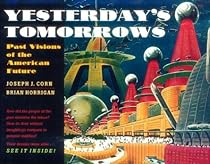
Yesterday's Tomorrows: Past Visions of the American Future


Yesterday's Tomorrows: Past Visions of the American Future (1984)
By Joseph J. Corn and Brian Horrigan

Synopsis: This book examines past American visions of the future in order to show how those visions shed light on the values of their times; sees future visions as cultural artifacts. This is a coffee-table type book that sprang from a Smithsonian exhibit, and includes chapters on 1) Finding the Future (beginning with late 19th century - explores science fiction and utopian fiction, pulp magazines, futurism as linked to commodities, the rise of sci-fi tv and film); 2) The Community of Tomorrow (Progressive vision, "white city," City Beautiful, Garden City, 1939 World's Fair, FLW, Greenbelt Cities, Buckminster Fuller[city of the future as requiring blank slate]); 3) The Home of Tomorrow (rise of apartment homes yet obsession with futuristic single family homes, the rising appeal of mass-produced housing, streamlined style, high-tech kitchens); 4) Transportation of Tomorrow (rise of transportation innovation from 1880-1905, cars and planes, hopes and fears of nuclear power); 5) Weapons and Warfare of Tomorrow (WWI = weapons and electricity, 1920-30s = airplanes and war, WWII = massively destructive potential of weaponry). Authors argue that the future in the U.S. has increasingly moved from communitarian/spiritual utopias of the early days, to a "secular city of the capitalist future" in which most of the emphasis fell on the look of the future rather than the social plan. Argues also that American have long held a strong belief in "technological utopianism" - that "material means can ameliorate social problems and even perfect society" (xii). "The belief that machines, not politics, produce beneficial social change diverts people from initiating reforms that would truly distinguish the future from the present or the past" (xiii).

Interesting Specifics:

Utopian fiction was hugely popular in U.S. from 1880-90s.

We generally look at the future in terms of commodities (11).

1929 = Buckminster Fuller's Dymaxion House.

1938 = Orson Wells' War of the Worlds radio show.

1952 = First Hydrogen Bomb

1957 = First nuclear power plant in the U.S.; Shippingport, PA.

Interacts With:

Maybe other books about World's Fairs or different vision of the future.
David Wojcik
Rem Koolhaas (for the different proposals for future cities).

Tuesday, March 11, 2008

No Place of Grace: Antimodernism and the Transformation of American Culture, 1880-1920


No Place of Grace: Antimodernism and the Transformation of American Culture, 1880-1920 (1981)
By T. J. Jackson Lears

Synopsis: This book explores the origins and effects of American antimodernism - especially its "recoil from an overcivilized modern existence to more intense forms of physical or spiritual experience" (xv). Lears argues that the turn of the century was not marked by democratization and the decline of the elites, "but rather by the reinforcement of elite power in new corporate and bureaucratic forms" (xii). Utilizing Gramsci's notion of hegemony, Lears analyzes books, magazines, private letters, novels, poems, essays, and sermons to build his argument linking antimodernism with the rise of therapeutic culture. He feels that antimodernism was "both more socially and more intellectually important than historians have supposed" (xv), claiming that "the shift from a Protestant to a therapeutic world view, which antimodern sentiments reinforced, marked a key transformation in the cultural hegemony of the dominant classes in America" (xvii). Modernism (lit and art) and antimodernism share common roots in the yearning for authentic experience - physical, emotional, or spiritual (xix). The book is divided into the following sections: 1) Roots of Antimodernism (the increased rationalization and systematic organization of life for maximum productivity leads to an increased feeling of "unreal"-ness; increased focus on time; increased obsession with comfort; crisis of cultural authority; fears of overcivilization; neurasthenia and weightlessness); 2) Arts and Crafts Ideology (regeneration through handicrafts); 3) Martial Ideal (war as antidote to weightlessness; rise of boxing, football, and the "strenuous life"); 4) Medieval Mentalities (increased focus on childhood and fantasy and antirationalism); 5) Catholic Forms (increased interest in Catholic art/ritual); 6) Patriarchy to Nirvana (oscillation between autonomy and dependence; male versus female realm); Henry Adams (epitome of antimodernism, hated efforts to banish irrationality, deeply conflicted). Antimodernists feared a docile and complacent society. "By exalting 'authentic' experience as an end in itself, antimodern impulses reinforced the shift from a Protestant ethos of salvation through self-denial to a therapeutic ideal of self-fulfillment in this world through exuberant health and intense experience" (xvi). The cult of self-fulfillment was easily co-opted by consumer capitalists whose economy worked perfectly via constant generation of new individual wants and desire. In a way then, antimodernism paved the way for these new modes of cultural hegemony. The therapeutic worldview is thus both a symptom and source of the banality of modern culture.

Interesting Specifics:

* Focus on this one for exam * Tons of notes on this book *

Modernity led to "the systematic organization of economic life for maximum productivity and of individual life for maximum personal achievement...the reduction of the world to a disenchanted object to be manipulated by rational technique" (7).

An obsession with comfort and a decrease in pain, along with a focus on time, were key components of modernity. This was also linked to an increased sensitivity to suffering in general (i.e. slavery, animal abuse, etc).

Spencerianism = optimistic faith in progress.

Increased presence of capitalism leads to increased fracturing of the self.

Modern culture = weightlessness [Marx derivative]

"...most varieties of 20th-century militarism - at least in the West - share a common cultural origin in the late-nineteenth-century recoil from a weightless modernity" (98).

"Antimodern vitalists, for whom intense feeling was its own reward, stressed becoming rather than being, eros rather than agape" (162).

Henry Adams, son of John Adams: "Riven by tension between autonomy and dependence, doubt and faith, he rejected efforts to banish irrationality and contradiction in the name of social or personal harmony" (295).

"Under a twentieth-century regime which multiplied wants and sanctioned total gratification, the avant-garde cult of self-fulfillment sometimes only exaggerated the culture it set out to repudiate" (299).

This desire was all too easily usurped, as "intensity of feeling...became a product to be consumed like any other" (300).

"...the vision of a self in endless development is perfectly attuned to an economy based on pointless growth and ceaseless destruction" (307).

Interacts With:

Gramsci's notion of hegemony
Terrible Honesty,