Showing posts with label modernity and aesthetics. Show all posts

Sunday, March 23, 2008

Elvis Culture: Fans, Faith, and Image


Elvis Culture: Fans, Faith, and Image (1999)
By Erika Doss

Synopsis: This book asks: Why is Elvis everywhere, why does he remain so popular, and what makes an American icon? To determine this, the book aims "to explore and analyze the meaning of Elvis Presley's image - his face and his body - in contemporary American culture" (25). Doss looks at various aspects of Elvis' image and fandom from quasi-religious shrines to his sexual power (as androgynous and erotic), to his racialization and "whiteness," to questions of ownership over his image. Argues that because we live in a predominantly visual culture, pictures and their materiality hold a tremendous amount of power, a power many have failed to analyze. Elvis has remained such a powerful icon because of his images' "unrestricted ambiguity and instability, its diversity and illegibility - and because Americans have never stopped arguing about what Elvis means and what he represents" (252-53). This multiplicity of meaning is essential to maintaining interest and vitality/relevance. Elvis Presley Enterprises is thus foolish for trying to control and sanitize Elvis' image. This desire for aesthetic control speaks to class bias. The discussion of Elvis' body and sexuality is one of the most interesting in the book, and states that his body/sexuality represents "the desire for integration and fullness in lives circumscribed by separation, dissolution, and alienation" (148). [This last line is a buzz-line favorite of the modernity people - but is this feeling of alienation just a part of the human condition, rather than a particular symptom of modernity? And if this "dislocation" has been going on since the rise of urbanization in the 1820s, shouldn't we have come up with coping mechanisms by now? This is all starting to feel a bit adolescent.]

Interacts With:

Kitsch,
Any book on Janet's list that discusses flexibility of meaning and the importance of multivocality; things seem to gain importance and value in exact proportion that their meaning is contestable and fluid.

Friday, March 21, 2008

Learning From Las Vegas: The Forgotten Symbolism of Architectural Form


Learning From Las Vegas: The Forgotten Symbolism of Architectural Form (1977 [1972])
By Robert Venturi, Denise Scott Brown, and Steven Izenour

Synopsis: This book is about the symbolism of architectural form (rather than about Las Vegas, per se), and examines the architecture of the strip in order to counter Modernist design and to celebrate an architecture of movement. The authors analyze the layout, structure, and design of the strip, its buildings, and the significance of its architecture as symbols and signs, and as creating a zone of pleasure. The authors prefer the postmodern playful use of symbols and signs to the austere Modernist style which rejects symbol and decoration in favor of becoming the decoration itself. The megastructures of Modernism are all about imposed unity, whereas "urban sprawl" is more about variety and pluralism. While Modern architecture claims to have rejected symbolism, the modern buildings have just become symbols themselves. The authors castigate modern architecture for dismissing contemporary vernacular architecture and for dismissing the tastes of "the people" in favor of some kind of elitist "heroic" architecture. Basically, the authors reject the idea that sprawl and the strip is "visual pollution," and question its necessarily link to ecological pollution. They instead want us to see this style as just a new type of order and symbol system, an order imposed by speed, movement, and the car.

Interacts With:

Variations on a Theme Park, Jane Jacobs, City of Quartz, Baudrillard, Country of Exiles, J. B. Jackson (in his celebration of everything and of the "common" landscape), Neon Metropolis
Which book talked about the "age of hieroglyphics" (symbols)? This would definitely connect with anything that focuses on semiotics and symbols - even those books on 19th cent urban culture.
This actually has echoes of Janet's list in its desire to "take back" the architecture "of the people" and rescue it from elitist criticism.
This book supposedly launched the postmodern movement (according to Jeff's Design in the U.S.A. book)

The Social Meaning of Civic Space: Studying Political Authority Through Architecture

The Social Meaning of Civic Space: Studying Political Authority Through Architecture (1988)
By Charles T. Goodsell

Synopsis: This book is a study of the design of city-council chambers from 1865-1980s, and investigates the way changing design styles reflect changing political ideas. The author examined 75 council chambers in the U.S. and Canada, and immersed himself in the surroundings, noting details, design, layout, and the overall aura of the chambers. He breaks his observations into three categories of analysis: 1) composition of space, 2) design of semi-fixed features, 3) patterns of decoration and object display. Chapter II provides an amazing synthesis of various useful theories for studying interior space from the realms of sociology, anthropology, history, architecture, linguistics and semiotics, art history, psychology, and environmental psychology. The author identifies three major design periods: Traditional, 1865-1920 (large, boxy space and strict separation of officials and spectators - sense of imposed authority), Midcentury, 1920-1960 (smaller, longer and lower, increased sense of checks and balances, more informal "confronted architecture"), Contemporary, 1960-1980s (rounded floor plan and amphitheatre seating, curved surfaces, increased sense of joined/shared authority). These design changes express our changing notions of public authority. Goodsell sees civic space as ceremonial space, as a space of ritual made special by the use of certain symbols. He reads architecture in a holistic rather than linear way, and thus has lots of interesting things to say about perception. This is a potentially very useful book [see full notes for details].

Interacts With:

This is one of my favorite books, and got me all inspired and stuff again. Has an amazing bibliography, and seems like a great book to follow, methodologically - esp. for researching meaning of interior spaces.
Also, this book stands out because it is one of the few on this list to emphasize an increasing coming together/holism as opposed to an increased fragmentation - it's refreshing!
Semiotics
Learning From Las Vegas, Los Angeles: The Architecture of Four Ecologies, Delirious New York, Variations on a Theme Park (all these books say very different thing, it's just that they view the built environment as creating a sort of aura or possibility).

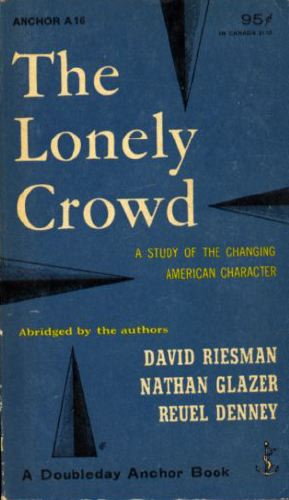
The Lonely Crowd: A Study of the Changing American Character


The Lonely Crowd: A Study of the Changing American Character (1953) [1950])
By David Riesman, Nathan Glazer, and Revel Denney

Synopsis: This book is about "social character and about the differences in social character between men of different regions, eras, and groups" (page?). It is concerned largely with the decline of the nineteenth-century style of inner-directed character and the rise of the new outer-directed type. The book is based on interview and community studies, poll data, histories, biographies, and novels, and is basically a study of broad trends as seen by the authors. Argues that there are three types of characters: 1) tradition-directed (shaped by massive social forces and tradition), 2) inner-directed (shaped mostly by family and has more options; strong sense of autonomy); 3) other-directed (gets moral code from many different sources, so has diffuse and changeable sense of morality; will go with the flow and has more shallow existence). Authors argue that the move towards other-direction is mostly due to capitalism, industrialism, and urbanization - and the dominance of consumption over production. Another big thread of this book is that we don't have enough serious play going on, and that we need avocational counselors to teach people how to play better (342). They also want cities to be more than mere sites of work. The bottom line is that a true sense of meaning and interestingness can only derive from a deep sense of individual autonomy - we need to be more like ourselves instead of like other people. "The promising alternative to other-direction...is not inner-direction, but autonomy" (188). [How Emersonian!] The last line of the book is interesting: "The idea that men are created free and equal is both true and misleading: men are created different; they lose their social freedom and their individual autonomy in seeking to become like each other" (349). [That's so American!]

Interacts With:

Bowling Alone (in its focus on broad trends over time), Culture of Narcissism, Habits of the Heart, Middletown and Middletown in Transition, The Levittowners,
Actually, I see this now as a book about the transition from modernism to postmodernism. It's not that the other-directed person has no sense of self, but rather that his sense of self is multivalent and more pluralistic/complex/multifaceted.
Actually, also interacts with Urban Masses and Moral Order, Rudeness and Civility, and all those other books about nineteenth-century urbanism and the impact this had on the senses and on one's sense of self. An assault on the senses leads to increasingly scattered and perhaps superficial attempts to decipher meaning from the vast melange of signs all around oneself. The outer-directed person today seems to be too fluid and transient to really experience anything in a deeply meaningful way - hence his inability to really "play" well.

The World of Goods: Toward an Anthropology of Consumption


The World of Goods: Toward an Anthropology of Consumption (1996 [1979])
By Mary Douglas and Baron Isherwood

Synopsis: This book is an attempt to bridge the gap between economics and anthropology by arguing that the "idea of consumption itself has to be set back into the social process, not merely looked upon as a result or objective of work" (viii). This is a critique of materialist views, and takes a very anthropological approach. The book is divided into two parts: Part I: Goods as Info System, and Part II: Implications For Social Policy. The main argument is that goods are primarily a function of social relations, and are markers of rational categories. Goods are part of a live information system, hence our ability to access and produce "information" is key. Consumption decisions define our culture, and commodities are nonverbal mediums for the human creative faculty. Goods are the visible part of culture, and there will indeed always be luxuries as rank will always be marked. Basically, though, argues that goods are a type of social communication, and are the medium through which social relations are carried out. This book tries to distance itself from the theories of moralists who say "stuff" is universally bad.

Interacts With:

Any book that views consumption and material culture as a social phenomenon full of meaning and identity construction: Meaning of Things,
This point of view is interesting, but in some ways it can come off as a bit too apologetic about/corrective of consumer culture. They sell goods and things as vital elements of identity and social connection, yet what about the very real moral, ethical, and environmental concerns that are connected to excessive consumption - can these really be avoided? It's hard to argue with something that they argue is vital to our very sense of humanity, but there is something a bit sick about people who place such a strong emphasis on construction of self and of status via things. In some cases, I think you can and should judge such excessiveness.

Variations on a Theme Park: The New American City and the End of Public Space


Variations on a Theme Park: The New American City and the End of Public Space (1992)
Edited by Michael Sorkin

Synopsis: This is a compilation of essays which seeks to describe (rather than theorize) the new ageographic city. This new city has three characteristics: 1) no attachment to local, physical, and cultural geography; 2) an obsession with "security;" 3) a city of simulations. Includes pieces by Margaret Crawford (West Edmonton Mall as land of fantasy consumption); Langdon Winner (Silicon Valley as info age city of floating bits); Neil Smith (Lower East Side as Wild West, gentrification, 1988 Tompkins Square Park Riot); Edward Soja (exopolis and Orange County, OC all about perpetual newness and reinvention and simulacra, postmodern numbness); Trevor Boddy (analogous cities of above and below ground tunnels separate one class from another and kill messy vitality of the street); Mike Davis (Fortress L.A. - islands of hermetically-sealed luxury in downtown L.A., city controlled by surveillance and private security); Christine Boyer (South Street Seaport, theatrical design, all about story and familiar narrative patterns); Sorkin (Disneyland as ultimate ageographic place, city as false utopia). Basically, this book is freaked out that "real urbanity" might be disappearing.

Interacts With:

Where do I begin!!? Everything that's angsty and bitchy about the built environ from the early 1990s connects to this:
Geography of Nowhere, Country of Exiles, "The World in a Shopping Mall" (as a counter-example to this), Behind the Gates, Celebration Chronicles, Learning from Las Vegas (as a positive precursor), Edge City, Simulacra and Simulations, Inside the Mouse, Delirious New York, Richard Sennett, Jane Jacobs
This really is an excellent look at early 1990s angst and this fear of "inauthenticity."

Tuesday, March 18, 2008

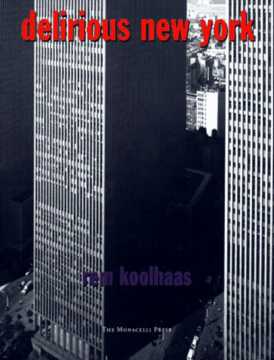
Delirious New York: A Retroactive Manifesto for Manhattan


Delirious New York: A Retroactive Manifesto for Manhattan (1994 [1978])
By Rem Koolhaas

Synopsis: This book basically sees Manhattan as a "theatre of progress" and mythical fantasy laboratory immersed in the "culture of congestion." It argues that Manhattan is a pinnacle of the artificial, and that its massive congestion is its own brand of urbanism. The book comes across as somewhat of a "fuck you" to Modernist Puritanical "order." Includes sections on "Coney Island: The Technology of the Fantastic" (theme parks of Coney Island as obsessed with the artificial; machines and lights; creation and destruction; Dreamland and its bizarre Lilliputia land of midgets and skewed morality - i.e. promiscuity, homosexulaity, nymphomania, etc.); "The Double Life of Utopia: The Skyscraper" (Manhattan skyscraper born 1900-1910 as a "utopia device for the production of unlimited numbers of virgin sites on a single metropolitan location" (83); tall buildings as laboratory islands and entire own world, i.e. Waldorf Astoria; Harvey Wiley Corbett and his plan for an ultra-ultra dense Manhattan; "the hotel" as a plot in itself - providing world of change encounters); "How Perfect Can Perfect Be: The Creation of Rockefeller Center" (yet another island; Roxy Theatre as producing "synthetic sunrise" (which Koolhaas loves); all as "anti-authentic;" Rockettes as a new breed of pure abstraction); "Europeans: Biuer! Dali and Le Corbusier Conquer NY" (Salvador Dali's "paranoid critical method; Corbu's attempt to pretend NY doesn't really exist so he can "create" his radiant city; Koolhaas hates Corbu as his plans drain NY of its lifeblood and congestion). This book is basically a tribute to the crazy chaos of New York.

Interesting Specifics:

Dreamland was designed as a place "to appeal to all classes" (45). 1911 = Dreamland burns down.

At this time, Modernism was all about an absence of color, and Dreamland was all white (46).

The Waldorf-Astoria was an attempt at the greatest hotel of all time - massive and all-encompassing (145). It was the focus of many 1930s Hollywood films - hotel is a plot, a world presenting myriad opportunities for random encounters at any time (148-50).

In reference to the Rockettes, I think: "Beyond sex, strictly through the effects of architecture, the virgins reproduce themselves" (217).

Interacts With:

This is a great contrast to Nature's Metropolis as Koolhaas views the city as totally unnatural and never even ventures that it could be related to nature at all.
Amusing the Million
I guess it's kind of a positive postmodernism is cool thing? Though don't know if you could really call NY urbanism "postmodern." I should maybe check again to see how "pomo" positive this guy really is - or even how pro-NYC he is. It's kind of a passionate, stream-of-consciousness kinda thing. Fun!

Monday, March 17, 2008

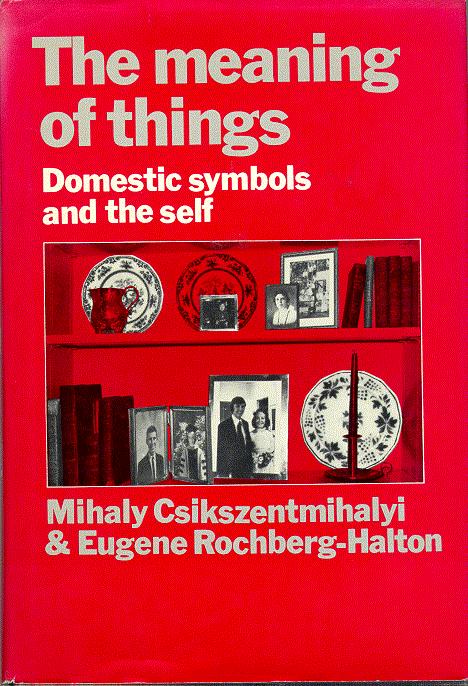
The Meaning of Things: Domestic Symbols and the Self


The Meaning of Things: Domestic Symbols and the Self (1981)
By Mihaly Csikszentmihalyi and Eugene Rochberg-Halton

Synopsis: This book is an empirical analysis of the interaction of persons and objects, which seeks to understand "how and why people in contemporary urban American relate to things in their immediate environments" (x). It also seeks to investigate the "role of objects in people's definition of who they are" (x). The methodology of this book stands out as it is a social science study done as a kind of ethnography, relying on interviews and questionnaires of family members living in Chicago. However, the book is mostly centered on theoretical and hypothetical ventures as opposed to detailed discussions of the concrete findings. One of the most striking arguments is that homes/people which lack lots of objects which tie them to other people (i.e. "this is a cup my father made" vs. "this is a comfortable chair") tend to have less ties to communities and less of a connection to causes larger than themselves. Also discovered that "warm" families inspire a sense of purpose and a drive for expertise, whereas "cold" families might leave members focused on themselves and on a search for people who will nurture them. Overall, argues that "things" are embodiments of psychic energy, and the way we equate meaning to that psychic energy relates to how we are connected to others; we have only a finite amount of psychic energy to invest. Bottom Line: "Past memories, present experiences, and future dreams of each person are inextricably linked to the objects that comprise his or her environment" (ix). The authors are also very concerned with the fracturing affect of modernity and the way it has focused so much attention on individuals. The goal should be to reach some kind of larger cosmic connection and to look always for new possibilities and growth.

Interesting Specifics:

Our relationship to objects is part of what makes us human.

"...the potential significance of things is realized in a process of actively cultivating a world of meanings, which both reflect and help create the ultimate goals of one's existence" (xi).

"The condition of community, as Hannah Arendt (1958) has said, is one of plurality, not homogeneity" (11).

"The objects of the household represent, at least potentially, the endogenous being of the owner" (17).

The possession of certain objects seems to also be "an expression of Eros in the broadest sense, a need to demonstrate that one is alive, that one matters, that one makes a difference in the world" (27). [Does this mean that you have no sense of worth if you don't have stuff?]

Durkheim claims that religion originated as a way to explain the mysterious experience of sociability, rather than inexplicable natural phenomena, i.e. the feeling of belongingness made people believe in the existence of a sacred force (33).

Durkheim used term "collective effervescence" to describe the feeling of collective exhilaration that was based on a sum greater than its parts (34).

Agrees with Marx's idea that "humans create their existence primarily through productive efforts" (92).

"For an adult, objects serve the purpose of maintaining the continuity of the self as it expands through time" (100).

Part of maturing is to shift "the center of the self from one's own actions to one's position in a network of enduring relationships" (101).

This book relies on a lot of gender stereotyping - hmm.

"...people who denied meanings to objects also lacked any close network of human relationships" (164).

Interacts With:

Books that deal with the use of objects to construct a sense of self/identity. Is not concerned with social status or class or generic "consumerism," but rather with how objects are embedded with/used to construct meaning.
Goss article
Elvis Culture
American Technological Sublime (discussion of communal experiences or things that bind people together - here through objects, there through amazing feats of technology)

The Positive Thinkers: Popular Religious Psychology from Mary Baker Eddy to Norman Vincent Peale

The Positive Thinkers: Popular Religious Psychology from Mary Baker Eddy to Norman Vincent Peale (1988 [1965])
By Donald Meyer

Synopsis: This book is an examination of popular psychology and its intersection with health, wealth, and peace of mind. It is divided into three parts: Part One: Theology as Psychology (nineteenth-century life brings increased fragmentation/compartmentalization; rise of nervousness brought on by modern life; Mary Baker Eddy's mind cure Christian Science of the 1880s as feminine way of passively making best of situation via attempt to "think the thoughts of God;" ideal was for one whole mind, a total coherence of environment, a giving up of one's self); Part Two: Peace in the System: Sociology as Psychology (rise of business culture and rise of scientific efficiency and rational order/mechanization, Taylorism, rise of managerial elite and organizational psychology; desire for happy and smoothly-running everything); Part Three: Peace in Peace: Psychology as Psychology (liberal Protestantism's loss of touch with sensuality/art; obsession with work ethic; rise of Norman Vincent Peale and mass services exalting "positive thinking"). Although the overall argument is a bit unclear, one interesting point I got out of it is that self-help culture and positive thinking are logical extensions of Protestantism's rejection of all things hierarchical (as embodied by their rejection of religious authority); the only real power lies within the individual. This might pave way for religious Right.

Interesting Specifics:

1881 = George Beard's American Nervousness

The rise of clean houses as a value represented the need for something to do (49).

"Mind cure rejected personality" (114). Personality represented fragmentation and lack of unity with the big picture.

Interacts With:

Again, one of the main points is that the modern era caused increased compartmentalization/fragmentation. Was there ever a moment in the 19th century in which people said, Fuck this holism, let's compartmentalize things!?
Also interacts with anything that focuses on the primacy of the individual. I can honestly also seem some connection to Storming Heaven with it's focus on the enlightening of the individual; really falls in line with transcendentalists as well. Hmm, if U.S. had remained homogeneous for longer, I wonder if there would have been enough momentum to create a strong community-based culture that could have withstood the individualistic competition of capitalism.. Because it really was with the influx of different kinds of people that the colonists were forced to use pluralism as their new ideal (not that pluralism is bad, but if pluralism - in the guise of acceptance of differences - had come along a little later, when a more stable community-based society had taken root, I wonder if we would be such an individual-focused society. Hmm.)
Warning: I skimmed this book pretty quickly.

Sunday, March 16, 2008

Inside the Mouse: Work and Play at Disney World


Inside the Mouse: Work and Play at Disney World (1995)
By The Project on Disney

Synopsis: This book seeks to interrogate pleasure and to analyze the Disney World phenomenon, and is a collaboration between four different academics who all give their take on separate Disney-World-related topics, including nostalgia, heteronormativity, simulacra, etc. There is not necessarily one overarching argument, but instead many, including the idea that our culture "condemns carnival: the bawdy and rude revel of the appetites and its consequent waste and dissipation" (3). Disney World arises as the anti-carnival (though the huge heads of its characters are a form of the grotesque - but kind of the baby grotesque). Though the book is highly critical of Disney, threads of utopianism run throughout the book, especially as utopian impulses are often embedded within consumer products, and the way various views of the future are seen as new beginnings and perhaps calls for radical change. Disney World really is all about consumption, and channels our desire for a utopian sense of community into mere consumerism. Disney World also is completely about heteronormativity and the exaltation of the family. All of the fun there is highly contained and structured, and there is no sense of spontaneity or of subversiveness (hence the "anti-carnival" thing). The pleasure of D.W. is thus, "identifying with a dominant ideology and the role it assigns us" (74). Disneyfication is "the application of simplified aesthetic, intellectual, or moral standards to a thing that has the potential for more complex and though-provoking expression" (103). Hmm, that's sad. Basically, book is saying that people today have limited options.

Interesting Specifics:

Antimodernist and utopian impulses are at cross purposes (224).

Says our culture clearly "condemns carnival: the bawdy and rude revel of the appetites and its consequent waste and dissipation" (3).

Says maybe obesity is partly an "active resistance to a perceived bourgeois norm" (3). [This is an interesting line of thought - that eating fast food and getting fat could be seen as an active move of rebellion. Also creepy though, because could you then say that our craving for revelry has been channeled into a love of fast food? How pointless and non-cathartic.].

Kids love to stay in motels and hotels - Great chapter!! Says that staying in a motel is exciting for kids because it represents independence and "an unconscious social yearning for security and community" (8). Also good because it takes them away from normal school day, which is really an "indoctrination" into the "adult" work world.

"Embedded in the notion that tomorrow initiates a new beginning is a utopian desire for radical change" (39).

Tourism represents a "quest for experience" (45).

One author seeks to discover "how the pleasure we feel at Walt Disney World is negotiated through an ongoing process of identification with and - at least in part, one hopes - evasion of the ideal subject constructed by Disney's tireless 'Imagineers'" (57).

Whereas t.o.c Coney Island was full of subversive games like smashing up fake fancy china and crystal, Disney World "rather than providing opportunities to violate social proprieties, everything in the park is designed to confirm them and make doing so fun" (61). DW keeps people isolated, while Coney Island was all about jostling and mixing it up.

"Human adults do not exist in Disney World except as parents" (69). [Is this just encouraging childhood solipsism?]

The pleasure of DW is "identifying with a dominant ideology and the role it assigns us" (74).

"All expressions of mass culture include contradictory utopian impulses, which may be buried or depicted in distorted form, but nevertheless generate much of the satisfaction of mass cultural commodities (whether the consumer recognizes them as utopian or not)" (190).

Has a cool chapter on the design of DW hotels.

Interacts With:

Goss article, "The World in a Shopping Mall" (I think that's the title - idea that "stuff" kind of represents utopian longings - though Goss article is way more positive)

Foucault (in belief that all mass culture phenomena contain elements of utopianism)

Was it Barthes or Hall who talked about the two different kinds of pleasure - the pleasure of following social conventions and the pleasure of dodging them? Whoever it was, this book kind of relates to that idea - the D.W. is all about pleasure of following conventions. That's actually kind of an interesting concept - I wonder which style ultimately gives more pleasure - following or subverting the norm? Prob subverting, but you never now. Do you get some kind of group/communal feeling out of following it? Or is that group too massive to result in a group feeling??
Amusing the Million (contrast between t.o.c. carnivals and Disney-esque stuff today)

Los Angeles: The Architecture of Four Ecologies


Los Angeles: The Architecture of Four Ecologies (1971)
By Reyner Banham

Synopsis: Banham aims to "present the architecture...within a topographical and historical context of the total artifact that constitutes Great Los Angeles, because it is this double context that binds the polymorphous architectures into a comprehensive unity that cannot often be discerned by comparing monument with monument out of context" (23). Book is broken down into "four ecologies:" Ecology I: Surfurbia (beaches as biggest thing to envy; focus on indoor/outdoor living; spanish colonial revival; freeways); Ecology II: Foothills (fancy suburbs; mobility-focused architecture; landscape of "do your own thing;" city obsessed with transportation); Ecology III: The Plains of Id (flatlands as "heartland;" Schindler, Neutra, and the International Style ; plain cubes; people should accept the non-existent downtown for what it is: dead); Ecology IV: Autopia (freeway as central feature; L.A. as embodiment of bourgeois good life of urban homestead; people unfairly castigate L.A. when they should examine all the fabulous architecture there and think about why L.A. has inspired so much of that). Argues that "the language of design, architecture and urbanism is Los Angeles is the language of movement" (23). Southern California is an ecological wonder and the land of "perpetual spring." People are too hard on L.A., and should not fault it for being different; it really embodies many ingrained American values - especially the desire for freedom of movement.

Interesting Specifics:

L.A. architecture is emblematic of that particular American phenomenon:"...the convulsions in building style that follow when traditional cultural and social restraints have been overthrown and replaced by the preferences of a mobile, affluent, consumer-oriented society, in which 'cultural values' and ancient symbols are handled primarily as methods of claiming or establishing status" (124).

"...Los Angeles is...the home of the most extravagant myths of private gratification and self-realization, institutionalized now in the doctrine of 'doing your own thing'" (124).

L.A. is steeped in the "fantasy of innocence" (129).

"So recreational living tends to become another synonym for the social 'turf' system of closed communities; systematic planning remains the creation of privileged enclaves" (145).

Anyone who cares about architecture simply cannot ignore Los Angeles - and to do so would be a huge and elitist blunder.

Interacts With:

This is really an L.A. apologist book. Says hey, it's not so bad, it's just different - you have to look at all its different parts to understand it.

City of Quartz, Variations on a Theme Park, Neon Metropolis, Country of Exiles (these are all negative takes on L.A. and L.A.-ish phenom, though Mike Davis straddles line between pos and neg); Holyland (not on any list), Learning from Las Vegas (for a positive attempt to understand car-centric landscapes), Golden State, Golden Youth


Subculture: The Meaning of Style


Subculture: The Meaning of Style (1979)
By Dick Hebdige

Synopsis: This book investigates the styles of subculture and the processes through which mundane objects take on symbolic dimensions. In doing so, Hebdige seeks to "recreate the dialectic between action and reaction which renders the objects meaningful" (2). Basically, this is a study of the meaning of style. Grounded in a cultural studies/semiotics perspective, Hebdige looks at case studies (Rastafarianism, hipters, teddy boys, punks, glam rockers) and performs "readings" on them, focusing on the functions of subculture, the use of styles, style as a type of communication, and style as embedded in subcultural meaning. Argues that tensions between dominant and subordinate groups are found in the surfaces of subcultures and their styles. "The meaning of subculture is, then, always in dispute, and style is the arena in which the opposing definitions clash with the most dramatic force" (3). Argues that the use of "common sense" is a way to bury ideology, i.e. of "naturalizing" it. Subcultures, he argues, represent noise and interference, as well as "symbolic challenges to a symbolic order" (page?). "Others" can either be dealt with via trivialization/domestication or turned into meaningless exotica. Bottom line: Subcultural style is intentional communication which means to be read (unlike "normal" style which attempts to be "natural" or "invisible"). Subcultural style all about collage and re-organization and mutations, rather than "pure" expressions.

Interesting Specifics:

Sometimes objects/styles become "a form of stigmata, tokens of a self-imposed exile" (2).

"...ideology saturates everyday discourse in the form of common sense" (12).

"Hegemony can only be maintained so long as the dominant classes 'succeed in framing all competing definitions within their range' [Hall, 1977]" (16).

"The succession of white subcultural forms can be read as a series of deep structural adaptations which symbolically accommodate or expunge the black presence from the host community...We can watch, played out on the loaded system of British working-class youth cultures, a phantom history of race relations since the war" (45).

"...the punk aesthetic can be read in part as a white 'translation' of black 'ethnicity'" (64).

"Reggae and punk were audibly opposed" (68).

"The twin concepts of conjuncture and specificity, (each subculture representing a distinctive 'moment' - a particular response to a particular set of circumstances) are therefore indispensable to a study of subcultural style" (84).

By subverting "conventional uses and inventing new ones, the subcultural stylist gives the lie to what Althusser has called the 'false obviousness of everyday practice'...and opens up the world of objects to new and covertly oppositional readings. The communication of a significant difference then...is the point" (102).

Subcultures can be conservative or progressive - "integrated into the community, continuous with the values of that community, or extrapolated from it, defining themselves against the parent culture" (127).

"...no amount of stylistic incantation can alter the oppressive mode in which the commodities used in subculture have been produced" (130).

Interacts With:

Many books on Janet's list, especially Stuart Hall and anything that deals with the flexibility of popular culture and the subversive potential embedded in it.
Barthes (through focus on semiotics).
Foucault ("naturalizing" of ideology by dominant class)
Gramsci (hegemony)
This is a key cultural studies book as it focuses on the totality of society, and not just on the "high" culture elements

Land of Desire: Merchants, Power, and the Rise of a New American Culture


Land of Desire: Merchants, Power, and the Rise of a New American Culture (1993)
By William Leach

Synopsis: This book is an examination of the "crucial formative years" of the rise of consumer culture (1880-1930), and asks how that culture first came into being, and what was gained, lost, and/or repressed in that process (xiii-iv). Examines archives, newspapers, diaries, etc, and divides the book into three parts: Part I: Strategies of Enticement (rise of department stores and of the "commercial aesthetic" which relied on glass, color, and light; rise of fancy display windows and of the visual; rise of themes and of children's clothes/toys; rise of orientalism; rise of the importance of service, atmosphere, and comfort; rise of the separation of production from consumption); Part II: Circuits of Power (examines the many institutions aiding the rise of consumer culture - commercial art schools, colleges and universities, urban museums, federal and municipal governments, and religion; rise of mind cure and sunny optimism; Wizard of Oz; world without suffering); Part III: Managing a Dream Culture: 1922-1932 (establishment of "consumptionism" by 1920; American obsession with defending the "standard of living;" flood of consumer goods and rise of chain stores and mergers; "luxury" loses its negative connotations; rise of spectacle and elaborate designs; Herbert Hoover and his advocacy of single family homes and govt. role in making big business even more efficient/profitable - creation of "a new institutional bureaucratic language of consumption). Leach argues that consumer culture is nonconsensual, and is not produced by the people but by commercial groups and elites obsessed with profit, promoting only one vision of the good life while pushing out all others. This was the rise of a new commercial aesthetic that advocated a culture of longing and desire. It ushered in a one-sided, capitalist concept of the self and perpetuated the myth of the separate consumer world as a realm of freedom, self-expression, and fulfillment.

Interesting Specifics:

The cardinal features of this new consumer culture are/were: "acquisition and consumption as the means of achieving happiness; the cult of the new; the democratization of desire; and money value as the predominant measure of all value in society" (3).

In the 1910s, there were massive fears over U.S. "overproduction" of goods, hence the desire for new ways to get people to buy more stuff.

The commercial aesthetic was all about the use of color, glass, and light to sell goods (40).

Rise of the show window = 1889.

1890s = proliferation of the use of glass and window displays to sell goods, marking an increased focus on the visual and a decline in the use of touch and smell which had been such a part of open-air markets (62-63). Display glass enticed viewers: "Here is is, everywhere you go, yet you cannot reach it" (63).

By 1915 the "central theme" idea unifying many rooms/spaces was standardized for "theatre owners, restauranteurs, and department store retailers with which to design adult fantasy environments" (82). Rooftop gardens were themed starting in late 1890s.

1900 = rise of tipping in restaurants

The rise of the service/comfort industries had some roots in hospitality of Christianity, and was seen as the comforting and benevolent side of capitalism (146).

Increased separation between production and consumption made it easier to deny any suffering inherent in capitalism, hence "The outcome was a greater tendency toward selfishness and a corrosive moral indifference" (150). [Geez, this guy is really moralistic - Pretty old-school].

"A comfortable gentility, fearful of emotional extremes and of public embarrassment, but capable of consumer extravagance" was the hallmark of American urban/suburban life (page?)

1912 = Eleanor Porter's Pollyanna

1923 = John Powers founds the first successful modeling agency

1920s = increased focus on color and light

"...the conception of the desiring self, as expressed and exploited by capitalism, offers a one-sided and flawed notion of what it means to be human" (385).

"But however flawed, the capitalist concept of self, the consumer concept of the self, is the reigning American concept" (386).

Interacts With:

Wow, he is very negative on consumer culture. He takes the non-pop culture approach and seems to look at consumption as a top-down thing, without seeing the potential liberatory powers of bottom-up flexibility of meaning, use, and purpose. Seems to view consumer culture as simply manipulation and exploitation. In this way, differs greatly from Meaning of Things and the material culture book that see consumption and things as a tool of social value. Really does fit with the angry tone of Country of Exiles. I still feel that such books are important, because at least they arouse passions in some way, and get people going.
No Place of Grace, Design in the U.S.A.
Class, Rudeness and Civility, Urban Masses and Moral Order, Reading the Romance
(again, any books that deal with middle class comfort obsession. But was it really only the middle classes which were obsessed with comfort, or was it just that they were the ones with the means to achieve comfort??)
Culture of Narcissism (for its moralistic shaming of "selfish" American and consumer culture).

The Mezzanine


The Mezzanine (1986)
by Nicholson Baker

Synopsis: This is the only novel on my list! It's about the superficial and symbol-laden materiality of modern life. The story follows a man as he journeys on the escalator up to his office on the mezzanine. It's composed entirely of his random and in-depth observations of the most minute details of everyday social rituals and material culture, and is punctuated by footnotes which elaborately expand on i.e. the mechanics and materials of drinking straws. Book often links material details to nostalgic memories and childhood; adulthood, nostalgia, and memory are recurrent themes. The book is obsessed with materiality - with the texture, look, and feel of things, especially paper vs. plastic, and various containers of all sorts. The most microscopic details are discussed and pondered upon in depth, giving a portrait of the "weightlessness" of modern culture and the way we've been forced to sublimate all sense of purpose and meaning onto the ridiculous aesthetic and material conditions that intrude on us in every moment. His descriptions are detailed and witty and sometimes hilarious, and although its style is more "postmodern," it's really about the banality of modernity, as machines and technology and artificiality figure prominently.

Interesting Specifics:

Good example of the narcissism of small details; collection of "microhistories."

"Why do these images have to age before we can be fond of them?" (78). This is a common theme - the importance of distance and nostalgia in producing a sense of fondness or importance.

Concerned with microscopic instances of the "renewal of newness" - like the appearance of another plastic cup when you pull one from the dispenser.

Paper is the nostalgic favorite over plastic.

Interacts With:

Material culture books, Meaning of Things,
No Place of Grace (as connected to the antimodern quest for personal fulfillment, and the banality of an existence focused on minutiae).
de Certeau (focus on the minute details of everyday life)
Monochrome Memories
Flight Maps, American Plastic
(idea that plastic represents the fake)

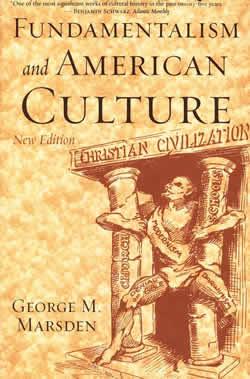
Fundamentalism and American Culture: The Shaping of Twentieth Century Evangelicalism, 1870-1925


Fundamentalism and American Culture: The Shaping of Twentieth Century Evangelicalism, 1870-1925 (1980)
By George Marsden

Synopsis: This book is a general history of the rise of fundamentalism in the U.S. from 1870-1925, and demonstrates the ways that cultural, religious, and intellectual currents transformed some American evangelicalism into fundamentalism. Argues that fundamentalism was essentially antimodernist, and could flourish in the U.S. because U.S. had a long history of religiosity. Fundamentalists ultimately came to feel that their worldview dominance was slipping away and threatened by the modernist paradigm, hence they sought to hold on to their "older" style, even though they felt outnumbered. Book is divided into four parts: Part One: Before Fundamentalism (U.S. in 1870 as "Christian Nation;" appropriateness of common sense philosophy); Part One: The Shaping of a Coalition (fundamentalists a very diverse bunch; they hated social gospel because it focused on social problems rather than salvation; WWI led to the decline of evangelicalism as a dominant force); Part Three: The Crucial Years: 1917-1925 (premillenialism seen as threat to national security as they did not believe political action or human efforts could solve the world's problems; 1920s-25 = rise of anti-evolutionism; fundamentalists all about unchanging truth, whereas modernists all about truth as shaped by cultural circumstances; Scopes trial of 1925 said to cement fundamentalism in the public mind as about the clash between rural and urban, 19th century and 20th); Part Four: Interpretation (post-WWII fundamentalists seen by many as anti-intellectual and paranoid, transferring good vs. evil dichotomous thinking to many realms; f not necessarily anti-science, but rather held to a different paradigm of science, a Baconian paradigm that was all about observation = proof, conflicted with modernist paradigm). Bottom Line: Fundamentalists believed in enduring truth, and this didn't fit with modernist belief in the influence of cultural circumstances.

Interesting Specifics:

Fundamentalism was in "fierce opposition to modernist attempts to bring Christianity into line with modern thought" (4).

William Jennings Bryan led the campaign to ban the teaching of Darwinism in schools (6). 1925 law in Tennessee had banned the teaching of Darwinism in any public school.

Finds three major themes within fundamentalism: Fs sometimes identified with the establishment, and sometimes with "outsiders;" is connected to earlier traditions and embodies ambivalence over the conflict between pietist and Calvinist traditions; fs embody a tension between trust and distrust of the intellect, and generally held to "common sense" views of the world (6-8).

Questions over whether to re-shape dominant culture or to separate completely from it (124).

Anti-evolution movement really kicked-off from 1920-25.

"By modernist definition fundamentalists were those who for sociological reasons held on to the past in stubborn and irrational resistance to inevitable changes in culture" (185).

Interacts With:
End of the World As We Know It, When Time Shall Be No More,

Saturday, March 15, 2008

Design in the U.S.A.


Design in the U.S.A. (2005)
By Jeffrey L. Meikle

Synopsis: "The purpose of this book is to trace the history of design in the U.S. as a functional tool, as an economic force, and as the expression of a consumer culture that continues to transform everyday life" (17). It traces the history of U.S. design from 1790-present, and is divided into five sections: 1) The Emergence of the American System, 1790-1860 (increased urbanization at the end of this period; Americans had democratic passion for physical comforts that influenced design; 1853 NY Exhibition showed fanciness that would soon be available to the middle class too); 2) Art and Industry in the Gilded Age, 1860-1918 (rise of visual appearance over touch-based production; increased focus on taste and personal expression; aesthetic vs. moral views of design; Arts and Crafts Movement, 1880s - ); 3) Designing the Machine Age, 1918-1940 (birth of the industrial design profession in 1930s; rise of streamlining = desire for a less complex world; increased mobility and efficiency); 4) High Design vs. Popular Styling, 1940-1965 (rise of functionalism; rise of populuxe; shift from material to immaterial existence); 5) Into the Millennium: Moving Beyond Modernism (fracturing of any single design vision; playful mixing of postmodern style; information age as extension of modernity). Most interesting argument (as this book is more of a survey as opposed to an argument-driven book) is that the increased malleability of everything in the information age (today) and the increased catering to a multitude of subcultures marks the dissolution of the "modernist vision of rational, universal coherence" (210). American design is largely about the massive proliferation of stuff.

Interesting Specifics:

"...The democratic pursuit of happiness was related to an increasing flow of material goods - all of them products of design" (12).

It is said that design imposes order - but whose order, and for what purposes? (15-16)

Catherine Beecher = 1800-78

Transcontinental Railroad Completed = 1869

Model T Ford = 1908

Frederick Taylor = 1856-1915

Ford shuts down River Rouge plant in 1927.

Fiestaware = 1930s

Journal Industrial Design launched in 1954.

1960s = shift from a material to immaterial world (information age - isnt' this also when "postmodernism" began?)

Defines what it means to be a consumer: "how to invest time and energy in shopping, how to gain emotional release by acquiring material things, and how to construct and express personal identity by arranging and displaying possessions" (52).

"Visual appearance...assumed greater economic and cultural significance, as a 'touch-oriented, local world of production' yielded to a 'sight-oriented, broader world of consumption'" (52).

There were two schools of British design philosophy - the aesthetic and the moral - "one advocating design as a source of visual and tactile pleasure, the other as a source of moral reform" (67).

Tiffany lamp craze was in the 1900s.

Arts and Crafts Movement big in 1880s-1900s.

Stickley started making mission style furniture in 1902.

Industrial design profession emerged in the 1930s.

Streamlining "represented a common assumption that society's larger processes had to be rendered smoother, less complex, more frictionless in operation" (125). Also, "its rounded, enclosing forms, particularly when applied to architecture, suggested a need for protection and stability" (125).

Ford Taurus as radical design breakthrough, and car historians regard it as "'the single most important American production design of the 1980s'" (191).

Says Learning from Las Vegas (1972) launched the postmodern movement (192). [Hmm, don't others say it was a little earlier? Maybe it's that these guys were the first to really defend it and make it a "taste of the people" movement to embrace - ]

Grid was the first laptop.

Interacts With:

Rudeness and Civility, Class (any book that deals with middle class obsession with comfort)
Meaning of Things
Land of Desire
(focus on the rise of the visual)
Did consumer culture kill Modernism?

Confidence Men and Painted Women: A Study of Middle-Class Culture in America, 1830-1870


Confidence Men and Painted Women: A Study of Middle-Class Culture in America, 1830-1870 (1982)
By Karen Halttunen

Synopsis: This book is "a cultural history of the sentimental ideal of social conduct" that defined the morals and behaviors of the antebellum nineteenth-century middle-class in America (xvi). Asks: Why did nineteenth-century conduct manuals, etc, see hypocrisy as such a huge threat? Analyzes etiquette books, conduct manuals, advice books, fashion magazines, and mourning books to uncover the fact that perfect sincerity and transparency of character was essential to the sentimental ideal of the time. Includes sections on fears of the "confidence man" or trickster in urban culture, the important of sincerity as a middle class ideal, sentimental culture's influence on fashion and etiquette, mourning as a huge gesture of genteel theatricality, the decline of sentimental culture and the increased acceptance of theatricality, disguise, and performance. Each of these illustrates the ways in which Americans grappled with the urbanizing mass of strangers via initial resistance to artifice, followed by the eventual acceptance of the highly stylized and individualized mode of fashion, disguise, and theatricality. Argues that an influx of young people into crowded cities led to fears that the young would be duped and corrupted (and young people were seen as metaphor for the nation at that point). The increased fluidity and amorphous liminality of people meant that you never really knew what someone was like, hence the middle class demand that one always be sincere. This elaborate performance of sentimental sincerity ultimately gave way in the 1850-70s to a gradual acceptance of disguise and theatricality. So, in the end, skillful social performance beat out transparent sincerity. The middle class preference for sincerity does live on a bit today. [Who hates sincerity? What is the benefit of insincerity? Are we talking sarcasm here, or what?] Bottom line: "...sentimental demand for sincerity was a defensive strategy against the perceived dangers of placelessness in the open society and of anonymity in the urban world of strangers" (194). Also, "it was through their definition of the problem of hypocrisy, and their efforts to resolve that problem in the sentimental cult of sincerity, that American seeking to rise in the urban world of strangers became resolutely middle-class" (197). [Hmm, try to think about how this connects with other explanations for the rise of the middle class. Does it differ?]

Interesting Specifics:

The incredibly mobile Victorian culture meant positions were no fixed, and so there was an intense fear that people were passing for something they were not (xv).

American were thrown rather suddenly into a world dominated by strangers, and this vastness led people to characterize others based on appearance, as that's all they had to go on (36). [Wow, almost identical argument that Rudeness and Civility makes]

Middle class women struggled over what kind of fashion would not obscure their sincerity and true nature (73). The clean, minimalist, body-conscious classical style gave way to the "sentimental style" in the 1830s (characterized by bonnets and plain styles/simplicity (89).

With the rise of sentimentality and the domestic ideal, the parlor became even more important, and the genteel hostess felt increasingly pressured to act as a kind of "stage manager" (105). Parlor as zone between private and public. All about the "controlled communication of proper sentiments" (121).

Mourning was a huge deal; seen as the most transparent and hence sincere/genteel sentiments.

"By the 1850s, the sentimental view that a particular dress form could embody a particular feeling or moral quality was losing credence" (158).

1860s = increased use of makeup.

1850s = increased acceptance of theatricality and with parlor stages and games like charades.

1848-1875 was an era of huge economic prosperity, creating a "bourgeois world" (187).

By the 1850s, the middle class decided to rely on a general confidence in the good intentions of others, as opposed to a strict trust in their Christian morals.

Interacts With:

Rudeness and Civility, Urban Masses and Moral Order, The Arts of Deception (basically any book about P.T. Barnum - as an example of the place of "fraud" in nineteenth-century culture), Horrible Prettiness (evolution of Americans' view of theatricality and performance)

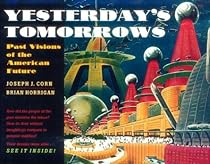
Yesterday's Tomorrows: Past Visions of the American Future


Yesterday's Tomorrows: Past Visions of the American Future (1984)
By Joseph J. Corn and Brian Horrigan

Synopsis: This book examines past American visions of the future in order to show how those visions shed light on the values of their times; sees future visions as cultural artifacts. This is a coffee-table type book that sprang from a Smithsonian exhibit, and includes chapters on 1) Finding the Future (beginning with late 19th century - explores science fiction and utopian fiction, pulp magazines, futurism as linked to commodities, the rise of sci-fi tv and film); 2) The Community of Tomorrow (Progressive vision, "white city," City Beautiful, Garden City, 1939 World's Fair, FLW, Greenbelt Cities, Buckminster Fuller[city of the future as requiring blank slate]); 3) The Home of Tomorrow (rise of apartment homes yet obsession with futuristic single family homes, the rising appeal of mass-produced housing, streamlined style, high-tech kitchens); 4) Transportation of Tomorrow (rise of transportation innovation from 1880-1905, cars and planes, hopes and fears of nuclear power); 5) Weapons and Warfare of Tomorrow (WWI = weapons and electricity, 1920-30s = airplanes and war, WWII = massively destructive potential of weaponry). Authors argue that the future in the U.S. has increasingly moved from communitarian/spiritual utopias of the early days, to a "secular city of the capitalist future" in which most of the emphasis fell on the look of the future rather than the social plan. Argues also that American have long held a strong belief in "technological utopianism" - that "material means can ameliorate social problems and even perfect society" (xii). "The belief that machines, not politics, produce beneficial social change diverts people from initiating reforms that would truly distinguish the future from the present or the past" (xiii).

Interesting Specifics:

Utopian fiction was hugely popular in U.S. from 1880-90s.

We generally look at the future in terms of commodities (11).

1929 = Buckminster Fuller's Dymaxion House.

1938 = Orson Wells' War of the Worlds radio show.

1952 = First Hydrogen Bomb

1957 = First nuclear power plant in the U.S.; Shippingport, PA.

Interacts With:

Maybe other books about World's Fairs or different vision of the future.
David Wojcik
Rem Koolhaas (for the different proposals for future cities).

Class: A Painfully Accurate Guide Through The American Status System


Class: A Painfully Accurate Guide Through The American Status System (1983)
by Paul Fussell

Synopsis: Fussell's basic goal is to debunk the very American idea that we live in a classless society. He does this by providing a tongue-in-cheek, yet somewhat accurate, taxonomy of the various class markers. He shows that even the most minute details can be seen as clear depictions of class. He discusses body shape, gestures, recreation habits, clothing, household objects, decor, materials, attitude, reading preferences, ways of speaking, food preferences, higher education, and architecture. The book's tone is self-consciously ironically snobby and playful, and is decidedly non-scholarly and footnote-free. His final point seems to be that the only way to escape your class is to bow-out of the system completely and become a self-made "inner-directed" "Category-X" person. This is the escape route he grants to (presumably) all his clever, creative, in-the-know readers (and himself). Overall, he argues that the middle class is intensely insecure about its status, and hence is obsessed with the inoffensive (which is perceived as "tasteful") and un-ideological. The middle class is horrified of conflict, controversy, and ideas, and this shows in most of what they do. The implication of this is that the middle class is a very dangerous class to be immersed in, as it avoids all conflict and pain to the point of ignorance and inaction. [This really connects to Radway].

Interesting Specifics:

"Style and taste and awareness are as important as money" (16), and the source of ones money is more important than the amount.

Really emphasizes the fact that the middle class suffers from status anxiety and intense desire to belong (35). For the middle class "Argument or even disagreement must be avoided at all costs" (97).

"Classy people never deal with the future" (74).

Says the desire for privacy is an upper class marker [but don't all people desire privacy, and it's just that the upper class has more access to it?]

The term "weekend" came about in 1878, "a moment marking what can be said to be the flowering of high bourgeois culture" (120).

"We're pretty much stuck for life in the class we're raised in" (198).

Says all of U.S. culture is immersed in a class-lowering, or "prole-drift" (205)

"It's only as an X, detached from the constraints and anxieties of the whole class racket, that an American can enjoy something like the Liberty promised on the coinage" (223). [Geez, that's not too overdramatic).

Interacts With:

Bourdieu (Class can be seen as an obscenely simplified and lay-person version of Distinction, without the theoretical framework. Is basically about the role of "stuff" in constructing a self. Departing from Bourdieu, Fussell does grant people some agency by allowing them to sneak off into the Category X realm if they want to.)
Connects with all the books that discuss the role of "stuff" in constructing a self/identity.
Rudeness and Civility (in the use of labels and clothing and goods to distinguish one person and "type" from another; also in the rise of "gentility" and its scorn of anything that seems offensive or rude).
Radway, Reading the Romance and A Feeling For Books (both demonstrate the ways in which middle class women go out of their way to avoid reading anything that is too heavy or upsetting - especially Reading the Romance; fits with Fussell's argument that the middle class goes out of its way to avoid pain and conflict of all kinds)
The Lonely Crowd (Fussell seems to run with a tweaked version of the "inner-directed" person in constructing his glorified class-dodger "Category X")

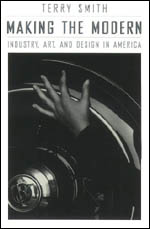
Making the Modern: Industry, Art, and Design In America


Making the Modern: Industry, Art, and Design In America (1993)
by Terry Smith

Synopsis: Smith asks: "Is there an iconography of modernity?" In investigating this, Smith explores the interconnecting forces that produced this iconography in the 1920-30s in the U.S. He states: "I explore the emergence, shaping, transformation, and then normalization of this visual order in a series of connected case studies, anything from the first Ford Motor Company plant at Highland Park, Detroit, commenced in 1910, to the New York World's Fair of 1939-40" (2). The book is divided into 4 parts: Part 1: The Modernization of Work: Detroit, 1910-1929 (River Rouge Plant and the rise of managerial observation; mass production functionalism and its influence on design; Charles Sheeler's art=functionalism can be beautiful); Part 2: Modernization and National Dissensus: Imagery of Reality in the 1930s (modernism became the style of the new corporatism; Diego Rivera's murals as depicting human side of industrial order; Frida Kahlo and gender imagery; FSA photos and the rise of "visualizing the people;" rural decline as flip-side of modernity); Part 3: Design or Revolution? Styling Modernity in the 1930s (androgynous "streamlined" shape; industrial designs hearkening a "usable future;" NY MOMA and NY World's Fair; Part 4: The Modern Effect )Modernity normalized and domesticated by 1940s, lost utopian bent due to horrors of various WWII realities). Argument is that modernity is all about severing ties with the past and creating something new. The modernist style is ultimately a triumph of corporate capitalism and the assembly-line aesthetic, and this whole thing demonstrates the interconnection of industry, New Deal agencies, art, and design. The role of visual imagery in the so-called Second Industrial Revolution ultimately "altered the way Americans saw themselves, saw others, and were seen by others" (2).

Interesting Specifics:

The 1920s-30s were especially concerned with the symbolic, and if fact many people were annoyed by modernity's "excesses, its sensationalized violence, its oversignification" (322).

Six images constantly occurred at this time: "industry and workers, cities and crowds, products and consumers" (7).

The huge River Rouge plant in Detroit was developed between 1915-25.

"Functionalism is essential to modernity" (72).

"Streamlining" was industrial design's biggest contribution, and the egg-like smooth shapes created an imagery of vague androgyny (380). [Interesting, but wasn't "modernity" all about the masculine, and the dispelling of the female? Maybe this was a way to bring the female back - after the rise of the skyscraper - in a subtle way].

Modernity lost a lot of its utopian value after WWII, probably due to the rising belief that machines would be bad too (i.e. connection between social planning and Nazism).

Modernism as triumph of corporate capitalism.

Mass production demanded an imagery which would be reflected in buildings too; it got this in post-Art Deco Moderne (92).

1914 = Ford introduces his $5 a day wages plan (idea being that workers could then buy more Ford stuff).

Model A = 1927.

Charles Sheeler was a famous photographer and painter of new industrial plants and modernist landscapes. He did much to open up the public eye to the beauty of functionalism and the idea that industrial order could be beautiful.

Photography was the dominant visual form of the 1930s.

Interacts With:
Twentieth Century Limited,