Imagining Los Angeles: A City in Fiction (2000)
By David Fine
Synopsis: This book asks how LA, as a place, shaped the imaginations of novelists who wrote about it. Fine does this by surveying the various genres of L.A.-based fiction, ranging from early booster imagery and myth-making of the 1880s-1920s, hard-boiled 1930s, tough guy detective stories, the Hollywood novel, "down and out in LA," Black Dahlia and Zoot Suits, and apocalyptic lit. It's not very argument-driven, and seems that the bottom line is that L.A. has always been both a utopia and a dystopia. It has long been seen as a land of new beginnings and of opportunities, thus also seen ironically when these new beginnings turn out to be false. Interestingly, much of L.A. lit is by migrants, and not by those who have long been entrenched in the culture, which is what regionalist lit is usually like. L.A. is shown as a timeless and placeless "liminal zone" filled with odd architecture that embodies no dominant style. For a place so obsessed with the future, L.A. always seems to be recreating the past.
Interacts With:
City of Quartz, Golden State, Golden Youth, The City in Literature
Showing posts with label urbanism. Show all posts
Showing posts with label urbanism. Show all posts
Tuesday, March 25, 2008

Monday, March 24, 2008
Gay New York: Gender, Urban Culture, and the Making of the Gay Male World, 1890-1940

Gay New York: Gender, Urban Culture, and the Making of the Gay Male World, 1890-1940 (1994)
By George Chauncey
Synopsis: This book seeks to challenge the idea that a vibrant gay culture did not exist prior to WWII by refuting three myths: 1) the myth of isolation, 2) the myth of invisibility, 3) the myth of internalization. Chuancey does an amazingly thorough social history which reconstructs the gay subculture of 1890-1940 New York City by drawing from vice society records, police records, newspapers, and all variety of media in order to provide a rich ethnographic description of gay life. The book is divided into three parts: I: Male (Homo) Sexual Practices and Identities in the Early Twentieth Century; II: The Making of the Gay Male World; III: The Politics of Gay Culture. Chauncey provides both a portrait and analysis of the geography and symbolism of the gay male world in order to show that it was more restricted/hidden in the second third of the century. Basically, the hetero/homo binary and way of defining personhood as based on sexual object preference did not really happen until the 1930s-50s, when it replaced the then-dominant system of "fairie" vs. "normal men" which used gender behavior/identification as the main categorizer (fairies were effeminate, queers were not but liked men, "trade" were masculine and "normal" but would fuck men if approached). This shows a much more fluid range of sexual activity that was allowed to "normal"men then versus now. The book also maps the "sexual topography of the gay world," and shows the way gay culture flourished within urban spaces like streets, parks, bathhouses, boarding houses, and nightclubs. Urban space was thus essential to the development of this culture. Argues that the thriving of this culture was an act of resistance, and that gay and straight culture were defined dialectically. Gays especially flourished among the working class and ethnic/immigrant communities. Seems to show that a sort of utopia emerged during prohibition in which all classes/sexualities were thrown together in search of booze/revelry, and that the repeal of prohibition ultimately led to a rise in anti-gay policing. "Privacy could only be had in public" (198).
Interacts With:
All books that deal with public life/public space:
Sidewalk, Rudeness and Civility, Urban Masses and Moral Order, Land of Desire, Confidence Man and Painted Women, Horrible Prettiness (urban life and the particularities of urban spaces like the theatre),
Maybe de Certeau (transgressive power of small everyday acts, use of space),
Times Square Red, Times Square Blue (not on lists, but connects on urban space and sex culture, and both have a sort of utopian bent to them), Cities on a Hill,
Could maybe contrast with books that focus more on private life, like Behind the Gates, Building Suburbia, The Levittowners, Middletown, Country of Exiles, etc
For books that focus on a different, mobility-based form of public life/space:
Learning from Las Vegas, Neon Metropolis,
Flourishing of gay culture as act of resistance (there's the pop culture list tie-ine!!)
Connects with Foucault, for idea that middle class tries to control sexuality by naming it and defining it.
**Still one of the best!** Tons of good info - See full notes for more details.
Edge City: Life on the New Frontier

Edge City: Life on the New Frontier (1991)
By Joel Garreau
Synopsis: In examining "the biggest change in a hundred years in how we build...cities" (xii), Garreau asks: What American values do Edge Cities embody, and are they places we will ever be proud of? Do Edge Cities really satisfy our longing for the good life? This is a journalistic account, and each chapter focuses on a different city or region, such as Detroit, Atlanta, Texas, Boston, Phoenix, and Southern California. He claims that while the phenomenon is new, they do embody timeless America values like individualism, mobility, and anti-urbanism. Edge Cities are places defined by tons of office and retail space - such as Bishop Ranch and Tyson's Corner, VA. He is undecided as to whether or not edge cities are "real cities," but does note that cities are always shaped by the "cutting edge" transportation of the time, and ECs are clearly shaped by the car. He also notes that cities are always a monument to the worship of something, and that ECs represent a reintegration of home, work, market, etc.
Interacts With:
In saying that ECs represent reintegration, could this then be seen as a counter-modernist plan? But it seems like such cities do not bring things together, they separate and categorize into different pockets of use. Could connect with lots of the pieces on this list, especially those that bemoan a loss of place:
Country of Exiles, Death and Life of Great American Cities, Variation on a Theme Park, J.B. Jackson (which a focus on understanding what's there as opposed to necessarily castigating it)
Friday, March 21, 2008
Learning From Las Vegas: The Forgotten Symbolism of Architectural Form

Learning From Las Vegas: The Forgotten Symbolism of Architectural Form (1977 [1972])
By Robert Venturi, Denise Scott Brown, and Steven Izenour
Synopsis: This book is about the symbolism of architectural form (rather than about Las Vegas, per se), and examines the architecture of the strip in order to counter Modernist design and to celebrate an architecture of movement. The authors analyze the layout, structure, and design of the strip, its buildings, and the significance of its architecture as symbols and signs, and as creating a zone of pleasure. The authors prefer the postmodern playful use of symbols and signs to the austere Modernist style which rejects symbol and decoration in favor of becoming the decoration itself. The megastructures of Modernism are all about imposed unity, whereas "urban sprawl" is more about variety and pluralism. While Modern architecture claims to have rejected symbolism, the modern buildings have just become symbols themselves. The authors castigate modern architecture for dismissing contemporary vernacular architecture and for dismissing the tastes of "the people" in favor of some kind of elitist "heroic" architecture. Basically, the authors reject the idea that sprawl and the strip is "visual pollution," and question its necessarily link to ecological pollution. They instead want us to see this style as just a new type of order and symbol system, an order imposed by speed, movement, and the car.
Interacts With:
Variations on a Theme Park, Jane Jacobs, City of Quartz, Baudrillard, Country of Exiles, J. B. Jackson (in his celebration of everything and of the "common" landscape), Neon Metropolis
Which book talked about the "age of hieroglyphics" (symbols)? This would definitely connect with anything that focuses on semiotics and symbols - even those books on 19th cent urban culture.
This actually has echoes of Janet's list in its desire to "take back" the architecture "of the people" and rescue it from elitist criticism.
This book supposedly launched the postmodern movement (according to Jeff's Design in the U.S.A. book)
Variations on a Theme Park: The New American City and the End of Public Space

Variations on a Theme Park: The New American City and the End of Public Space (1992)
Edited by Michael Sorkin
Synopsis: This is a compilation of essays which seeks to describe (rather than theorize) the new ageographic city. This new city has three characteristics: 1) no attachment to local, physical, and cultural geography; 2) an obsession with "security;" 3) a city of simulations. Includes pieces by Margaret Crawford (West Edmonton Mall as land of fantasy consumption); Langdon Winner (Silicon Valley as info age city of floating bits); Neil Smith (Lower East Side as Wild West, gentrification, 1988 Tompkins Square Park Riot); Edward Soja (exopolis and Orange County, OC all about perpetual newness and reinvention and simulacra, postmodern numbness); Trevor Boddy (analogous cities of above and below ground tunnels separate one class from another and kill messy vitality of the street); Mike Davis (Fortress L.A. - islands of hermetically-sealed luxury in downtown L.A., city controlled by surveillance and private security); Christine Boyer (South Street Seaport, theatrical design, all about story and familiar narrative patterns); Sorkin (Disneyland as ultimate ageographic place, city as false utopia). Basically, this book is freaked out that "real urbanity" might be disappearing.
Interacts With:
Where do I begin!!? Everything that's angsty and bitchy about the built environ from the early 1990s connects to this:
Geography of Nowhere, Country of Exiles, "The World in a Shopping Mall" (as a counter-example to this), Behind the Gates, Celebration Chronicles, Learning from Las Vegas (as a positive precursor), Edge City, Simulacra and Simulations, Inside the Mouse, Delirious New York, Richard Sennett, Jane Jacobs
This really is an excellent look at early 1990s angst and this fear of "inauthenticity."
Tuesday, March 18, 2008
Delirious New York: A Retroactive Manifesto for Manhattan
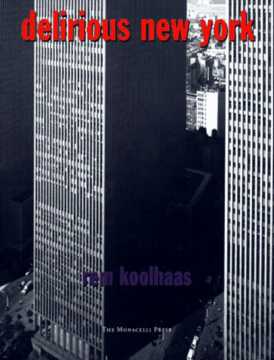
Delirious New York: A Retroactive Manifesto for Manhattan (1994 [1978])
By Rem Koolhaas
Synopsis: This book basically sees Manhattan as a "theatre of progress" and mythical fantasy laboratory immersed in the "culture of congestion." It argues that Manhattan is a pinnacle of the artificial, and that its massive congestion is its own brand of urbanism. The book comes across as somewhat of a "fuck you" to Modernist Puritanical "order." Includes sections on "Coney Island: The Technology of the Fantastic" (theme parks of Coney Island as obsessed with the artificial; machines and lights; creation and destruction; Dreamland and its bizarre Lilliputia land of midgets and skewed morality - i.e. promiscuity, homosexulaity, nymphomania, etc.); "The Double Life of Utopia: The Skyscraper" (Manhattan skyscraper born 1900-1910 as a "utopia device for the production of unlimited numbers of virgin sites on a single metropolitan location" (83); tall buildings as laboratory islands and entire own world, i.e. Waldorf Astoria; Harvey Wiley Corbett and his plan for an ultra-ultra dense Manhattan; "the hotel" as a plot in itself - providing world of change encounters); "How Perfect Can Perfect Be: The Creation of Rockefeller Center" (yet another island; Roxy Theatre as producing "synthetic sunrise" (which Koolhaas loves); all as "anti-authentic;" Rockettes as a new breed of pure abstraction); "Europeans: Biuer! Dali and Le Corbusier Conquer NY" (Salvador Dali's "paranoid critical method; Corbu's attempt to pretend NY doesn't really exist so he can "create" his radiant city; Koolhaas hates Corbu as his plans drain NY of its lifeblood and congestion). This book is basically a tribute to the crazy chaos of New York.
Interesting Specifics:
Dreamland was designed as a place "to appeal to all classes" (45). 1911 = Dreamland burns down.
At this time, Modernism was all about an absence of color, and Dreamland was all white (46).
The Waldorf-Astoria was an attempt at the greatest hotel of all time - massive and all-encompassing (145). It was the focus of many 1930s Hollywood films - hotel is a plot, a world presenting myriad opportunities for random encounters at any time (148-50).
In reference to the Rockettes, I think: "Beyond sex, strictly through the effects of architecture, the virgins reproduce themselves" (217).
Interacts With:
This is a great contrast to Nature's Metropolis as Koolhaas views the city as totally unnatural and never even ventures that it could be related to nature at all.
Amusing the Million
I guess it's kind of a positive postmodernism is cool thing? Though don't know if you could really call NY urbanism "postmodern." I should maybe check again to see how "pomo" positive this guy really is - or even how pro-NYC he is. It's kind of a passionate, stream-of-consciousness kinda thing. Fun!
Sunday, March 16, 2008
Los Angeles: The Architecture of Four Ecologies

Los Angeles: The Architecture of Four Ecologies (1971)
By Reyner Banham
Synopsis: Banham aims to "present the architecture...within a topographical and historical context of the total artifact that constitutes Great Los Angeles, because it is this double context that binds the polymorphous architectures into a comprehensive unity that cannot often be discerned by comparing monument with monument out of context" (23). Book is broken down into "four ecologies:" Ecology I: Surfurbia (beaches as biggest thing to envy; focus on indoor/outdoor living; spanish colonial revival; freeways); Ecology II: Foothills (fancy suburbs; mobility-focused architecture; landscape of "do your own thing;" city obsessed with transportation); Ecology III: The Plains of Id (flatlands as "heartland;" Schindler, Neutra, and the International Style ; plain cubes; people should accept the non-existent downtown for what it is: dead); Ecology IV: Autopia (freeway as central feature; L.A. as embodiment of bourgeois good life of urban homestead; people unfairly castigate L.A. when they should examine all the fabulous architecture there and think about why L.A. has inspired so much of that). Argues that "the language of design, architecture and urbanism is Los Angeles is the language of movement" (23). Southern California is an ecological wonder and the land of "perpetual spring." People are too hard on L.A., and should not fault it for being different; it really embodies many ingrained American values - especially the desire for freedom of movement.
Interesting Specifics:
L.A. architecture is emblematic of that particular American phenomenon:"...the convulsions in building style that follow when traditional cultural and social restraints have been overthrown and replaced by the preferences of a mobile, affluent, consumer-oriented society, in which 'cultural values' and ancient symbols are handled primarily as methods of claiming or establishing status" (124).
"...Los Angeles is...the home of the most extravagant myths of private gratification and self-realization, institutionalized now in the doctrine of 'doing your own thing'" (124).
L.A. is steeped in the "fantasy of innocence" (129).
"So recreational living tends to become another synonym for the social 'turf' system of closed communities; systematic planning remains the creation of privileged enclaves" (145).
Anyone who cares about architecture simply cannot ignore Los Angeles - and to do so would be a huge and elitist blunder.
Interacts With:
This is really an L.A. apologist book. Says hey, it's not so bad, it's just different - you have to look at all its different parts to understand it.
City of Quartz, Variations on a Theme Park, Neon Metropolis, Country of Exiles (these are all negative takes on L.A. and L.A.-ish phenom, though Mike Davis straddles line between pos and neg); Holyland (not on any list), Learning from Las Vegas (for a positive attempt to understand car-centric landscapes), Golden State, Golden Youth
Land of Desire: Merchants, Power, and the Rise of a New American Culture

Land of Desire: Merchants, Power, and the Rise of a New American Culture (1993)
By William Leach
Synopsis: This book is an examination of the "crucial formative years" of the rise of consumer culture (1880-1930), and asks how that culture first came into being, and what was gained, lost, and/or repressed in that process (xiii-iv). Examines archives, newspapers, diaries, etc, and divides the book into three parts: Part I: Strategies of Enticement (rise of department stores and of the "commercial aesthetic" which relied on glass, color, and light; rise of fancy display windows and of the visual; rise of themes and of children's clothes/toys; rise of orientalism; rise of the importance of service, atmosphere, and comfort; rise of the separation of production from consumption); Part II: Circuits of Power (examines the many institutions aiding the rise of consumer culture - commercial art schools, colleges and universities, urban museums, federal and municipal governments, and religion; rise of mind cure and sunny optimism; Wizard of Oz; world without suffering); Part III: Managing a Dream Culture: 1922-1932 (establishment of "consumptionism" by 1920; American obsession with defending the "standard of living;" flood of consumer goods and rise of chain stores and mergers; "luxury" loses its negative connotations; rise of spectacle and elaborate designs; Herbert Hoover and his advocacy of single family homes and govt. role in making big business even more efficient/profitable - creation of "a new institutional bureaucratic language of consumption). Leach argues that consumer culture is nonconsensual, and is not produced by the people but by commercial groups and elites obsessed with profit, promoting only one vision of the good life while pushing out all others. This was the rise of a new commercial aesthetic that advocated a culture of longing and desire. It ushered in a one-sided, capitalist concept of the self and perpetuated the myth of the separate consumer world as a realm of freedom, self-expression, and fulfillment.
Interesting Specifics:
The cardinal features of this new consumer culture are/were: "acquisition and consumption as the means of achieving happiness; the cult of the new; the democratization of desire; and money value as the predominant measure of all value in society" (3).
In the 1910s, there were massive fears over U.S. "overproduction" of goods, hence the desire for new ways to get people to buy more stuff.
The commercial aesthetic was all about the use of color, glass, and light to sell goods (40).
Rise of the show window = 1889.
1890s = proliferation of the use of glass and window displays to sell goods, marking an increased focus on the visual and a decline in the use of touch and smell which had been such a part of open-air markets (62-63). Display glass enticed viewers: "Here is is, everywhere you go, yet you cannot reach it" (63).
By 1915 the "central theme" idea unifying many rooms/spaces was standardized for "theatre owners, restauranteurs, and department store retailers with which to design adult fantasy environments" (82). Rooftop gardens were themed starting in late 1890s.
1900 = rise of tipping in restaurants
The rise of the service/comfort industries had some roots in hospitality of Christianity, and was seen as the comforting and benevolent side of capitalism (146).
Increased separation between production and consumption made it easier to deny any suffering inherent in capitalism, hence "The outcome was a greater tendency toward selfishness and a corrosive moral indifference" (150). [Geez, this guy is really moralistic - Pretty old-school].
"A comfortable gentility, fearful of emotional extremes and of public embarrassment, but capable of consumer extravagance" was the hallmark of American urban/suburban life (page?)
1912 = Eleanor Porter's Pollyanna
1923 = John Powers founds the first successful modeling agency
1920s = increased focus on color and light
"...the conception of the desiring self, as expressed and exploited by capitalism, offers a one-sided and flawed notion of what it means to be human" (385).
"But however flawed, the capitalist concept of self, the consumer concept of the self, is the reigning American concept" (386).
Interacts With:
Wow, he is very negative on consumer culture. He takes the non-pop culture approach and seems to look at consumption as a top-down thing, without seeing the potential liberatory powers of bottom-up flexibility of meaning, use, and purpose. Seems to view consumer culture as simply manipulation and exploitation. In this way, differs greatly from Meaning of Things and the material culture book that see consumption and things as a tool of social value. Really does fit with the angry tone of Country of Exiles. I still feel that such books are important, because at least they arouse passions in some way, and get people going.
No Place of Grace, Design in the U.S.A.
Class, Rudeness and Civility, Urban Masses and Moral Order, Reading the Romance (again, any books that deal with middle class comfort obsession. But was it really only the middle classes which were obsessed with comfort, or was it just that they were the ones with the means to achieve comfort??)
Culture of Narcissism (for its moralistic shaming of "selfish" American and consumer culture).
Saturday, March 15, 2008
Confidence Men and Painted Women: A Study of Middle-Class Culture in America, 1830-1870

Confidence Men and Painted Women: A Study of Middle-Class Culture in America, 1830-1870 (1982)
By Karen Halttunen
Synopsis: This book is "a cultural history of the sentimental ideal of social conduct" that defined the morals and behaviors of the antebellum nineteenth-century middle-class in America (xvi). Asks: Why did nineteenth-century conduct manuals, etc, see hypocrisy as such a huge threat? Analyzes etiquette books, conduct manuals, advice books, fashion magazines, and mourning books to uncover the fact that perfect sincerity and transparency of character was essential to the sentimental ideal of the time. Includes sections on fears of the "confidence man" or trickster in urban culture, the important of sincerity as a middle class ideal, sentimental culture's influence on fashion and etiquette, mourning as a huge gesture of genteel theatricality, the decline of sentimental culture and the increased acceptance of theatricality, disguise, and performance. Each of these illustrates the ways in which Americans grappled with the urbanizing mass of strangers via initial resistance to artifice, followed by the eventual acceptance of the highly stylized and individualized mode of fashion, disguise, and theatricality. Argues that an influx of young people into crowded cities led to fears that the young would be duped and corrupted (and young people were seen as metaphor for the nation at that point). The increased fluidity and amorphous liminality of people meant that you never really knew what someone was like, hence the middle class demand that one always be sincere. This elaborate performance of sentimental sincerity ultimately gave way in the 1850-70s to a gradual acceptance of disguise and theatricality. So, in the end, skillful social performance beat out transparent sincerity. The middle class preference for sincerity does live on a bit today. [Who hates sincerity? What is the benefit of insincerity? Are we talking sarcasm here, or what?] Bottom line: "...sentimental demand for sincerity was a defensive strategy against the perceived dangers of placelessness in the open society and of anonymity in the urban world of strangers" (194). Also, "it was through their definition of the problem of hypocrisy, and their efforts to resolve that problem in the sentimental cult of sincerity, that American seeking to rise in the urban world of strangers became resolutely middle-class" (197). [Hmm, try to think about how this connects with other explanations for the rise of the middle class. Does it differ?]
Interesting Specifics:
The incredibly mobile Victorian culture meant positions were no fixed, and so there was an intense fear that people were passing for something they were not (xv).
American were thrown rather suddenly into a world dominated by strangers, and this vastness led people to characterize others based on appearance, as that's all they had to go on (36). [Wow, almost identical argument that Rudeness and Civility makes]
Middle class women struggled over what kind of fashion would not obscure their sincerity and true nature (73). The clean, minimalist, body-conscious classical style gave way to the "sentimental style" in the 1830s (characterized by bonnets and plain styles/simplicity (89).
With the rise of sentimentality and the domestic ideal, the parlor became even more important, and the genteel hostess felt increasingly pressured to act as a kind of "stage manager" (105). Parlor as zone between private and public. All about the "controlled communication of proper sentiments" (121).
Mourning was a huge deal; seen as the most transparent and hence sincere/genteel sentiments.
"By the 1850s, the sentimental view that a particular dress form could embody a particular feeling or moral quality was losing credence" (158).
1860s = increased use of makeup.
1850s = increased acceptance of theatricality and with parlor stages and games like charades.
1848-1875 was an era of huge economic prosperity, creating a "bourgeois world" (187).
By the 1850s, the middle class decided to rely on a general confidence in the good intentions of others, as opposed to a strict trust in their Christian morals.
Interacts With:
Rudeness and Civility, Urban Masses and Moral Order, The Arts of Deception (basically any book about P.T. Barnum - as an example of the place of "fraud" in nineteenth-century culture), Horrible Prettiness (evolution of Americans' view of theatricality and performance)
Rudeness and Civility: Manners in Nineteenth-Century Urban America

Rudeness and Civility: Manners in Nineteenth-Century Urban America (1990)
by John F. Kasson
Synopsis: This book asks: "What...was the relationship of the symbolic system of economic exchange (money) to the symbolic system of social relationships (manners) in a democracy?" (6) Kasson investigates this question by looking at "the semiotics of everyday urban life" via etiquette rules, manners, etc., to get at how such practices bear "upon key questions about the nature of social conventions, social relationships, and individual identity in the supposedly 'free' market and democratic society of the nineteenth-century metropolis" (5). Includes a discussion of pre-nineteenth-century manners (pre-"modernity,"), etiquette books and gentility, reading the city, bodily management, emotional control, table manners, and "disciplining spectacle." This book is thus basically about the "transition from a rank-structured society to an impersonal 'class' society" (33). The rise of urban center populations led to an increased sense of fragmentation and confusion and a fragmented sense of self; this resulted in a need to create some kind of system of self-protection/cohesiveness. Etiquette and manners stepped-in to provide this system of semiotic guideposts. The more chaos ensued, the more people relied on the most minute signs and symbols as a way to "read" or understand others. Clothes, silverware, manner of walking, etc. all thus became increasingly emblematic of one's character. This increased restraint, control, and decorum, came at the expense of jovial togetherness, and this increasingly passive spectator style really paved the way for modern consumer culture. Meanwhile, the city itself was read from 1) the bird's eye view of "unity and progress," and 2) the mole's eye view of vice and shadows. Overall, this book demonstrates the intense need to develop some new system of ranking, status, and order in the face of immense change and fracturing.
Interesting Specifics:
** Excellent! Focus on! Lots of good info and specifics! **
The output of etiquette manuals surged from 1870 to t.o.c.
"In the name of civility and self-discipline, the bourgeois code of manners deflected the pressures and inequities of the society back on the individual" (6).
The Civilizing Process by Norbert Elias (from about 50 years ago) was one of the first to analyze manners and etiquette and study them as history.
Many of the changes associated with modernity include: rise of the nation-state, the rise of egalitarian spirit associated with Western democracies, modern capitalist economy, the rise of relations defined by the market, the rise of Evangelicalism, and the Enlightenment focus on rationality and tolerance, etc (18).
The rise of capitalism meant that gentility was now something to be purchased.
"As late at 1820, only one person in fourteen lived in a community of more than 2,500, and only twelve cities exceeded 10,000" (71). From 1860-1910, the urban population rose from 19.8% - 45.7% of the total American population (72).
By 1920, in cities of 100,000+, 58% were foreign-born or had foreign-born parents (72).
The 1850s saw a rise of "gaslight" tours in which the bourgeois would explore the horrors of those who lived in the slums (78).
There was an increase in agoraphobia in the 19th century due to "sharp discontinuities between public and private life" (113); also connected to an increased fear of embarrassment.
Increased focus on control at this time meant that emotional outbursts - especially of anger - were shunned.
"Private tastes, rather than public actions, became the crucial indicator of sincerity and authenticity" (169). "Privacy" also became increasingly desirable. [Hmm, would be interesting to do a history of privacy in the U.S. Very connected to current issues i.e. online communities. Can love of privacy be directly linked to xenophobia? Does its rise dovetail increased immigration? This book says yes, basically, I wonder if this pattern continues through history?]
Increased specialization of flatware mirrored increased specialization in the workplace.
The 1830s marked a huge revolution in cutlery and table-manners.
Astor Place Theatre represented a new era in refinement.
The term "confidence man" was coined in 1849, and referred to a well-dressed con-artist who pretended to be an old friend and then would say "Have you confidence in me to trust me with your watch until tomorrow?" and then would of course take off with the watch (103).
The increasingly demanding social rules of the time represented an attempt to defend a "solid self" in a fragmenting world (257). Says self-help books of today are the successors of etiquette books, and are still attempts to come to terms with our fragmented world/selves.
Interacts With:
Says that although material development of society is well studied, few have paid much attention to "vital but elusive changes in cultural practices, conduct and consciousness that attended this physical transformation" (4). I guess that is his intervention then.
Paul Boyer (Urban Masses and Moral Order - in attempt to deal with/adjust to the increasingly impersonal metropolis)
Rothman, The Discovery of the Asylum (need for order in the face of chaos)
Even the books from the jeremiad section, like The Culture of Narcissism (via the increased focus on tiny individual details as key parts of one's self)
Actually, a lot of the material culture books too, as related to the use of stuff to construct one's identity and sense of self (in Kasson's book, as done with clothing and overall personal "style").
Horrible Prettiness (as related to increased passivity and bourgeois-ification of theatre; what was lost with the rise of "gentility" and "polite" spectatorship).
de Certeau (for their shared focus on the "practice of everyday life;" the small gestures).
Books that deal with the separation of home from workplace.
With its focus on the "fragmenting self," it seems that this book is really about early strains of postmodernism - but then again, postmodernism really can just be seen as an extension of modernism, but without the faith in the potential of a "grand plan."
Urban Masses and Moral Order in America, 1820-1920

Urban Masses and Moral Order in America, 1820-1920 (1992 [1978])
By Paul Boyer
Synopsis: This book is "a fresh synthesis of familiar material" that examines America's moral response to the city, from 1820-1920, and the various reform measure taken to deal with it. The book is divided into four parts: 1) The Jacksonian Era, 2) The Mid-Century Decades: Years of Frustration and Innovation, 3) The Gilded Age: Urban Moral Control in a Turbulent Time, 4) The Progressives and the City: Common Concerns, Divergent Strategies. Argues that prior to 1920 (mostly pre-1860), many of the reform efforts really focused on restoring a sort of village life/familiar surveillance in a society which no longer followed that model. Reform efforts also sought "moral uplift" through tracts (Lyman Beecher was especially involved). The switch from a rural to urban society freaked people out and led them to fear a loss of control. Into the Guilded Age, more coercive strategies took hold (such as Teddy Roosevelt's "we have to fight the poor to save them" strategy - wasn't he post-Gilded Age though?) vs. positive environmentalist strategies (such as the City Beautiful Movement, park movement, playground movement, etc). By the 1920s, however, the view of the city had changed, and people now saw it as a den of conformity.
Interesting Specifics:
Attempts at increased surveillance included the publishing of personal details, whose aim was "to introduce a public dimension into even the most intimate private realm; to reassert society's right to oversee every facet of personal behavior" (19). [Interesting, as this is exactly what's going on now with MySpace, etc, but in an intentional, hey look at me and my personal details! way. Would this idea still even work? Oh, I guess it still exists with "To Catch a Predator"]
Many of the religious-based reform movements were designed to reach the masses and provide them with a sense of order. Thus, the Jacksonian era became somewhat obsessed with order and discipline as a counter to the increased chaos; "this early urban moral-reform effort, then, simply underscored the erosion of an organic sense of community in a period of urban growth" (56).
YMCA movement started in England in 1841, and was brought to the U.S. in 1851.
1910 = Mann Act passed - made is a federal offense of transport a woman across state lines for "immoral purposes" (191).
The 1890s saw a massive rise of anti-prostitution and anti-liquor sentiment.
1896 = Raines Law, and the rise of Raines Law hotels.
Park movement, playground movement, etc, were all part of the "positive-environmentalist" movement, which sought to improve living conditions of the poor so as to influence their moral and social values (234).
Interacts With:
Rothman (Discovery of the Asylum, in this increased push for order and hermetic, old-time community as a solution to increased chaos and change of urbanization)
Hmm, I wrote in my notes that this book might also be about the (implicit) homogenizing effects of mass culture, even though it doesn't explicitly state that.
Subscribe to:
Posts (Atom)
