Showing posts with label leisure. Show all posts

Friday, March 21, 2008

Learning From Las Vegas: The Forgotten Symbolism of Architectural Form


Learning From Las Vegas: The Forgotten Symbolism of Architectural Form (1977 [1972])
By Robert Venturi, Denise Scott Brown, and Steven Izenour

Synopsis: This book is about the symbolism of architectural form (rather than about Las Vegas, per se), and examines the architecture of the strip in order to counter Modernist design and to celebrate an architecture of movement. The authors analyze the layout, structure, and design of the strip, its buildings, and the significance of its architecture as symbols and signs, and as creating a zone of pleasure. The authors prefer the postmodern playful use of symbols and signs to the austere Modernist style which rejects symbol and decoration in favor of becoming the decoration itself. The megastructures of Modernism are all about imposed unity, whereas "urban sprawl" is more about variety and pluralism. While Modern architecture claims to have rejected symbolism, the modern buildings have just become symbols themselves. The authors castigate modern architecture for dismissing contemporary vernacular architecture and for dismissing the tastes of "the people" in favor of some kind of elitist "heroic" architecture. Basically, the authors reject the idea that sprawl and the strip is "visual pollution," and question its necessarily link to ecological pollution. They instead want us to see this style as just a new type of order and symbol system, an order imposed by speed, movement, and the car.

Interacts With:

Variations on a Theme Park, Jane Jacobs, City of Quartz, Baudrillard, Country of Exiles, J. B. Jackson (in his celebration of everything and of the "common" landscape), Neon Metropolis
Which book talked about the "age of hieroglyphics" (symbols)? This would definitely connect with anything that focuses on semiotics and symbols - even those books on 19th cent urban culture.
This actually has echoes of Janet's list in its desire to "take back" the architecture "of the people" and rescue it from elitist criticism.
This book supposedly launched the postmodern movement (according to Jeff's Design in the U.S.A. book)

Variations on a Theme Park: The New American City and the End of Public Space


Variations on a Theme Park: The New American City and the End of Public Space (1992)
Edited by Michael Sorkin

Synopsis: This is a compilation of essays which seeks to describe (rather than theorize) the new ageographic city. This new city has three characteristics: 1) no attachment to local, physical, and cultural geography; 2) an obsession with "security;" 3) a city of simulations. Includes pieces by Margaret Crawford (West Edmonton Mall as land of fantasy consumption); Langdon Winner (Silicon Valley as info age city of floating bits); Neil Smith (Lower East Side as Wild West, gentrification, 1988 Tompkins Square Park Riot); Edward Soja (exopolis and Orange County, OC all about perpetual newness and reinvention and simulacra, postmodern numbness); Trevor Boddy (analogous cities of above and below ground tunnels separate one class from another and kill messy vitality of the street); Mike Davis (Fortress L.A. - islands of hermetically-sealed luxury in downtown L.A., city controlled by surveillance and private security); Christine Boyer (South Street Seaport, theatrical design, all about story and familiar narrative patterns); Sorkin (Disneyland as ultimate ageographic place, city as false utopia). Basically, this book is freaked out that "real urbanity" might be disappearing.

Interacts With:

Where do I begin!!? Everything that's angsty and bitchy about the built environ from the early 1990s connects to this:
Geography of Nowhere, Country of Exiles, "The World in a Shopping Mall" (as a counter-example to this), Behind the Gates, Celebration Chronicles, Learning from Las Vegas (as a positive precursor), Edge City, Simulacra and Simulations, Inside the Mouse, Delirious New York, Richard Sennett, Jane Jacobs
This really is an excellent look at early 1990s angst and this fear of "inauthenticity."

Tuesday, March 18, 2008

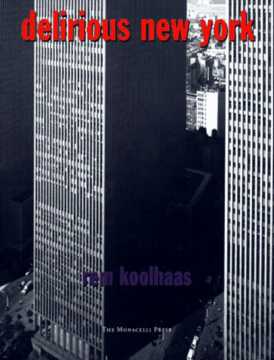
Delirious New York: A Retroactive Manifesto for Manhattan


Delirious New York: A Retroactive Manifesto for Manhattan (1994 [1978])
By Rem Koolhaas

Synopsis: This book basically sees Manhattan as a "theatre of progress" and mythical fantasy laboratory immersed in the "culture of congestion." It argues that Manhattan is a pinnacle of the artificial, and that its massive congestion is its own brand of urbanism. The book comes across as somewhat of a "fuck you" to Modernist Puritanical "order." Includes sections on "Coney Island: The Technology of the Fantastic" (theme parks of Coney Island as obsessed with the artificial; machines and lights; creation and destruction; Dreamland and its bizarre Lilliputia land of midgets and skewed morality - i.e. promiscuity, homosexulaity, nymphomania, etc.); "The Double Life of Utopia: The Skyscraper" (Manhattan skyscraper born 1900-1910 as a "utopia device for the production of unlimited numbers of virgin sites on a single metropolitan location" (83); tall buildings as laboratory islands and entire own world, i.e. Waldorf Astoria; Harvey Wiley Corbett and his plan for an ultra-ultra dense Manhattan; "the hotel" as a plot in itself - providing world of change encounters); "How Perfect Can Perfect Be: The Creation of Rockefeller Center" (yet another island; Roxy Theatre as producing "synthetic sunrise" (which Koolhaas loves); all as "anti-authentic;" Rockettes as a new breed of pure abstraction); "Europeans: Biuer! Dali and Le Corbusier Conquer NY" (Salvador Dali's "paranoid critical method; Corbu's attempt to pretend NY doesn't really exist so he can "create" his radiant city; Koolhaas hates Corbu as his plans drain NY of its lifeblood and congestion). This book is basically a tribute to the crazy chaos of New York.

Interesting Specifics:

Dreamland was designed as a place "to appeal to all classes" (45). 1911 = Dreamland burns down.

At this time, Modernism was all about an absence of color, and Dreamland was all white (46).

The Waldorf-Astoria was an attempt at the greatest hotel of all time - massive and all-encompassing (145). It was the focus of many 1930s Hollywood films - hotel is a plot, a world presenting myriad opportunities for random encounters at any time (148-50).

In reference to the Rockettes, I think: "Beyond sex, strictly through the effects of architecture, the virgins reproduce themselves" (217).

Interacts With:

This is a great contrast to Nature's Metropolis as Koolhaas views the city as totally unnatural and never even ventures that it could be related to nature at all.
Amusing the Million
I guess it's kind of a positive postmodernism is cool thing? Though don't know if you could really call NY urbanism "postmodern." I should maybe check again to see how "pomo" positive this guy really is - or even how pro-NYC he is. It's kind of a passionate, stream-of-consciousness kinda thing. Fun!

Sunday, March 16, 2008

Inside the Mouse: Work and Play at Disney World


Inside the Mouse: Work and Play at Disney World (1995)
By The Project on Disney

Synopsis: This book seeks to interrogate pleasure and to analyze the Disney World phenomenon, and is a collaboration between four different academics who all give their take on separate Disney-World-related topics, including nostalgia, heteronormativity, simulacra, etc. There is not necessarily one overarching argument, but instead many, including the idea that our culture "condemns carnival: the bawdy and rude revel of the appetites and its consequent waste and dissipation" (3). Disney World arises as the anti-carnival (though the huge heads of its characters are a form of the grotesque - but kind of the baby grotesque). Though the book is highly critical of Disney, threads of utopianism run throughout the book, especially as utopian impulses are often embedded within consumer products, and the way various views of the future are seen as new beginnings and perhaps calls for radical change. Disney World really is all about consumption, and channels our desire for a utopian sense of community into mere consumerism. Disney World also is completely about heteronormativity and the exaltation of the family. All of the fun there is highly contained and structured, and there is no sense of spontaneity or of subversiveness (hence the "anti-carnival" thing). The pleasure of D.W. is thus, "identifying with a dominant ideology and the role it assigns us" (74). Disneyfication is "the application of simplified aesthetic, intellectual, or moral standards to a thing that has the potential for more complex and though-provoking expression" (103). Hmm, that's sad. Basically, book is saying that people today have limited options.

Interesting Specifics:

Antimodernist and utopian impulses are at cross purposes (224).

Says our culture clearly "condemns carnival: the bawdy and rude revel of the appetites and its consequent waste and dissipation" (3).

Says maybe obesity is partly an "active resistance to a perceived bourgeois norm" (3). [This is an interesting line of thought - that eating fast food and getting fat could be seen as an active move of rebellion. Also creepy though, because could you then say that our craving for revelry has been channeled into a love of fast food? How pointless and non-cathartic.].

Kids love to stay in motels and hotels - Great chapter!! Says that staying in a motel is exciting for kids because it represents independence and "an unconscious social yearning for security and community" (8). Also good because it takes them away from normal school day, which is really an "indoctrination" into the "adult" work world.

"Embedded in the notion that tomorrow initiates a new beginning is a utopian desire for radical change" (39).

Tourism represents a "quest for experience" (45).

One author seeks to discover "how the pleasure we feel at Walt Disney World is negotiated through an ongoing process of identification with and - at least in part, one hopes - evasion of the ideal subject constructed by Disney's tireless 'Imagineers'" (57).

Whereas t.o.c Coney Island was full of subversive games like smashing up fake fancy china and crystal, Disney World "rather than providing opportunities to violate social proprieties, everything in the park is designed to confirm them and make doing so fun" (61). DW keeps people isolated, while Coney Island was all about jostling and mixing it up.

"Human adults do not exist in Disney World except as parents" (69). [Is this just encouraging childhood solipsism?]

The pleasure of DW is "identifying with a dominant ideology and the role it assigns us" (74).

"All expressions of mass culture include contradictory utopian impulses, which may be buried or depicted in distorted form, but nevertheless generate much of the satisfaction of mass cultural commodities (whether the consumer recognizes them as utopian or not)" (190).

Has a cool chapter on the design of DW hotels.

Interacts With:

Goss article, "The World in a Shopping Mall" (I think that's the title - idea that "stuff" kind of represents utopian longings - though Goss article is way more positive)

Foucault (in belief that all mass culture phenomena contain elements of utopianism)

Was it Barthes or Hall who talked about the two different kinds of pleasure - the pleasure of following social conventions and the pleasure of dodging them? Whoever it was, this book kind of relates to that idea - the D.W. is all about pleasure of following conventions. That's actually kind of an interesting concept - I wonder which style ultimately gives more pleasure - following or subverting the norm? Prob subverting, but you never now. Do you get some kind of group/communal feeling out of following it? Or is that group too massive to result in a group feeling??
Amusing the Million (contrast between t.o.c. carnivals and Disney-esque stuff today)

Los Angeles: The Architecture of Four Ecologies


Los Angeles: The Architecture of Four Ecologies (1971)
By Reyner Banham

Synopsis: Banham aims to "present the architecture...within a topographical and historical context of the total artifact that constitutes Great Los Angeles, because it is this double context that binds the polymorphous architectures into a comprehensive unity that cannot often be discerned by comparing monument with monument out of context" (23). Book is broken down into "four ecologies:" Ecology I: Surfurbia (beaches as biggest thing to envy; focus on indoor/outdoor living; spanish colonial revival; freeways); Ecology II: Foothills (fancy suburbs; mobility-focused architecture; landscape of "do your own thing;" city obsessed with transportation); Ecology III: The Plains of Id (flatlands as "heartland;" Schindler, Neutra, and the International Style ; plain cubes; people should accept the non-existent downtown for what it is: dead); Ecology IV: Autopia (freeway as central feature; L.A. as embodiment of bourgeois good life of urban homestead; people unfairly castigate L.A. when they should examine all the fabulous architecture there and think about why L.A. has inspired so much of that). Argues that "the language of design, architecture and urbanism is Los Angeles is the language of movement" (23). Southern California is an ecological wonder and the land of "perpetual spring." People are too hard on L.A., and should not fault it for being different; it really embodies many ingrained American values - especially the desire for freedom of movement.

Interesting Specifics:

L.A. architecture is emblematic of that particular American phenomenon:"...the convulsions in building style that follow when traditional cultural and social restraints have been overthrown and replaced by the preferences of a mobile, affluent, consumer-oriented society, in which 'cultural values' and ancient symbols are handled primarily as methods of claiming or establishing status" (124).

"...Los Angeles is...the home of the most extravagant myths of private gratification and self-realization, institutionalized now in the doctrine of 'doing your own thing'" (124).

L.A. is steeped in the "fantasy of innocence" (129).

"So recreational living tends to become another synonym for the social 'turf' system of closed communities; systematic planning remains the creation of privileged enclaves" (145).

Anyone who cares about architecture simply cannot ignore Los Angeles - and to do so would be a huge and elitist blunder.

Interacts With:

This is really an L.A. apologist book. Says hey, it's not so bad, it's just different - you have to look at all its different parts to understand it.

City of Quartz, Variations on a Theme Park, Neon Metropolis, Country of Exiles (these are all negative takes on L.A. and L.A.-ish phenom, though Mike Davis straddles line between pos and neg); Holyland (not on any list), Learning from Las Vegas (for a positive attempt to understand car-centric landscapes), Golden State, Golden Youth