Showing posts with label consumer culture. Show all posts

Tuesday, March 25, 2008

Hope in a Jar: The Making of America's Beauty Culture


Hope in a Jar: The Making of America's Beauty Culture (1998)
By Kathy Peiss

Synopsis: This book is an examination of the rise of the cosmetics and make-up industry in the U.S., and the constantly reconfigured and renegotiated understanding of make-up use among women, and in American culture overall. Aim is to understand women's intentions as well as social and cultural forces surrounding them. She focuses mostly on imagery and general cultural trends, rather than on what individual women thought, and does this by analyzing the history of the cosmetics industry from the early nineteenth-century to today, with the bulk of the focus on 1900-1930. She shows the way the beauty industry evolved from a female-run business which ducked standard advertising and marketing efforts, to a big consumer culture phenomenon in the 1920s run by men. She also shows how make-up moved from the realm of hookers to average American women, and the way it ultimately came to be deeply connected to femininity and self-expression, identity and community. Argues that the beauty industry continues to be a contested thing - the African American side is especially political, i.e. what is the ideal beauty?
Peiss argues that beauty culture was a way for women to negotiate modernity - the artifice and performance aspect of it was appealing and appropriate for the modern era, yet men continuously had a hard time with this "artifice." Make-up as "skin improvement" vs. make-up as "paint" was an early and tight distinction. This is all still up for debate though - i.e. is this oppressive? "Hussy" outsold "Lady" by a lot, and these two types were seen as moods and not types of people (how postmodern!!) Transformative power of make-up. [The parts about failed attempts to get men to use make-up are fascinating - kind of reminds me of failed attempts to get people to drink coke for breakfast].

Interacts With:

Manliness and Civilization, Tarzan, Houdini, and the Perfect Man, Venus Envy, Where the Girls Are, Fraud in the Age of Barnum (for the discussion of artifice), anything that deals with the performance or charade aspect of Modernity/urban life: Confidence Men and Painted Women,

Sunday, March 23, 2008

Elvis Culture: Fans, Faith, and Image


Elvis Culture: Fans, Faith, and Image (1999)
By Erika Doss

Synopsis: This book asks: Why is Elvis everywhere, why does he remain so popular, and what makes an American icon? To determine this, the book aims "to explore and analyze the meaning of Elvis Presley's image - his face and his body - in contemporary American culture" (25). Doss looks at various aspects of Elvis' image and fandom from quasi-religious shrines to his sexual power (as androgynous and erotic), to his racialization and "whiteness," to questions of ownership over his image. Argues that because we live in a predominantly visual culture, pictures and their materiality hold a tremendous amount of power, a power many have failed to analyze. Elvis has remained such a powerful icon because of his images' "unrestricted ambiguity and instability, its diversity and illegibility - and because Americans have never stopped arguing about what Elvis means and what he represents" (252-53). This multiplicity of meaning is essential to maintaining interest and vitality/relevance. Elvis Presley Enterprises is thus foolish for trying to control and sanitize Elvis' image. This desire for aesthetic control speaks to class bias. The discussion of Elvis' body and sexuality is one of the most interesting in the book, and states that his body/sexuality represents "the desire for integration and fullness in lives circumscribed by separation, dissolution, and alienation" (148). [This last line is a buzz-line favorite of the modernity people - but is this feeling of alienation just a part of the human condition, rather than a particular symptom of modernity? And if this "dislocation" has been going on since the rise of urbanization in the 1820s, shouldn't we have come up with coping mechanisms by now? This is all starting to feel a bit adolescent.]

Interacts With:

Kitsch,
Any book on Janet's list that discusses flexibility of meaning and the importance of multivocality; things seem to gain importance and value in exact proportion that their meaning is contestable and fluid.

Friday, March 21, 2008

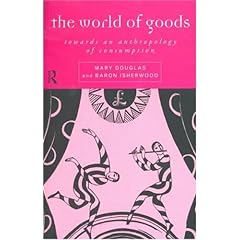
The World of Goods: Toward an Anthropology of Consumption


The World of Goods: Toward an Anthropology of Consumption (1996 [1979])
By Mary Douglas and Baron Isherwood

Synopsis: This book is an attempt to bridge the gap between economics and anthropology by arguing that the "idea of consumption itself has to be set back into the social process, not merely looked upon as a result or objective of work" (viii). This is a critique of materialist views, and takes a very anthropological approach. The book is divided into two parts: Part I: Goods as Info System, and Part II: Implications For Social Policy. The main argument is that goods are primarily a function of social relations, and are markers of rational categories. Goods are part of a live information system, hence our ability to access and produce "information" is key. Consumption decisions define our culture, and commodities are nonverbal mediums for the human creative faculty. Goods are the visible part of culture, and there will indeed always be luxuries as rank will always be marked. Basically, though, argues that goods are a type of social communication, and are the medium through which social relations are carried out. This book tries to distance itself from the theories of moralists who say "stuff" is universally bad.

Interacts With:

Any book that views consumption and material culture as a social phenomenon full of meaning and identity construction: Meaning of Things,
This point of view is interesting, but in some ways it can come off as a bit too apologetic about/corrective of consumer culture. They sell goods and things as vital elements of identity and social connection, yet what about the very real moral, ethical, and environmental concerns that are connected to excessive consumption - can these really be avoided? It's hard to argue with something that they argue is vital to our very sense of humanity, but there is something a bit sick about people who place such a strong emphasis on construction of self and of status via things. In some cases, I think you can and should judge such excessiveness.

Variations on a Theme Park: The New American City and the End of Public Space


Variations on a Theme Park: The New American City and the End of Public Space (1992)
Edited by Michael Sorkin

Synopsis: This is a compilation of essays which seeks to describe (rather than theorize) the new ageographic city. This new city has three characteristics: 1) no attachment to local, physical, and cultural geography; 2) an obsession with "security;" 3) a city of simulations. Includes pieces by Margaret Crawford (West Edmonton Mall as land of fantasy consumption); Langdon Winner (Silicon Valley as info age city of floating bits); Neil Smith (Lower East Side as Wild West, gentrification, 1988 Tompkins Square Park Riot); Edward Soja (exopolis and Orange County, OC all about perpetual newness and reinvention and simulacra, postmodern numbness); Trevor Boddy (analogous cities of above and below ground tunnels separate one class from another and kill messy vitality of the street); Mike Davis (Fortress L.A. - islands of hermetically-sealed luxury in downtown L.A., city controlled by surveillance and private security); Christine Boyer (South Street Seaport, theatrical design, all about story and familiar narrative patterns); Sorkin (Disneyland as ultimate ageographic place, city as false utopia). Basically, this book is freaked out that "real urbanity" might be disappearing.

Interacts With:

Where do I begin!!? Everything that's angsty and bitchy about the built environ from the early 1990s connects to this:
Geography of Nowhere, Country of Exiles, "The World in a Shopping Mall" (as a counter-example to this), Behind the Gates, Celebration Chronicles, Learning from Las Vegas (as a positive precursor), Edge City, Simulacra and Simulations, Inside the Mouse, Delirious New York, Richard Sennett, Jane Jacobs
This really is an excellent look at early 1990s angst and this fear of "inauthenticity."

Sunday, March 16, 2008

Land of Desire: Merchants, Power, and the Rise of a New American Culture


Land of Desire: Merchants, Power, and the Rise of a New American Culture (1993)
By William Leach

Synopsis: This book is an examination of the "crucial formative years" of the rise of consumer culture (1880-1930), and asks how that culture first came into being, and what was gained, lost, and/or repressed in that process (xiii-iv). Examines archives, newspapers, diaries, etc, and divides the book into three parts: Part I: Strategies of Enticement (rise of department stores and of the "commercial aesthetic" which relied on glass, color, and light; rise of fancy display windows and of the visual; rise of themes and of children's clothes/toys; rise of orientalism; rise of the importance of service, atmosphere, and comfort; rise of the separation of production from consumption); Part II: Circuits of Power (examines the many institutions aiding the rise of consumer culture - commercial art schools, colleges and universities, urban museums, federal and municipal governments, and religion; rise of mind cure and sunny optimism; Wizard of Oz; world without suffering); Part III: Managing a Dream Culture: 1922-1932 (establishment of "consumptionism" by 1920; American obsession with defending the "standard of living;" flood of consumer goods and rise of chain stores and mergers; "luxury" loses its negative connotations; rise of spectacle and elaborate designs; Herbert Hoover and his advocacy of single family homes and govt. role in making big business even more efficient/profitable - creation of "a new institutional bureaucratic language of consumption). Leach argues that consumer culture is nonconsensual, and is not produced by the people but by commercial groups and elites obsessed with profit, promoting only one vision of the good life while pushing out all others. This was the rise of a new commercial aesthetic that advocated a culture of longing and desire. It ushered in a one-sided, capitalist concept of the self and perpetuated the myth of the separate consumer world as a realm of freedom, self-expression, and fulfillment.

Interesting Specifics:

The cardinal features of this new consumer culture are/were: "acquisition and consumption as the means of achieving happiness; the cult of the new; the democratization of desire; and money value as the predominant measure of all value in society" (3).

In the 1910s, there were massive fears over U.S. "overproduction" of goods, hence the desire for new ways to get people to buy more stuff.

The commercial aesthetic was all about the use of color, glass, and light to sell goods (40).

Rise of the show window = 1889.

1890s = proliferation of the use of glass and window displays to sell goods, marking an increased focus on the visual and a decline in the use of touch and smell which had been such a part of open-air markets (62-63). Display glass enticed viewers: "Here is is, everywhere you go, yet you cannot reach it" (63).

By 1915 the "central theme" idea unifying many rooms/spaces was standardized for "theatre owners, restauranteurs, and department store retailers with which to design adult fantasy environments" (82). Rooftop gardens were themed starting in late 1890s.

1900 = rise of tipping in restaurants

The rise of the service/comfort industries had some roots in hospitality of Christianity, and was seen as the comforting and benevolent side of capitalism (146).

Increased separation between production and consumption made it easier to deny any suffering inherent in capitalism, hence "The outcome was a greater tendency toward selfishness and a corrosive moral indifference" (150). [Geez, this guy is really moralistic - Pretty old-school].

"A comfortable gentility, fearful of emotional extremes and of public embarrassment, but capable of consumer extravagance" was the hallmark of American urban/suburban life (page?)

1912 = Eleanor Porter's Pollyanna

1923 = John Powers founds the first successful modeling agency

1920s = increased focus on color and light

"...the conception of the desiring self, as expressed and exploited by capitalism, offers a one-sided and flawed notion of what it means to be human" (385).

"But however flawed, the capitalist concept of self, the consumer concept of the self, is the reigning American concept" (386).

Interacts With:

Wow, he is very negative on consumer culture. He takes the non-pop culture approach and seems to look at consumption as a top-down thing, without seeing the potential liberatory powers of bottom-up flexibility of meaning, use, and purpose. Seems to view consumer culture as simply manipulation and exploitation. In this way, differs greatly from Meaning of Things and the material culture book that see consumption and things as a tool of social value. Really does fit with the angry tone of Country of Exiles. I still feel that such books are important, because at least they arouse passions in some way, and get people going.
No Place of Grace, Design in the U.S.A.
Class, Rudeness and Civility, Urban Masses and Moral Order, Reading the Romance
(again, any books that deal with middle class comfort obsession. But was it really only the middle classes which were obsessed with comfort, or was it just that they were the ones with the means to achieve comfort??)
Culture of Narcissism (for its moralistic shaming of "selfish" American and consumer culture).

The Mezzanine


The Mezzanine (1986)
by Nicholson Baker

Synopsis: This is the only novel on my list! It's about the superficial and symbol-laden materiality of modern life. The story follows a man as he journeys on the escalator up to his office on the mezzanine. It's composed entirely of his random and in-depth observations of the most minute details of everyday social rituals and material culture, and is punctuated by footnotes which elaborately expand on i.e. the mechanics and materials of drinking straws. Book often links material details to nostalgic memories and childhood; adulthood, nostalgia, and memory are recurrent themes. The book is obsessed with materiality - with the texture, look, and feel of things, especially paper vs. plastic, and various containers of all sorts. The most microscopic details are discussed and pondered upon in depth, giving a portrait of the "weightlessness" of modern culture and the way we've been forced to sublimate all sense of purpose and meaning onto the ridiculous aesthetic and material conditions that intrude on us in every moment. His descriptions are detailed and witty and sometimes hilarious, and although its style is more "postmodern," it's really about the banality of modernity, as machines and technology and artificiality figure prominently.

Interesting Specifics:

Good example of the narcissism of small details; collection of "microhistories."

"Why do these images have to age before we can be fond of them?" (78). This is a common theme - the importance of distance and nostalgia in producing a sense of fondness or importance.

Concerned with microscopic instances of the "renewal of newness" - like the appearance of another plastic cup when you pull one from the dispenser.

Paper is the nostalgic favorite over plastic.

Interacts With:

Material culture books, Meaning of Things,
No Place of Grace (as connected to the antimodern quest for personal fulfillment, and the banality of an existence focused on minutiae).
de Certeau (focus on the minute details of everyday life)
Monochrome Memories
Flight Maps, American Plastic
(idea that plastic represents the fake)

Saturday, March 15, 2008

Design in the U.S.A.


Design in the U.S.A. (2005)
By Jeffrey L. Meikle

Synopsis: "The purpose of this book is to trace the history of design in the U.S. as a functional tool, as an economic force, and as the expression of a consumer culture that continues to transform everyday life" (17). It traces the history of U.S. design from 1790-present, and is divided into five sections: 1) The Emergence of the American System, 1790-1860 (increased urbanization at the end of this period; Americans had democratic passion for physical comforts that influenced design; 1853 NY Exhibition showed fanciness that would soon be available to the middle class too); 2) Art and Industry in the Gilded Age, 1860-1918 (rise of visual appearance over touch-based production; increased focus on taste and personal expression; aesthetic vs. moral views of design; Arts and Crafts Movement, 1880s - ); 3) Designing the Machine Age, 1918-1940 (birth of the industrial design profession in 1930s; rise of streamlining = desire for a less complex world; increased mobility and efficiency); 4) High Design vs. Popular Styling, 1940-1965 (rise of functionalism; rise of populuxe; shift from material to immaterial existence); 5) Into the Millennium: Moving Beyond Modernism (fracturing of any single design vision; playful mixing of postmodern style; information age as extension of modernity). Most interesting argument (as this book is more of a survey as opposed to an argument-driven book) is that the increased malleability of everything in the information age (today) and the increased catering to a multitude of subcultures marks the dissolution of the "modernist vision of rational, universal coherence" (210). American design is largely about the massive proliferation of stuff.

Interesting Specifics:

"...The democratic pursuit of happiness was related to an increasing flow of material goods - all of them products of design" (12).

It is said that design imposes order - but whose order, and for what purposes? (15-16)

Catherine Beecher = 1800-78

Transcontinental Railroad Completed = 1869

Model T Ford = 1908

Frederick Taylor = 1856-1915

Ford shuts down River Rouge plant in 1927.

Fiestaware = 1930s

Journal Industrial Design launched in 1954.

1960s = shift from a material to immaterial world (information age - isnt' this also when "postmodernism" began?)

Defines what it means to be a consumer: "how to invest time and energy in shopping, how to gain emotional release by acquiring material things, and how to construct and express personal identity by arranging and displaying possessions" (52).

"Visual appearance...assumed greater economic and cultural significance, as a 'touch-oriented, local world of production' yielded to a 'sight-oriented, broader world of consumption'" (52).

There were two schools of British design philosophy - the aesthetic and the moral - "one advocating design as a source of visual and tactile pleasure, the other as a source of moral reform" (67).

Tiffany lamp craze was in the 1900s.

Arts and Crafts Movement big in 1880s-1900s.

Stickley started making mission style furniture in 1902.

Industrial design profession emerged in the 1930s.

Streamlining "represented a common assumption that society's larger processes had to be rendered smoother, less complex, more frictionless in operation" (125). Also, "its rounded, enclosing forms, particularly when applied to architecture, suggested a need for protection and stability" (125).

Ford Taurus as radical design breakthrough, and car historians regard it as "'the single most important American production design of the 1980s'" (191).

Says Learning from Las Vegas (1972) launched the postmodern movement (192). [Hmm, don't others say it was a little earlier? Maybe it's that these guys were the first to really defend it and make it a "taste of the people" movement to embrace - ]

Grid was the first laptop.

Interacts With:

Rudeness and Civility, Class (any book that deals with middle class obsession with comfort)
Meaning of Things
Land of Desire
(focus on the rise of the visual)
Did consumer culture kill Modernism?

Wednesday, March 12, 2008

A Consumer's Republic: The Politics of Mass Consumption in Postwar America


A Consumer's Republic: The Politics of Mass Consumption in Postwar America (2003)
By Lizabeth Cohen

Synopsis: Cohen makes an argument that the postwar period (1945-1975) embodied the rise of the "Consumer's Republic" - that is, "an economy, culture, and politics built around the promises of mass consumption, both in terms of material life and the more idealistic goals of greater freedom, democracy, and equality" (7). Utilizing government sources, sociological surveys, marketing research, and historical monographs, Cohen provides a dense history of this era as it connects with the "consumers' republic" notion. The book is divided into: Origins of the Postwar CR (1930s, New Deal and war efforts); Birth of CR (consumption as the American way of life; continuous push for more purchasing and ownership; Black purchasing and boycotting power to voice discontent; The Landscape of Mass Consumption (suburbanization, commercialization, and privatization; feminization of public space via suburban shopping centers usurping downtowns; decline of legal redlining leads to rise of more covert segregation); Political Culture of Mass Consumption (rise of market segmentation and splintering off into more specialized groups; rise of the consumer movement). Cohen argues that the rise of the "consumers' republic" was just as influential as other Cold War issues, in that it was the belief that mass consumption could bring increased prosperity and equality. While it did do some good, it resulted in increased market segmentation and overall fragmentation.

Interesting Specifics:

Discusses the postwar "return to normalcy" push, and thrift as almost "un-America."

The national output of goods and services doubled between 1946 and 1956, and would double again by 1970" (121).

Between 1947 and 1953, the suburban population increased by 43 percent (195).

1948 Supreme Court ruling of Shelley vs. Kraemer found restrictive covenants unconstitutional.

In 1953, 70,000 person Levittown was biggest community in U.S. with no black residents.

Interacts With:

Actually, does kind of interact with books about the rise of mass production in the late nineteenth century and the hopes that this would democratize goods and put everyone on equal footing. Also is kind of connected to the republican ideal that we will all be united by our (relatively) equal access to stuff. It's a very "common man"/anti-elitist kind of idea that Americans seem to love.
Also, can be seen as another example of increased fragmentation of the modern era.
This is what most of my 1950s lecture is derived from.
This book has tons of good info, but is extremely dry and not American studies enough for me.

Tuesday, March 11, 2008

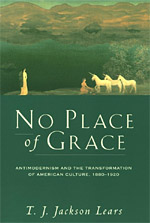
No Place of Grace: Antimodernism and the Transformation of American Culture, 1880-1920


No Place of Grace: Antimodernism and the Transformation of American Culture, 1880-1920 (1981)
By T. J. Jackson Lears

Synopsis: This book explores the origins and effects of American antimodernism - especially its "recoil from an overcivilized modern existence to more intense forms of physical or spiritual experience" (xv). Lears argues that the turn of the century was not marked by democratization and the decline of the elites, "but rather by the reinforcement of elite power in new corporate and bureaucratic forms" (xii). Utilizing Gramsci's notion of hegemony, Lears analyzes books, magazines, private letters, novels, poems, essays, and sermons to build his argument linking antimodernism with the rise of therapeutic culture. He feels that antimodernism was "both more socially and more intellectually important than historians have supposed" (xv), claiming that "the shift from a Protestant to a therapeutic world view, which antimodern sentiments reinforced, marked a key transformation in the cultural hegemony of the dominant classes in America" (xvii). Modernism (lit and art) and antimodernism share common roots in the yearning for authentic experience - physical, emotional, or spiritual (xix). The book is divided into the following sections: 1) Roots of Antimodernism (the increased rationalization and systematic organization of life for maximum productivity leads to an increased feeling of "unreal"-ness; increased focus on time; increased obsession with comfort; crisis of cultural authority; fears of overcivilization; neurasthenia and weightlessness); 2) Arts and Crafts Ideology (regeneration through handicrafts); 3) Martial Ideal (war as antidote to weightlessness; rise of boxing, football, and the "strenuous life"); 4) Medieval Mentalities (increased focus on childhood and fantasy and antirationalism); 5) Catholic Forms (increased interest in Catholic art/ritual); 6) Patriarchy to Nirvana (oscillation between autonomy and dependence; male versus female realm); Henry Adams (epitome of antimodernism, hated efforts to banish irrationality, deeply conflicted). Antimodernists feared a docile and complacent society. "By exalting 'authentic' experience as an end in itself, antimodern impulses reinforced the shift from a Protestant ethos of salvation through self-denial to a therapeutic ideal of self-fulfillment in this world through exuberant health and intense experience" (xvi). The cult of self-fulfillment was easily co-opted by consumer capitalists whose economy worked perfectly via constant generation of new individual wants and desire. In a way then, antimodernism paved the way for these new modes of cultural hegemony. The therapeutic worldview is thus both a symptom and source of the banality of modern culture.

Interesting Specifics:

* Focus on this one for exam * Tons of notes on this book *

Modernity led to "the systematic organization of economic life for maximum productivity and of individual life for maximum personal achievement...the reduction of the world to a disenchanted object to be manipulated by rational technique" (7).

An obsession with comfort and a decrease in pain, along with a focus on time, were key components of modernity. This was also linked to an increased sensitivity to suffering in general (i.e. slavery, animal abuse, etc).

Spencerianism = optimistic faith in progress.

Increased presence of capitalism leads to increased fracturing of the self.

Modern culture = weightlessness [Marx derivative]

"...most varieties of 20th-century militarism - at least in the West - share a common cultural origin in the late-nineteenth-century recoil from a weightless modernity" (98).

"Antimodern vitalists, for whom intense feeling was its own reward, stressed becoming rather than being, eros rather than agape" (162).

Henry Adams, son of John Adams: "Riven by tension between autonomy and dependence, doubt and faith, he rejected efforts to banish irrationality and contradiction in the name of social or personal harmony" (295).

"Under a twentieth-century regime which multiplied wants and sanctioned total gratification, the avant-garde cult of self-fulfillment sometimes only exaggerated the culture it set out to repudiate" (299).

This desire was all too easily usurped, as "intensity of feeling...became a product to be consumed like any other" (300).

"...the vision of a self in endless development is perfectly attuned to an economy based on pointless growth and ceaseless destruction" (307).

Interacts With:

Gramsci's notion of hegemony
Terrible Honesty,

Friday, March 7, 2008

"Once-Upon-A-Time in the Commodity World: An Unofficial Guide to Mall of America"


"Once-Upon-A-Time in the Commodity World: An Unofficial Guide to Mall of America" (March 1999)
By Jon Goss (from Annals)

Synopsis: Argues that the Mall of America "narrates out collective loss of a natural world of innocence and immanence, and promises restoration in a utopian community of consumption" (45). In fact a sense of loss and longing seems to subconsciously drive a lot of the fantasies found there. Goss spent ten days doing "semiotic reading and participant observation" at the Mall of America, mostly reading the mall as a text. Consumption depends on a faith that the objects possess some kind of power which will then be transfered to the purchaser - i.e. sexual desirability, prestige, status, etc - and this falls in line with the anthro concept of magic systems (56). He finds that the main tropes within the mall are: movement and mobility, memory and magic, nature, primitives, enchantment, and heritage. Says "the commodity is not a souvenir of the real experience of a past or distant reality, but a memento of the retail experience in which its possibility is imagined" (70). "The task is to recognize how the age-old fears of obsolescence - nature dies, children grow up, primitives are 'civilized,' and out heritage is lost - and dreams of immanence, live in the commodity aesthetic, not to eliminate them as so much 'false consciousness,' but to liberate them and live them more fully in really meaningful consumption" (72).

Interesting Specifics:

This article has a great bibliography.

This is one of my favorites - I love it!

Says the contemporary malls are what Foucault calls " 'heterotopias of compensation,' real and discrete 'counter-sites' where multiple images of ideal times and places combine to create an illusion of a world standing outside of everyday life" (45).

Shopping malls are examples of "hypernarrated spaces (Boyer, 1994), providing texts and contents for commemoration through which are narrated the loss and restoration of a thematic meaning" (47). It attempts to unite "individual biography with natural and cultural history" via the commodity (47). [This reminds me of the Buffalo Bill book on Janet's list - that BBWWS was combining personal and historical memory through the experience of the consumer spectacle].

Interacts With:

Jennifer Price (Flight Maps)
Walter Benjamin
Bakhtin's concept of the chronotype - "generic spaciotemporal structures where stories take place" (50)
In its view of objects as things imbided with meaning and embodying a sense of loss, this fits with most of the material culture books on Jeff's list, like The Meaning of Things, and On Longing, etc. Basically anything that looks at objects as having a special almost talisman-esque power that is passed on to its owner/possessor/giver.
This book does not engage with various debates over the artificiality of the mall or consumer culture, or with the hollow shallowness of consumer culture in general. Rather, it is asking us to look deeper into the meaning behind the objects and what kind of need they must represent.
Doesn't like the high culture critique of authentic vs. inauthentic experiences, and feel discussion of that (i.e. consumption as inauthentic) just reproduces the dichotomy what consumption revolves around (49).