Showing posts with label masculinity. Show all posts

Tuesday, March 25, 2008

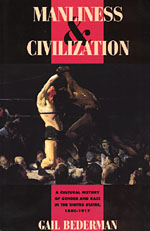
Manliness and Civilization: A Cultural History of Gender and Race in the United States, 1880-1917


Manliness and Civilization: A Cultural History of Gender and Race in the United States, 1880-1917 (1995)
By Gail Bederman

Synopsis: This book seeks to illuminate the ways in which "middle-class men and women worked to re-define manhood in terms of racial dominance, especially in terms of 'civilization'" (20). Focuses the bulk of the book on four different figures: Ida B. Wells (discussed race problem and lynching as "unmanly" and an act of barbarism, yet whites continued to link lynching with manliness); G. Stanley Hall (believed in "recapitulation" theory that each human lived entire evolutionary sequence, and that kids were going through "primitive/savage" stage, and this should be encouraged so they don't turn out as weak, overcivilized pansies); Charlotte Perkins Gillman (linked feminism to white supremacy of civilization); Theodore Roosevelt (obsessive view that white race was the manliest and most powerful, and that it would remain manly via the strenuous life and via imperialist expansion into Cuba, Philippines, and Puerto Rico; and that middle class whites must prevent "race suicide" by having more kids). Argues that race and gender are intricately linked, and that "gender - whether manhood or womanhood - is a historical, ideological process...[it's a] continual, dynamic process" (7). Because definitions of manliness are always shifting, we shouldn't see 1870-1910 as a time of "crisis" per se, but rather as another redefinition. The rise of leisure and the decline of self-employed men led to changing notions of "masculinity," and increased fears that the "feminine" Victorian era would emasculate men. Men basically felt that they were losing control. However, the rhetoric of "civilization" and "manliness" was so flexible that it could be used in an array of ways - often contradictory ways. At its core, "civilization" discourse was all about race, gender, and power. 1910 Jack Johnson (black)/Jim Jeffries (white) "fight of the century" all about "reclaiming" white male dominance (though Johnson won).

Interacts With:

Hope in a Jar, Houdini, Tarzan, and the Perfect Man, Terrible Honesty (with idea that certain eras can be "feminine" or "masculine" - "masculine" modernity as a reaction against "feminine" Victorian era), All the World's A Fair (for discussion of white male superiority and racial dominance)

Tuesday, March 11, 2008

Fit for America: Health, Fitness, Sport, and American Society

Fit for America: Health, Fitness, Sport, and American Society (1986)
By Harvey Green

Synopsis: This book is a history of the culture of American health reform, 1830-1940, and examines the ways in which ideas about health and fitness changed over the century and were tied to larger cultural events. Utilizes sources like catalogues, ads, diaries, letters, journals, medical books, and advice books, and divides health reform into three major periods: Part I: Millennial Dreams and Physical Realities, 1830-1860 (in which body/health reforms were strongly tied to religion and millennial beliefs that the second coming of Christ would only happen is people had reached a state of perfection); Part II: The Price of Civilization, 1860-1890 (reforms based on increased focus on nervous disorders and neurasthenia due to increased urbanization and brainwork; increased focus on "water cure" and "muscular Christianity" and athletics; U.S. increasingly strives to become world power); Part III: Regeneration, 1890-1940 (increased racism and nationalism and fears of race suicide and the decrease of vigorous manliness; leads to rise of "strenuous life"). Many reforms dealt with diet (especially meat-eating versus vegetarianism), and electricity and devises designed to increase energy/efficiency. There was a lot of concern with, even paranoia over, decreased energy and conservation of energy (within the person). Argues that all of these body reforms were acts of individualism, yet the popularity of sports shows our continued desire for community and emotional bonding.

Interesting Specifics:

Self-help books were big by the 1830s.

Some reformers warned against the dangers of spiced and salted foods, and of too many condiments.

Was a lingering fear that passions might get out of control, and that "stimulation" was harmful because it drained away the body's energy.

Sylvester Graham advocated a vegetarian diet of bran bread, water, and vegetables; "Grahamism" was popular among radical communities which sought to separate themselves from the great mass.

Argues that vegetarianism never really took off in U.S. because it is passive, an avoidance of something instead of an active use of something else (53).

By 1850s, children were seen as pure and not wicked, marking a big shift.

George Beard was the neurologist obsessed with neurasthenia.

John Harvey Kellogg another big advocate of the water cure, etc. Water cure involved lots of submersion, etc, and led to therapeutic spas and resorts.

Some thought that meat-eating was linked with human progress and "racial nationalism" (165) - i.e. idea that meat-eaters were more evolved.

Post-Civil War = increased focus on sports and calisthenics, etc.

Ideal male body type gets bulkier in 1880s (198).

View of the body as a machine (late nineteenth century), and need for internal cleanliness.

The Olympic games were reinstated in 1896.

By 1920, Bernarr McFadden's Physical Culture magazine was crammed with self-help and advice.

In the 1920s, there was a fear that blondes would decrease (i.e. due to floods of immigrants, etc.).

Horace Fletcher invents "Fletcherism" - way to lose weight by chewing food endlessly before swallowing it.

Interacts With:
Books dealing with perfectionism
Manliness and Civilization,
Seems very much a product of the 1980s, which were obsessed with body image and fitness.
This book is awesome, but it covers an impossible amount of stuff.