Showing posts with label capitalism. Show all posts

Monday, March 24, 2008

Sidewalk


Sidewalk (1999)
By Mitchell Duneier

Synopsis: This book is an examination of the "invisible social structure of the sidewalk," which asks how the various street vendors, etc "live in a moral order" in "the face of exclusions and stigmatization on the basis of race and class," and wonders how "their acts intersect with a city's mechanisms to regulate its public spaces" (9). Book is based-on first-person ethnographic research conducted from 1996-97 (and a bit from 1998-99), which included participant observation on the sidewalks of certain Greenwich Village streets, following the street economy of many unhoused or marginally-housed Black street vendors who sell recycled magazines and books fished from the trash. Hakin Hasan was the main street vendor Duneier focused on. The book is divided into five sections: Part One: The Informal Life of the Sidewalk, Part Two: New uses of the Sidewalks, Part Three: The Limits of Informal Social Control; Part Four: Regulating the People Who Work the Streets, Part Five: The Construction of Decency. This book draws largely from Jane Jacobs and her discussion of the importance of "public characters." It also argues that sidewalk space allows struggling people "to engage in legal entrepreneurial activity that helps them maintain respect for others and for themselves" (179). Refers to Zimbardo's "broken windows" study and says that physical disorder shouldn't necessarily be equated with social disorder. What is the social disorder equivalent of a broken window, and how do we know when people are really broken rather than actually on their way up? Just because people are forced to do everything in public (i.e. "use the bathroom"), doesn't mean people are actually less decent than those who don't have to.

Interacts With:

Jane Jacobs, Edge City (could a community like this ever thrive in an Edge City? Don't think so. Couldn't really "thrive" in any non-walking city)
I guess a criticism of this book is that the author may have gotten too close to his subjects - i.e. was not "tough" enough on them. In that way, this book can be a good example of methodological questions, though personally I think the author was fair enough. It's true he didn't really adequately deal with gender issues, but I think that's a minor point.
Seems to say that capitalism is a noble effort. See, at least these guys were trying to act like respectable capitalists.

Saturday, March 15, 2008

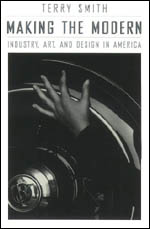
Making the Modern: Industry, Art, and Design In America


Making the Modern: Industry, Art, and Design In America (1993)
by Terry Smith

Synopsis: Smith asks: "Is there an iconography of modernity?" In investigating this, Smith explores the interconnecting forces that produced this iconography in the 1920-30s in the U.S. He states: "I explore the emergence, shaping, transformation, and then normalization of this visual order in a series of connected case studies, anything from the first Ford Motor Company plant at Highland Park, Detroit, commenced in 1910, to the New York World's Fair of 1939-40" (2). The book is divided into 4 parts: Part 1: The Modernization of Work: Detroit, 1910-1929 (River Rouge Plant and the rise of managerial observation; mass production functionalism and its influence on design; Charles Sheeler's art=functionalism can be beautiful); Part 2: Modernization and National Dissensus: Imagery of Reality in the 1930s (modernism became the style of the new corporatism; Diego Rivera's murals as depicting human side of industrial order; Frida Kahlo and gender imagery; FSA photos and the rise of "visualizing the people;" rural decline as flip-side of modernity); Part 3: Design or Revolution? Styling Modernity in the 1930s (androgynous "streamlined" shape; industrial designs hearkening a "usable future;" NY MOMA and NY World's Fair; Part 4: The Modern Effect )Modernity normalized and domesticated by 1940s, lost utopian bent due to horrors of various WWII realities). Argument is that modernity is all about severing ties with the past and creating something new. The modernist style is ultimately a triumph of corporate capitalism and the assembly-line aesthetic, and this whole thing demonstrates the interconnection of industry, New Deal agencies, art, and design. The role of visual imagery in the so-called Second Industrial Revolution ultimately "altered the way Americans saw themselves, saw others, and were seen by others" (2).

Interesting Specifics:

The 1920s-30s were especially concerned with the symbolic, and if fact many people were annoyed by modernity's "excesses, its sensationalized violence, its oversignification" (322).

Six images constantly occurred at this time: "industry and workers, cities and crowds, products and consumers" (7).

The huge River Rouge plant in Detroit was developed between 1915-25.

"Functionalism is essential to modernity" (72).

"Streamlining" was industrial design's biggest contribution, and the egg-like smooth shapes created an imagery of vague androgyny (380). [Interesting, but wasn't "modernity" all about the masculine, and the dispelling of the female? Maybe this was a way to bring the female back - after the rise of the skyscraper - in a subtle way].

Modernity lost a lot of its utopian value after WWII, probably due to the rising belief that machines would be bad too (i.e. connection between social planning and Nazism).

Modernism as triumph of corporate capitalism.

Mass production demanded an imagery which would be reflected in buildings too; it got this in post-Art Deco Moderne (92).

1914 = Ford introduces his $5 a day wages plan (idea being that workers could then buy more Ford stuff).

Model A = 1927.

Charles Sheeler was a famous photographer and painter of new industrial plants and modernist landscapes. He did much to open up the public eye to the beauty of functionalism and the idea that industrial order could be beautiful.

Photography was the dominant visual form of the 1930s.

Interacts With:
Twentieth Century Limited,

Rudeness and Civility: Manners in Nineteenth-Century Urban America


Rudeness and Civility: Manners in Nineteenth-Century Urban America (1990)
by John F. Kasson

Synopsis: This book asks: "What...was the relationship of the symbolic system of economic exchange (money) to the symbolic system of social relationships (manners) in a democracy?" (6) Kasson investigates this question by looking at "the semiotics of everyday urban life" via etiquette rules, manners, etc., to get at how such practices bear "upon key questions about the nature of social conventions, social relationships, and individual identity in the supposedly 'free' market and democratic society of the nineteenth-century metropolis" (5). Includes a discussion of pre-nineteenth-century manners (pre-"modernity,"), etiquette books and gentility, reading the city, bodily management, emotional control, table manners, and "disciplining spectacle." This book is thus basically about the "transition from a rank-structured society to an impersonal 'class' society" (33). The rise of urban center populations led to an increased sense of fragmentation and confusion and a fragmented sense of self; this resulted in a need to create some kind of system of self-protection/cohesiveness. Etiquette and manners stepped-in to provide this system of semiotic guideposts. The more chaos ensued, the more people relied on the most minute signs and symbols as a way to "read" or understand others. Clothes, silverware, manner of walking, etc. all thus became increasingly emblematic of one's character. This increased restraint, control, and decorum, came at the expense of jovial togetherness, and this increasingly passive spectator style really paved the way for modern consumer culture. Meanwhile, the city itself was read from 1) the bird's eye view of "unity and progress," and 2) the mole's eye view of vice and shadows. Overall, this book demonstrates the intense need to develop some new system of ranking, status, and order in the face of immense change and fracturing.

Interesting Specifics:

** Excellent! Focus on! Lots of good info and specifics! **

The output of etiquette manuals surged from 1870 to t.o.c.

"In the name of civility and self-discipline, the bourgeois code of manners deflected the pressures and inequities of the society back on the individual" (6).

The Civilizing Process by Norbert Elias (from about 50 years ago) was one of the first to analyze manners and etiquette and study them as history.

Many of the changes associated with modernity include: rise of the nation-state, the rise of egalitarian spirit associated with Western democracies, modern capitalist economy, the rise of relations defined by the market, the rise of Evangelicalism, and the Enlightenment focus on rationality and tolerance, etc (18).

The rise of capitalism meant that gentility was now something to be purchased.

"As late at 1820, only one person in fourteen lived in a community of more than 2,500, and only twelve cities exceeded 10,000" (71). From 1860-1910, the urban population rose from 19.8% - 45.7% of the total American population (72).

By 1920, in cities of 100,000+, 58% were foreign-born or had foreign-born parents (72).

The 1850s saw a rise of "gaslight" tours in which the bourgeois would explore the horrors of those who lived in the slums (78).

There was an increase in agoraphobia in the 19th century due to "sharp discontinuities between public and private life" (113); also connected to an increased fear of embarrassment.

Increased focus on control at this time meant that emotional outbursts - especially of anger - were shunned.

"Private tastes, rather than public actions, became the crucial indicator of sincerity and authenticity" (169). "Privacy" also became increasingly desirable. [Hmm, would be interesting to do a history of privacy in the U.S. Very connected to current issues i.e. online communities. Can love of privacy be directly linked to xenophobia? Does its rise dovetail increased immigration? This book says yes, basically, I wonder if this pattern continues through history?]

Increased specialization of flatware mirrored increased specialization in the workplace.

The 1830s marked a huge revolution in cutlery and table-manners.

Astor Place Theatre represented a new era in refinement.

The term "confidence man" was coined in 1849, and referred to a well-dressed con-artist who pretended to be an old friend and then would say "Have you confidence in me to trust me with your watch until tomorrow?" and then would of course take off with the watch (103).

The increasingly demanding social rules of the time represented an attempt to defend a "solid self" in a fragmenting world (257). Says self-help books of today are the successors of etiquette books, and are still attempts to come to terms with our fragmented world/selves.

Interacts With:

Says that although material development of society is well studied, few have paid much attention to "vital but elusive changes in cultural practices, conduct and consciousness that attended this physical transformation" (4). I guess that is his intervention then.
Paul Boyer (Urban Masses and Moral Order - in attempt to deal with/adjust to the increasingly impersonal metropolis)
Rothman, The Discovery of the Asylum (need for order in the face of chaos)
Even the books from the jeremiad section, like The Culture of Narcissism (via the increased focus on tiny individual details as key parts of one's self)
Actually, a lot of the material culture books too, as related to the use of stuff to construct one's identity and sense of self (in Kasson's book, as done with clothing and overall personal "style").
Horrible Prettiness (as related to increased passivity and bourgeois-ification of theatre; what was lost with the rise of "gentility" and "polite" spectatorship).
de Certeau (for their shared focus on the "practice of everyday life;" the small gestures).
Books that deal with the separation of home from workplace.
With its focus on the "fragmenting self," it seems that this book is really about early strains of postmodernism - but then again, postmodernism really can just be seen as an extension of modernism, but without the faith in the potential of a "grand plan."

Thursday, March 6, 2008

The Lie of the Land: Migrant Workers and the California Landscape


The Lie of the Land: Migrant Workers and the California Landscape (1996)
By Don Mitchell

Synopsis: "This book explores...the connection between the material production of landscape and the production of landscape representations, between work and the 'exercise of the imagination'..."(1). It basically seeks to "connect the shape of the CA landscape to the process of work that made it...and to wed a literature on landscape with that on labor history" (ix). One of main purposes is to interrogate the difference between representation and reality, and to put the reality of labor specifically back in to our understanding of landscape. Book begins around 1913 and travels through to 1930s through a series of vignettes and discussions of various bad working conditions, workers revolts, and the various attempts to disempower workers. Argument is that in order to make something a landscape, the work and labor behind it must be erased (and this has been particularly true of California which was created as a rural agricultural idyll). Landscape is thus inseparable from capitalist geographies based on commodifications of the land. Pain and work is hidden to produce a pretty image. California is shorthand for American Dream. Mitchell wants to reinsert workers' lives into the landscapes, highlighting their struggles. This is a Marxist labor history of California.

Interesting Specifics:

This book is essentially a labor history of the California landscape.

Follows Denis Cosgrove's line of thinking in that the history of landscape was "inseparable from the construction of capitalist geographies based on the full commodification of the land...and the subsequent need to represent ownership (or non-ownership) as a natural order of society" (4).

Says New Cultural Geographers have gotten too wrapped-up in representation and have abandoned "traditional concerns of geographers with material form" (5).

Landscape is "both a work and an erasure of work" (6).

Takes a very Marxist approach in his belief in labor as one of the defining features of humanity.

[I don't fully understand why the production of landscape should specifically hide labor more than other types of goods. Isn't the labor process hidden from the everything?? I guess this alienation is the central point of Marxism - but anything you don't make yourself is a repository of hidden labor.]

Has a great explanation of Carl Sauer and his view of landscape, that landscape "was the sum of its morphological components" - i.e. its buildings, populations, etc - and that one could understand a people by interpreting the landscape they created (24).

Says Denis Cosgrove led the shift in geography toward ideology and image (26).

Landscape as both a thing and a process/struggle (30).

Wheatland Riots of 1913 resulted when Durst farm workers rioted due to horrid living and working conditions; served to made workers visible and to bring labor problems to the public eye. Led to the formation of the California Commission of Immigration and Housing. The CCIH also held to the belief that bad environments led "triggered" innate bad genetic behavior, so they sought to "environmentally correct" for any such "outbreaks." Sought to hinder the anonymous mobility of workers (so common to the rotating crop pattern of CA) by watching them and increasing their feelings of accountability. A way to strip the power of mobility.

In CA, workers have to remain extremely militant in order not to be naturalized into the landscape.

Interacts With:
Ed Soja, Denis Cosgrove, William Cronon (Changes in the Land), "The Reinvention of Cultural Geography,"
This is a corrective both of "new cultural geography" and its focus on image, and of the "old" cultural geography of Sauer and its obsession with untheoretical morphology.

Saturday, March 1, 2008

The Production of Space

The Production of Space (1991) [1974]
By Henri Lefebvre

Synopsis: Wants to bridge the gap between mental space, real/physical space, and social space, and thus is looking for a unitary theory of mental, physical, and social space which would break down the barriers between the various kinds of spaces (21). Spatial practice, representation of space, and representational space all work to form the perceived-conceived-lived triad (40). Space is intertwined with social processes, and social space is "a materialization of 'social being'" (102). Capitalism has fucked things up because it has compartmentalized and separated the various types of spaces, following the logic of the way we separate the forms of labor and production. Dominated space = space transformed by technology and practice; appropriated space = space adapted to the needs of the groups; abstract space = reduces all space to signs and symbols, thus obscuring the reality of the space - it's a tool of domination and it's the logic of state-imposed, destructive force. Therefore, to transform society we must transform space; we must move from the production of things (capitalism), to the production of space (with a decrease in private ownership). He wants to increase a sense of holism and unity in a world that has been fractured and compartmentalized and fethishized, and wants an organic, bottom-up space of the people. This book is heavily influenced by Marxism, and today is loved by postmodern geographers like Soja and Dear. Is a critique of poststructuralism, structuralism, and logocentrism. Lefebvre was a communist and socialist and Situationist. Believes in the revolutionary potential of space.

Specifics:

Sight has nearly totally eclipsed all the other senses due to our obsession with and prioritizing of signs and language (logocentrism) (139).

"To change life we must first change space" (190).

Modern life has caused a fracturing of the body into separate, disconnected parts (205).

"...absolute space is located nowhere. It has no place because it embodies all places, and has a strictly symbolic existence" (256).

Parts of the city are sexualized, just as certain zones of leisure are sexualized (310).

The bourgeois apartment has been stripped of eros (315).

Lefebvre was part of the Situationist movement.