Showing posts with label fragmentation. Show all posts

Monday, March 24, 2008

Suburban Nation: The Rise of Sprawl and the Decline of the American Dream


Suburban Nation: The Rise of Sprawl and the Decline of the American Dream (2000)
By Andres Duany, Elizabeth Plater-Zyberk, and Jeff Speck

Synopsis: This book is basically the mission statement for New Urbanism, and is "a primer on how design can help us untangle the mess we have made and once again build and inhabit places worth caring about" (xiv). It's also a "study of two different models of urban growth: the traditional neighborhood and suburban sprawl" (3). This book is a plan for how to create good human environments, and provides an overview of the various problems of sprawl - how they were created by federal funding, how they are maintained, what sprawl looks like, and why it is bad. All of this is intermixed with elements of traditional neighborhood development in order to show a solution to the problem. The tone is definitely defensive, yet they do a good job of defending New Urbanism against critics who mock the "traditional" design. The authors basically say hey, that's what people want, and we have bigger concerns to be thinking about. Authors state that sprawl consists of 1) housing subdivisions, 2) shopping centers, 3) office parks, 4) civic institutions, 5) roadways. The problem is that sprawl separates and isolates all our vital functions, thus this book is an attempt to bring back a sense of holism. We have become fragmented and can combat this via design. The authors propose six rules of Traditional Neighborhood Design (TND): 1) 5-minute walk from edge to cente, 2) a center, 3) good street networks, 4) narrow, versatile streets, 5) mixed-use, 6) special sites for special buildings. The problem is that traditional suburbia lacks choice. We shouldn't let mistaken impulses/design of Modernist architectural solutions prevent us today from designing places to better help society. They say: "experiment on the rich, who can always move out" (53).

Interacts With:

Building Suburbia, Edge City (and Garreau claims edge cities are a way of re-integrating functions, but I'm not totally convinced), The Modern Urban Landscape
Hmm, this could be seen as yet another antidote to the fragmentation/alienation of modernity, as authors claim New Urbanism will bring a sense of re-unification and holism.

Monday, March 17, 2008

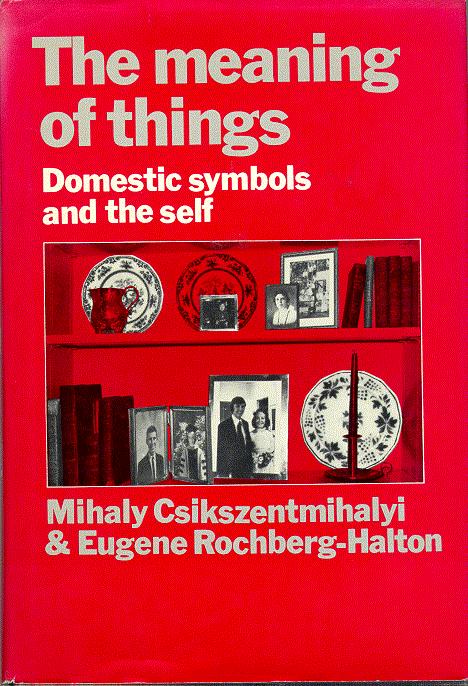
The Meaning of Things: Domestic Symbols and the Self


The Meaning of Things: Domestic Symbols and the Self (1981)
By Mihaly Csikszentmihalyi and Eugene Rochberg-Halton

Synopsis: This book is an empirical analysis of the interaction of persons and objects, which seeks to understand "how and why people in contemporary urban American relate to things in their immediate environments" (x). It also seeks to investigate the "role of objects in people's definition of who they are" (x). The methodology of this book stands out as it is a social science study done as a kind of ethnography, relying on interviews and questionnaires of family members living in Chicago. However, the book is mostly centered on theoretical and hypothetical ventures as opposed to detailed discussions of the concrete findings. One of the most striking arguments is that homes/people which lack lots of objects which tie them to other people (i.e. "this is a cup my father made" vs. "this is a comfortable chair") tend to have less ties to communities and less of a connection to causes larger than themselves. Also discovered that "warm" families inspire a sense of purpose and a drive for expertise, whereas "cold" families might leave members focused on themselves and on a search for people who will nurture them. Overall, argues that "things" are embodiments of psychic energy, and the way we equate meaning to that psychic energy relates to how we are connected to others; we have only a finite amount of psychic energy to invest. Bottom Line: "Past memories, present experiences, and future dreams of each person are inextricably linked to the objects that comprise his or her environment" (ix). The authors are also very concerned with the fracturing affect of modernity and the way it has focused so much attention on individuals. The goal should be to reach some kind of larger cosmic connection and to look always for new possibilities and growth.

Interesting Specifics:

Our relationship to objects is part of what makes us human.

"...the potential significance of things is realized in a process of actively cultivating a world of meanings, which both reflect and help create the ultimate goals of one's existence" (xi).

"The condition of community, as Hannah Arendt (1958) has said, is one of plurality, not homogeneity" (11).

"The objects of the household represent, at least potentially, the endogenous being of the owner" (17).

The possession of certain objects seems to also be "an expression of Eros in the broadest sense, a need to demonstrate that one is alive, that one matters, that one makes a difference in the world" (27). [Does this mean that you have no sense of worth if you don't have stuff?]

Durkheim claims that religion originated as a way to explain the mysterious experience of sociability, rather than inexplicable natural phenomena, i.e. the feeling of belongingness made people believe in the existence of a sacred force (33).

Durkheim used term "collective effervescence" to describe the feeling of collective exhilaration that was based on a sum greater than its parts (34).

Agrees with Marx's idea that "humans create their existence primarily through productive efforts" (92).

"For an adult, objects serve the purpose of maintaining the continuity of the self as it expands through time" (100).

Part of maturing is to shift "the center of the self from one's own actions to one's position in a network of enduring relationships" (101).

This book relies on a lot of gender stereotyping - hmm.

"...people who denied meanings to objects also lacked any close network of human relationships" (164).

Interacts With:

Books that deal with the use of objects to construct a sense of self/identity. Is not concerned with social status or class or generic "consumerism," but rather with how objects are embedded with/used to construct meaning.
Goss article
Elvis Culture
American Technological Sublime (discussion of communal experiences or things that bind people together - here through objects, there through amazing feats of technology)

The Positive Thinkers: Popular Religious Psychology from Mary Baker Eddy to Norman Vincent Peale

The Positive Thinkers: Popular Religious Psychology from Mary Baker Eddy to Norman Vincent Peale (1988 [1965])
By Donald Meyer

Synopsis: This book is an examination of popular psychology and its intersection with health, wealth, and peace of mind. It is divided into three parts: Part One: Theology as Psychology (nineteenth-century life brings increased fragmentation/compartmentalization; rise of nervousness brought on by modern life; Mary Baker Eddy's mind cure Christian Science of the 1880s as feminine way of passively making best of situation via attempt to "think the thoughts of God;" ideal was for one whole mind, a total coherence of environment, a giving up of one's self); Part Two: Peace in the System: Sociology as Psychology (rise of business culture and rise of scientific efficiency and rational order/mechanization, Taylorism, rise of managerial elite and organizational psychology; desire for happy and smoothly-running everything); Part Three: Peace in Peace: Psychology as Psychology (liberal Protestantism's loss of touch with sensuality/art; obsession with work ethic; rise of Norman Vincent Peale and mass services exalting "positive thinking"). Although the overall argument is a bit unclear, one interesting point I got out of it is that self-help culture and positive thinking are logical extensions of Protestantism's rejection of all things hierarchical (as embodied by their rejection of religious authority); the only real power lies within the individual. This might pave way for religious Right.

Interesting Specifics:

1881 = George Beard's American Nervousness

The rise of clean houses as a value represented the need for something to do (49).

"Mind cure rejected personality" (114). Personality represented fragmentation and lack of unity with the big picture.

Interacts With:

Again, one of the main points is that the modern era caused increased compartmentalization/fragmentation. Was there ever a moment in the 19th century in which people said, Fuck this holism, let's compartmentalize things!?
Also interacts with anything that focuses on the primacy of the individual. I can honestly also seem some connection to Storming Heaven with it's focus on the enlightening of the individual; really falls in line with transcendentalists as well. Hmm, if U.S. had remained homogeneous for longer, I wonder if there would have been enough momentum to create a strong community-based culture that could have withstood the individualistic competition of capitalism.. Because it really was with the influx of different kinds of people that the colonists were forced to use pluralism as their new ideal (not that pluralism is bad, but if pluralism - in the guise of acceptance of differences - had come along a little later, when a more stable community-based society had taken root, I wonder if we would be such an individual-focused society. Hmm.)
Warning: I skimmed this book pretty quickly.

Sunday, March 2, 2008

Country of Exiles: The Destruction of Place in American Life

Country of Exiles: The Destruction of Place in American Life
By William Leach (1999)

Synopsis: Asks: What is this cast landscape of the temporary doing to us, and how did it come about? Since the 1970s or so there has been an incredible weakening of place in the lives of ordinary people, and the wearing away of this sense of place-connection is dangerous. We've become too obsessed with a freedom from history and freedom from place, and we need to reestablish the importance of place in order to connect to one another and to feel whole. Includes a discussion of transportation and the flow of global goods; yuppies and businessmen have replaced bohemians and the literary "higher goal" types by constructing a bland landscape of the temporary full of extended-stay hotels; Indian casinos (ironic) and gambling places as substitutes for "real" place; universities are more linked to global flow; "new cosmopolitanism" says it's good to not be tied to anything, but Leach says this is bad. Basically, Leach is all about regrounding us in a stronger sense of place and of the local. Says that all great art has arisen from a strong sense of place. Without this, we weaken and fragment as a nation. I think this can be seen as kind of a nostalgic and conservative book - seems like it should have appeared in 1993 and not 1999.

Interacts With:
Lure of the Local, Variation on a Theme Park (not on this list), Celebration Chronicles, Geography of Nowhere (not on list)

Saturday, March 1, 2008

The Production of Space

The Production of Space (1991) [1974]
By Henri Lefebvre

Synopsis: Wants to bridge the gap between mental space, real/physical space, and social space, and thus is looking for a unitary theory of mental, physical, and social space which would break down the barriers between the various kinds of spaces (21). Spatial practice, representation of space, and representational space all work to form the perceived-conceived-lived triad (40). Space is intertwined with social processes, and social space is "a materialization of 'social being'" (102). Capitalism has fucked things up because it has compartmentalized and separated the various types of spaces, following the logic of the way we separate the forms of labor and production. Dominated space = space transformed by technology and practice; appropriated space = space adapted to the needs of the groups; abstract space = reduces all space to signs and symbols, thus obscuring the reality of the space - it's a tool of domination and it's the logic of state-imposed, destructive force. Therefore, to transform society we must transform space; we must move from the production of things (capitalism), to the production of space (with a decrease in private ownership). He wants to increase a sense of holism and unity in a world that has been fractured and compartmentalized and fethishized, and wants an organic, bottom-up space of the people. This book is heavily influenced by Marxism, and today is loved by postmodern geographers like Soja and Dear. Is a critique of poststructuralism, structuralism, and logocentrism. Lefebvre was a communist and socialist and Situationist. Believes in the revolutionary potential of space.

Specifics:

Sight has nearly totally eclipsed all the other senses due to our obsession with and prioritizing of signs and language (logocentrism) (139).

"To change life we must first change space" (190).

Modern life has caused a fracturing of the body into separate, disconnected parts (205).

"...absolute space is located nowhere. It has no place because it embodies all places, and has a strictly symbolic existence" (256).

Parts of the city are sexualized, just as certain zones of leisure are sexualized (310).

The bourgeois apartment has been stripped of eros (315).

Lefebvre was part of the Situationist movement.