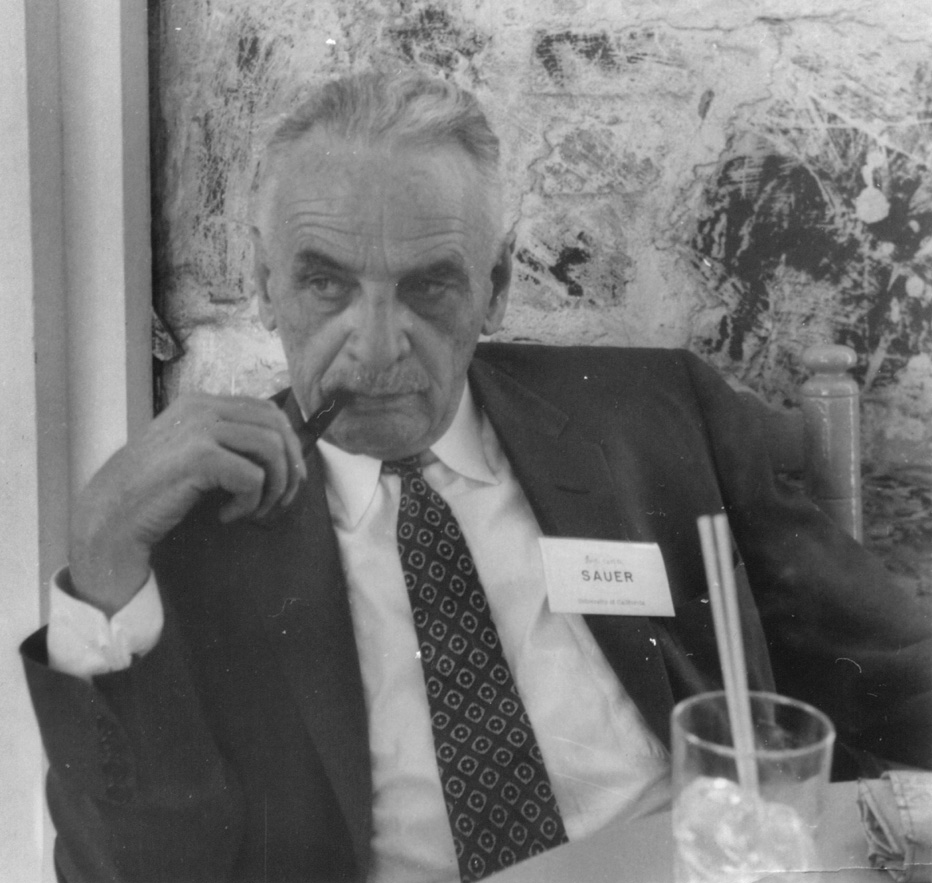
Showing posts with label carl sauer. Show all posts

Thursday, March 6, 2008

"The Morphology of Landscape"


"The Morphology of Landscape" (1925)
By Carl Sauer

Synopsis: Sauer's main purpose here is to define what geography is. In this 35 page article he discusses different aspects of geography and talks a bit about its history and various ways of looking at the field. He argues that: "Geography is based on the reality of the union of physical and cultural elements of the landscape" (325). He believes there to be a distinct separation between "natural landscape" (areas not touched by man), and "cultural landscape" (places where human influence is manifest). It's important to study the natural environment though, because it "furnishes the materials out of which man builds his culture" (340). He is primarily interested only in the materials cultures leave on the land, as cultural geography is not interested in the customs or beliefs of man, but with "man's record upon the landscape" (342). This material evidence may include housing, population density, production, and communication. Bottom line is, indeed: "Culture is the agent, the natural area is the medium, the cultural landscape is the result" (343).

Interesting Specifics:

Says geography is usually divided into three realms: 1) earth geography (physical geography); 2) life forms in connection with physical environment; 3) "study of the areal or habitat differentiation of the earth" (316).

Landscape is "an area made up of a distinct association of forms, both physical and cultural" (321).

"The content of landscape is something less than the whole of its visible constituents" (324).

Cultural geography is not interested in the customs or beliefs of man, but with "man's record upon the landscape"(342).

Branches of geography: 1) morphology, 2) comparative morphology, 3) historical geography, 4) commercial geography.

Interacts With:
[Yes - Sauer definitely seems apolitical here. Was his focus only on the material/physical artifiacts, with no concern for the underlying beliefs and ideas, his attempt to distinguish geography from cultural anthropology?]
This is considered a key article in the field.

The Lie of the Land: Migrant Workers and the California Landscape


The Lie of the Land: Migrant Workers and the California Landscape (1996)
By Don Mitchell

Synopsis: "This book explores...the connection between the material production of landscape and the production of landscape representations, between work and the 'exercise of the imagination'..."(1). It basically seeks to "connect the shape of the CA landscape to the process of work that made it...and to wed a literature on landscape with that on labor history" (ix). One of main purposes is to interrogate the difference between representation and reality, and to put the reality of labor specifically back in to our understanding of landscape. Book begins around 1913 and travels through to 1930s through a series of vignettes and discussions of various bad working conditions, workers revolts, and the various attempts to disempower workers. Argument is that in order to make something a landscape, the work and labor behind it must be erased (and this has been particularly true of California which was created as a rural agricultural idyll). Landscape is thus inseparable from capitalist geographies based on commodifications of the land. Pain and work is hidden to produce a pretty image. California is shorthand for American Dream. Mitchell wants to reinsert workers' lives into the landscapes, highlighting their struggles. This is a Marxist labor history of California.

Interesting Specifics:

This book is essentially a labor history of the California landscape.

Follows Denis Cosgrove's line of thinking in that the history of landscape was "inseparable from the construction of capitalist geographies based on the full commodification of the land...and the subsequent need to represent ownership (or non-ownership) as a natural order of society" (4).

Says New Cultural Geographers have gotten too wrapped-up in representation and have abandoned "traditional concerns of geographers with material form" (5).

Landscape is "both a work and an erasure of work" (6).

Takes a very Marxist approach in his belief in labor as one of the defining features of humanity.

[I don't fully understand why the production of landscape should specifically hide labor more than other types of goods. Isn't the labor process hidden from the everything?? I guess this alienation is the central point of Marxism - but anything you don't make yourself is a repository of hidden labor.]

Has a great explanation of Carl Sauer and his view of landscape, that landscape "was the sum of its morphological components" - i.e. its buildings, populations, etc - and that one could understand a people by interpreting the landscape they created (24).

Says Denis Cosgrove led the shift in geography toward ideology and image (26).

Landscape as both a thing and a process/struggle (30).

Wheatland Riots of 1913 resulted when Durst farm workers rioted due to horrid living and working conditions; served to made workers visible and to bring labor problems to the public eye. Led to the formation of the California Commission of Immigration and Housing. The CCIH also held to the belief that bad environments led "triggered" innate bad genetic behavior, so they sought to "environmentally correct" for any such "outbreaks." Sought to hinder the anonymous mobility of workers (so common to the rotating crop pattern of CA) by watching them and increasing their feelings of accountability. A way to strip the power of mobility.

In CA, workers have to remain extremely militant in order not to be naturalized into the landscape.

Interacts With:
Ed Soja, Denis Cosgrove, William Cronon (Changes in the Land), "The Reinvention of Cultural Geography,"
This is a corrective both of "new cultural geography" and its focus on image, and of the "old" cultural geography of Sauer and its obsession with untheoretical morphology.

Sunday, March 2, 2008

"The Reinvention of Cultural Geography"

"The Revinvention of Cultural Geography"
By Marie Price and Martin Lewis (1993)

Synopsis: This article started a series of arguments and responses, and is basically refuting the "new cultural geographers'" claim that the "old" Berkeley School style was highly problematic and that the "new" people are doing something totally different. Feels that new cultural geographers critique the Berkeley School for only being concerned with artifacts, and for being anti-ethnographical and very conservative. Price and Lewis say no, that Berkeley School is not just about artifacts. and that Sauer never really did embrace the problematic superorganic model. Denis Cosgrove responds by saying he doesn't consider himself part of any school, and maybe Price and Lewis are pissed because geography is more about the city now. James Duncan replies that Sauer must have had an implicit theory of culture, and maybe is did fit superorganic model. Peter Jackson says fuck off, there is no coherent "new cultural geography" group, so stop policing the boundaries. Bottom line question: Has cultural geography split from its Berkeley roots, or has it simply broadened?

Saturday, March 1, 2008

“The Superorganic in American Cultural Geography”

“The Superorganic in American Cultural Geography” from Annals of the Association of American Geographers

By James S. Duncan, 1980

Synopsis: Traces the evolution of and problems with the concept of the “superorganic;” interrogates the accepted view within geography that culture is “superorganic,” that is, “an entity above man, not reducible to actions by the individuals who are associated with it” (182). The superorganic is a concept that arose in the 1920s-30s with Carl Sauer and the Berkeley School geographers. That is, culture was seen as some upper layer of force/ultimate power/entity which made individuals mere passive agents. There have long been two competing ways of understanding culture: 1) individualistic – that we’re all separate entities and actors, 2) holistic – that actions occur in a large scale way via a sprit or collective consciousness (Durkheim, Hegel). Alfred Krober brought idea of cultural determinism (which is basically the superorganic idea that culture rules all) to anthropology in the 1950s. This idea of the all-powerful superorganic has been hard to prove and has been largely discredited. Duncan argues that idea of the superorganic is problematic as it ignores differences among populations, ignores agency of individuals, and ignores interaction between culture and individuals. Duncan thus argues for an interactive/reciprocal approach.

Interacts With:

Carl Sauer,

Labels: superorganic, Berkeley School, Carl Sauer