The Positive Thinkers: Popular Religious Psychology from Mary Baker Eddy to Norman Vincent Peale (1988 [1965])
By Donald Meyer
Synopsis: This book is an examination of popular psychology and its intersection with health, wealth, and peace of mind. It is divided into three parts: Part One: Theology as Psychology (nineteenth-century life brings increased fragmentation/compartmentalization; rise of nervousness brought on by modern life; Mary Baker Eddy's mind cure Christian Science of the 1880s as feminine way of passively making best of situation via attempt to "think the thoughts of God;" ideal was for one whole mind, a total coherence of environment, a giving up of one's self); Part Two: Peace in the System: Sociology as Psychology (rise of business culture and rise of scientific efficiency and rational order/mechanization, Taylorism, rise of managerial elite and organizational psychology; desire for happy and smoothly-running everything); Part Three: Peace in Peace: Psychology as Psychology (liberal Protestantism's loss of touch with sensuality/art; obsession with work ethic; rise of Norman Vincent Peale and mass services exalting "positive thinking"). Although the overall argument is a bit unclear, one interesting point I got out of it is that self-help culture and positive thinking are logical extensions of Protestantism's rejection of all things hierarchical (as embodied by their rejection of religious authority); the only real power lies within the individual. This might pave way for religious Right.
Interesting Specifics:
1881 = George Beard's American Nervousness
The rise of clean houses as a value represented the need for something to do (49).
"Mind cure rejected personality" (114). Personality represented fragmentation and lack of unity with the big picture.
Interacts With:
Again, one of the main points is that the modern era caused increased compartmentalization/fragmentation. Was there ever a moment in the 19th century in which people said, Fuck this holism, let's compartmentalize things!?
Also interacts with anything that focuses on the primacy of the individual. I can honestly also seem some connection to Storming Heaven with it's focus on the enlightening of the individual; really falls in line with transcendentalists as well. Hmm, if U.S. had remained homogeneous for longer, I wonder if there would have been enough momentum to create a strong community-based culture that could have withstood the individualistic competition of capitalism.. Because it really was with the influx of different kinds of people that the colonists were forced to use pluralism as their new ideal (not that pluralism is bad, but if pluralism - in the guise of acceptance of differences - had come along a little later, when a more stable community-based society had taken root, I wonder if we would be such an individual-focused society. Hmm.)
Warning: I skimmed this book pretty quickly.
Showing posts with label religion. Show all posts
Showing posts with label religion. Show all posts
Monday, March 17, 2008

Sunday, March 16, 2008
Fundamentalism and American Culture: The Shaping of Twentieth Century Evangelicalism, 1870-1925
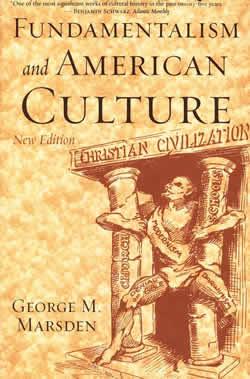
Fundamentalism and American Culture: The Shaping of Twentieth Century Evangelicalism, 1870-1925 (1980)
By George Marsden
Synopsis: This book is a general history of the rise of fundamentalism in the U.S. from 1870-1925, and demonstrates the ways that cultural, religious, and intellectual currents transformed some American evangelicalism into fundamentalism. Argues that fundamentalism was essentially antimodernist, and could flourish in the U.S. because U.S. had a long history of religiosity. Fundamentalists ultimately came to feel that their worldview dominance was slipping away and threatened by the modernist paradigm, hence they sought to hold on to their "older" style, even though they felt outnumbered. Book is divided into four parts: Part One: Before Fundamentalism (U.S. in 1870 as "Christian Nation;" appropriateness of common sense philosophy); Part One: The Shaping of a Coalition (fundamentalists a very diverse bunch; they hated social gospel because it focused on social problems rather than salvation; WWI led to the decline of evangelicalism as a dominant force); Part Three: The Crucial Years: 1917-1925 (premillenialism seen as threat to national security as they did not believe political action or human efforts could solve the world's problems; 1920s-25 = rise of anti-evolutionism; fundamentalists all about unchanging truth, whereas modernists all about truth as shaped by cultural circumstances; Scopes trial of 1925 said to cement fundamentalism in the public mind as about the clash between rural and urban, 19th century and 20th); Part Four: Interpretation (post-WWII fundamentalists seen by many as anti-intellectual and paranoid, transferring good vs. evil dichotomous thinking to many realms; f not necessarily anti-science, but rather held to a different paradigm of science, a Baconian paradigm that was all about observation = proof, conflicted with modernist paradigm). Bottom Line: Fundamentalists believed in enduring truth, and this didn't fit with modernist belief in the influence of cultural circumstances.
Interesting Specifics:
Fundamentalism was in "fierce opposition to modernist attempts to bring Christianity into line with modern thought" (4).
William Jennings Bryan led the campaign to ban the teaching of Darwinism in schools (6). 1925 law in Tennessee had banned the teaching of Darwinism in any public school.
Finds three major themes within fundamentalism: Fs sometimes identified with the establishment, and sometimes with "outsiders;" is connected to earlier traditions and embodies ambivalence over the conflict between pietist and Calvinist traditions; fs embody a tension between trust and distrust of the intellect, and generally held to "common sense" views of the world (6-8).
Questions over whether to re-shape dominant culture or to separate completely from it (124).
Anti-evolution movement really kicked-off from 1920-25.
"By modernist definition fundamentalists were those who for sociological reasons held on to the past in stubborn and irrational resistance to inevitable changes in culture" (185).
Interacts With:
End of the World As We Know It, When Time Shall Be No More,
Tuesday, March 11, 2008
Worlds of Wonder, Days of Judgment: Popular Religious Belief in Early New England
Worlds of Wonder, Days of Judgment: Popular Religious Belief in Early New England (1989)
By David Hall
Synopsis: Examines the roles and uses of religion in the everyday lives of colonial New Englanders by focusing on six main ideas: "the role of the 'folk,' the geography of religion, the relationship between the church and state, the appeal of 'radical' religion, the appeal of 'magic,' and the sway of the literary" (5). Shows that religion permeated everyday life, even for those who were not hard-core about religion. An excellent example of this is the way the Bible was used as a tool of literacy, and that the Bible and other religious books represented "a myth of freedom from the tyranny of priests" (52). Also, they looked for signs of the supernatural everywhere, the will of God as everywhere, and thus all about defeating an evil world. Argues that "Culture and religion...must be understood as partly independent of the social system in which hey occur" (245). This seems to be why so much old-time religion survived - it could elude the changes taking place in the other realms. Basically, religion was a shared rather than a divided/elite culture, power-wise (245).
Interesting Specifics:
"Literacy and religion were inseparable" (38). Books as key link between Protestant traditions and the market economy (70).
Popular literature and religion grew intertwined; tales of damnation and doom were big sellers (137).
Colonists saw "their meetinghouses and cemeteries as civil space, not sacred. The very ground was drained of ritual significance" (167).
Interacts With:
Very mild use of "resistance" in that reading books (esp. the Bible) was seen as a slight act of resistance as one could have the word directly and do what they wanted with them rather than rely on a priest or minister. In this way perhaps interacts with:
de Certeau, Beneath the American Renaissance [in its argument for the omnipresence of religion, that religion affected the popular literature of the time - even though Hall's book is dealing with an earlier period, the Renaissance book makes a similar point.]
By David Hall
Synopsis: Examines the roles and uses of religion in the everyday lives of colonial New Englanders by focusing on six main ideas: "the role of the 'folk,' the geography of religion, the relationship between the church and state, the appeal of 'radical' religion, the appeal of 'magic,' and the sway of the literary" (5). Shows that religion permeated everyday life, even for those who were not hard-core about religion. An excellent example of this is the way the Bible was used as a tool of literacy, and that the Bible and other religious books represented "a myth of freedom from the tyranny of priests" (52). Also, they looked for signs of the supernatural everywhere, the will of God as everywhere, and thus all about defeating an evil world. Argues that "Culture and religion...must be understood as partly independent of the social system in which hey occur" (245). This seems to be why so much old-time religion survived - it could elude the changes taking place in the other realms. Basically, religion was a shared rather than a divided/elite culture, power-wise (245).
Interesting Specifics:
"Literacy and religion were inseparable" (38). Books as key link between Protestant traditions and the market economy (70).
Popular literature and religion grew intertwined; tales of damnation and doom were big sellers (137).
Colonists saw "their meetinghouses and cemeteries as civil space, not sacred. The very ground was drained of ritual significance" (167).
Interacts With:
Very mild use of "resistance" in that reading books (esp. the Bible) was seen as a slight act of resistance as one could have the word directly and do what they wanted with them rather than rely on a priest or minister. In this way perhaps interacts with:
de Certeau, Beneath the American Renaissance [in its argument for the omnipresence of religion, that religion affected the popular literature of the time - even though Hall's book is dealing with an earlier period, the Renaissance book makes a similar point.]
Saturday, March 8, 2008
Awash in a Sea of Faith: Christianizing the American People
Awash in a Sea of Faith: Christianizing the American People (1990)
By Jon Butler
Synopsis: Butler argues that we should focus less on the importance of Purtinanism in shaping American religion, and more on religious eclecticism. Argues that Europe failed to transfer a coherent religious structure to the U.S., and while the U.S. Anglican movement sought to sacrilize the landscape, it didn't really have any authority. The slave trade caused a holocaust of African religious systems, and put a new spin on Christianity, ultimately making it more dichotomous. It was the massive expansion of denominations and the increase of pluralism that allowed religion to really keep going in the U.S., and not the Puritan homogeneity that others have argued. "In the post-1680 Anglican renaissance, the renewal of Christian denominational authority, the effects of the African spiritual holocaust, the shifting of the old colonial church-state relationship, and the further development of highly volatile antebellum mixtures of popular supernatural views, the American religious tradition was born and reborn" (290). The push to make the U.S. seem Christian since day one actually came later, when people were seeking a sense of authority.
Interesting Specifics:
Interacts With:
Provides somewhat of a counternarrative to books on Puritans - esp. Perry Miller (Errand into the Wilderness), and most Sacvan Berkovitch stuff. Those books put Puritanism at their center, and viewed this as the trope that would always continue through American character, whereas this book says, uh, this place has always been religiously eclectic and pluralistic.
By Jon Butler
Synopsis: Butler argues that we should focus less on the importance of Purtinanism in shaping American religion, and more on religious eclecticism. Argues that Europe failed to transfer a coherent religious structure to the U.S., and while the U.S. Anglican movement sought to sacrilize the landscape, it didn't really have any authority. The slave trade caused a holocaust of African religious systems, and put a new spin on Christianity, ultimately making it more dichotomous. It was the massive expansion of denominations and the increase of pluralism that allowed religion to really keep going in the U.S., and not the Puritan homogeneity that others have argued. "In the post-1680 Anglican renaissance, the renewal of Christian denominational authority, the effects of the African spiritual holocaust, the shifting of the old colonial church-state relationship, and the further development of highly volatile antebellum mixtures of popular supernatural views, the American religious tradition was born and reborn" (290). The push to make the U.S. seem Christian since day one actually came later, when people were seeking a sense of authority.
Interesting Specifics:
Interacts With:
Provides somewhat of a counternarrative to books on Puritans - esp. Perry Miller (Errand into the Wilderness), and most Sacvan Berkovitch stuff. Those books put Puritanism at their center, and viewed this as the trope that would always continue through American character, whereas this book says, uh, this place has always been religiously eclectic and pluralistic.
Subscribe to:
Posts (Atom)
