Showing posts with label public culture. Show all posts

Monday, March 24, 2008

Gay New York: Gender, Urban Culture, and the Making of the Gay Male World, 1890-1940


Gay New York: Gender, Urban Culture, and the Making of the Gay Male World, 1890-1940 (1994)
By George Chauncey

Synopsis: This book seeks to challenge the idea that a vibrant gay culture did not exist prior to WWII by refuting three myths: 1) the myth of isolation, 2) the myth of invisibility, 3) the myth of internalization. Chuancey does an amazingly thorough social history which reconstructs the gay subculture of 1890-1940 New York City by drawing from vice society records, police records, newspapers, and all variety of media in order to provide a rich ethnographic description of gay life. The book is divided into three parts: I: Male (Homo) Sexual Practices and Identities in the Early Twentieth Century; II: The Making of the Gay Male World; III: The Politics of Gay Culture. Chauncey provides both a portrait and analysis of the geography and symbolism of the gay male world in order to show that it was more restricted/hidden in the second third of the century. Basically, the hetero/homo binary and way of defining personhood as based on sexual object preference did not really happen until the 1930s-50s, when it replaced the then-dominant system of "fairie" vs. "normal men" which used gender behavior/identification as the main categorizer (fairies were effeminate, queers were not but liked men, "trade" were masculine and "normal" but would fuck men if approached). This shows a much more fluid range of sexual activity that was allowed to "normal"men then versus now. The book also maps the "sexual topography of the gay world," and shows the way gay culture flourished within urban spaces like streets, parks, bathhouses, boarding houses, and nightclubs. Urban space was thus essential to the development of this culture. Argues that the thriving of this culture was an act of resistance, and that gay and straight culture were defined dialectically. Gays especially flourished among the working class and ethnic/immigrant communities. Seems to show that a sort of utopia emerged during prohibition in which all classes/sexualities were thrown together in search of booze/revelry, and that the repeal of prohibition ultimately led to a rise in anti-gay policing. "Privacy could only be had in public" (198).

Interacts With:

All books that deal with public life/public space:
Sidewalk, Rudeness and Civility, Urban Masses and Moral Order, Land of Desire, Confidence Man and Painted Women, Horrible Prettiness (urban life and the particularities of urban spaces like the theatre),
Maybe de Certeau (transgressive power of small everyday acts, use of space),
Times Square Red, Times Square Blue (not on lists, but connects on urban space and sex culture, and both have a sort of utopian bent to them), Cities on a Hill,
Could maybe contrast with books that focus more on private life, like Behind the Gates, Building Suburbia, The Levittowners, Middletown, Country of Exiles, etc
For books that focus on a different, mobility-based form of public life/space:
Learning from Las Vegas, Neon Metropolis,
Flourishing of gay culture as act of resistance (there's the pop culture list tie-ine!!)
Connects with Foucault, for idea that middle class tries to control sexuality by naming it and defining it.

**Still one of the best!** Tons of good info - See full notes for more details.

Sidewalk


Sidewalk (1999)
By Mitchell Duneier

Synopsis: This book is an examination of the "invisible social structure of the sidewalk," which asks how the various street vendors, etc "live in a moral order" in "the face of exclusions and stigmatization on the basis of race and class," and wonders how "their acts intersect with a city's mechanisms to regulate its public spaces" (9). Book is based-on first-person ethnographic research conducted from 1996-97 (and a bit from 1998-99), which included participant observation on the sidewalks of certain Greenwich Village streets, following the street economy of many unhoused or marginally-housed Black street vendors who sell recycled magazines and books fished from the trash. Hakin Hasan was the main street vendor Duneier focused on. The book is divided into five sections: Part One: The Informal Life of the Sidewalk, Part Two: New uses of the Sidewalks, Part Three: The Limits of Informal Social Control; Part Four: Regulating the People Who Work the Streets, Part Five: The Construction of Decency. This book draws largely from Jane Jacobs and her discussion of the importance of "public characters." It also argues that sidewalk space allows struggling people "to engage in legal entrepreneurial activity that helps them maintain respect for others and for themselves" (179). Refers to Zimbardo's "broken windows" study and says that physical disorder shouldn't necessarily be equated with social disorder. What is the social disorder equivalent of a broken window, and how do we know when people are really broken rather than actually on their way up? Just because people are forced to do everything in public (i.e. "use the bathroom"), doesn't mean people are actually less decent than those who don't have to.

Interacts With:

Jane Jacobs, Edge City (could a community like this ever thrive in an Edge City? Don't think so. Couldn't really "thrive" in any non-walking city)
I guess a criticism of this book is that the author may have gotten too close to his subjects - i.e. was not "tough" enough on them. In that way, this book can be a good example of methodological questions, though personally I think the author was fair enough. It's true he didn't really adequately deal with gender issues, but I think that's a minor point.
Seems to say that capitalism is a noble effort. See, at least these guys were trying to act like respectable capitalists.

Saturday, March 15, 2008

Confidence Men and Painted Women: A Study of Middle-Class Culture in America, 1830-1870


Confidence Men and Painted Women: A Study of Middle-Class Culture in America, 1830-1870 (1982)
By Karen Halttunen

Synopsis: This book is "a cultural history of the sentimental ideal of social conduct" that defined the morals and behaviors of the antebellum nineteenth-century middle-class in America (xvi). Asks: Why did nineteenth-century conduct manuals, etc, see hypocrisy as such a huge threat? Analyzes etiquette books, conduct manuals, advice books, fashion magazines, and mourning books to uncover the fact that perfect sincerity and transparency of character was essential to the sentimental ideal of the time. Includes sections on fears of the "confidence man" or trickster in urban culture, the important of sincerity as a middle class ideal, sentimental culture's influence on fashion and etiquette, mourning as a huge gesture of genteel theatricality, the decline of sentimental culture and the increased acceptance of theatricality, disguise, and performance. Each of these illustrates the ways in which Americans grappled with the urbanizing mass of strangers via initial resistance to artifice, followed by the eventual acceptance of the highly stylized and individualized mode of fashion, disguise, and theatricality. Argues that an influx of young people into crowded cities led to fears that the young would be duped and corrupted (and young people were seen as metaphor for the nation at that point). The increased fluidity and amorphous liminality of people meant that you never really knew what someone was like, hence the middle class demand that one always be sincere. This elaborate performance of sentimental sincerity ultimately gave way in the 1850-70s to a gradual acceptance of disguise and theatricality. So, in the end, skillful social performance beat out transparent sincerity. The middle class preference for sincerity does live on a bit today. [Who hates sincerity? What is the benefit of insincerity? Are we talking sarcasm here, or what?] Bottom line: "...sentimental demand for sincerity was a defensive strategy against the perceived dangers of placelessness in the open society and of anonymity in the urban world of strangers" (194). Also, "it was through their definition of the problem of hypocrisy, and their efforts to resolve that problem in the sentimental cult of sincerity, that American seeking to rise in the urban world of strangers became resolutely middle-class" (197). [Hmm, try to think about how this connects with other explanations for the rise of the middle class. Does it differ?]

Interesting Specifics:

The incredibly mobile Victorian culture meant positions were no fixed, and so there was an intense fear that people were passing for something they were not (xv).

American were thrown rather suddenly into a world dominated by strangers, and this vastness led people to characterize others based on appearance, as that's all they had to go on (36). [Wow, almost identical argument that Rudeness and Civility makes]

Middle class women struggled over what kind of fashion would not obscure their sincerity and true nature (73). The clean, minimalist, body-conscious classical style gave way to the "sentimental style" in the 1830s (characterized by bonnets and plain styles/simplicity (89).

With the rise of sentimentality and the domestic ideal, the parlor became even more important, and the genteel hostess felt increasingly pressured to act as a kind of "stage manager" (105). Parlor as zone between private and public. All about the "controlled communication of proper sentiments" (121).

Mourning was a huge deal; seen as the most transparent and hence sincere/genteel sentiments.

"By the 1850s, the sentimental view that a particular dress form could embody a particular feeling or moral quality was losing credence" (158).

1860s = increased use of makeup.

1850s = increased acceptance of theatricality and with parlor stages and games like charades.

1848-1875 was an era of huge economic prosperity, creating a "bourgeois world" (187).

By the 1850s, the middle class decided to rely on a general confidence in the good intentions of others, as opposed to a strict trust in their Christian morals.

Interacts With:

Rudeness and Civility, Urban Masses and Moral Order, The Arts of Deception (basically any book about P.T. Barnum - as an example of the place of "fraud" in nineteenth-century culture), Horrible Prettiness (evolution of Americans' view of theatricality and performance)

Rudeness and Civility: Manners in Nineteenth-Century Urban America


Rudeness and Civility: Manners in Nineteenth-Century Urban America (1990)
by John F. Kasson

Synopsis: This book asks: "What...was the relationship of the symbolic system of economic exchange (money) to the symbolic system of social relationships (manners) in a democracy?" (6) Kasson investigates this question by looking at "the semiotics of everyday urban life" via etiquette rules, manners, etc., to get at how such practices bear "upon key questions about the nature of social conventions, social relationships, and individual identity in the supposedly 'free' market and democratic society of the nineteenth-century metropolis" (5). Includes a discussion of pre-nineteenth-century manners (pre-"modernity,"), etiquette books and gentility, reading the city, bodily management, emotional control, table manners, and "disciplining spectacle." This book is thus basically about the "transition from a rank-structured society to an impersonal 'class' society" (33). The rise of urban center populations led to an increased sense of fragmentation and confusion and a fragmented sense of self; this resulted in a need to create some kind of system of self-protection/cohesiveness. Etiquette and manners stepped-in to provide this system of semiotic guideposts. The more chaos ensued, the more people relied on the most minute signs and symbols as a way to "read" or understand others. Clothes, silverware, manner of walking, etc. all thus became increasingly emblematic of one's character. This increased restraint, control, and decorum, came at the expense of jovial togetherness, and this increasingly passive spectator style really paved the way for modern consumer culture. Meanwhile, the city itself was read from 1) the bird's eye view of "unity and progress," and 2) the mole's eye view of vice and shadows. Overall, this book demonstrates the intense need to develop some new system of ranking, status, and order in the face of immense change and fracturing.

Interesting Specifics:

** Excellent! Focus on! Lots of good info and specifics! **

The output of etiquette manuals surged from 1870 to t.o.c.

"In the name of civility and self-discipline, the bourgeois code of manners deflected the pressures and inequities of the society back on the individual" (6).

The Civilizing Process by Norbert Elias (from about 50 years ago) was one of the first to analyze manners and etiquette and study them as history.

Many of the changes associated with modernity include: rise of the nation-state, the rise of egalitarian spirit associated with Western democracies, modern capitalist economy, the rise of relations defined by the market, the rise of Evangelicalism, and the Enlightenment focus on rationality and tolerance, etc (18).

The rise of capitalism meant that gentility was now something to be purchased.

"As late at 1820, only one person in fourteen lived in a community of more than 2,500, and only twelve cities exceeded 10,000" (71). From 1860-1910, the urban population rose from 19.8% - 45.7% of the total American population (72).

By 1920, in cities of 100,000+, 58% were foreign-born or had foreign-born parents (72).

The 1850s saw a rise of "gaslight" tours in which the bourgeois would explore the horrors of those who lived in the slums (78).

There was an increase in agoraphobia in the 19th century due to "sharp discontinuities between public and private life" (113); also connected to an increased fear of embarrassment.

Increased focus on control at this time meant that emotional outbursts - especially of anger - were shunned.

"Private tastes, rather than public actions, became the crucial indicator of sincerity and authenticity" (169). "Privacy" also became increasingly desirable. [Hmm, would be interesting to do a history of privacy in the U.S. Very connected to current issues i.e. online communities. Can love of privacy be directly linked to xenophobia? Does its rise dovetail increased immigration? This book says yes, basically, I wonder if this pattern continues through history?]

Increased specialization of flatware mirrored increased specialization in the workplace.

The 1830s marked a huge revolution in cutlery and table-manners.

Astor Place Theatre represented a new era in refinement.

The term "confidence man" was coined in 1849, and referred to a well-dressed con-artist who pretended to be an old friend and then would say "Have you confidence in me to trust me with your watch until tomorrow?" and then would of course take off with the watch (103).

The increasingly demanding social rules of the time represented an attempt to defend a "solid self" in a fragmenting world (257). Says self-help books of today are the successors of etiquette books, and are still attempts to come to terms with our fragmented world/selves.

Interacts With:

Says that although material development of society is well studied, few have paid much attention to "vital but elusive changes in cultural practices, conduct and consciousness that attended this physical transformation" (4). I guess that is his intervention then.
Paul Boyer (Urban Masses and Moral Order - in attempt to deal with/adjust to the increasingly impersonal metropolis)
Rothman, The Discovery of the Asylum (need for order in the face of chaos)
Even the books from the jeremiad section, like The Culture of Narcissism (via the increased focus on tiny individual details as key parts of one's self)
Actually, a lot of the material culture books too, as related to the use of stuff to construct one's identity and sense of self (in Kasson's book, as done with clothing and overall personal "style").
Horrible Prettiness (as related to increased passivity and bourgeois-ification of theatre; what was lost with the rise of "gentility" and "polite" spectatorship).
de Certeau (for their shared focus on the "practice of everyday life;" the small gestures).
Books that deal with the separation of home from workplace.
With its focus on the "fragmenting self," it seems that this book is really about early strains of postmodernism - but then again, postmodernism really can just be seen as an extension of modernism, but without the faith in the potential of a "grand plan."

Wednesday, March 12, 2008

Rabelais and His World


Rabelais and His World (1984 [1968])
By Mikhail Bakhtin

Synopsis: This book is an examination of the raw, folk-culture, laughter-infused aspects of Rabelais's work, mostly centering on the carnivalesque. It focuses on 1) ritual spectacles, 2) comic verbal compositions, and 3) "billingsgate" (curses, oaths, etc.). Both Bakhtin (post-Russian Revolution) and Rabelais (Renaissance), were writing during a time of revolution and renewal. Bakhtin looks at laughter, the language of the marketplace, festive images, banquet imagery, the grotesque body,. "material bodily lower stratum," and Rabelais' image in his own time. Bakhtin argues that carnival is all about "the feast of becoming, change, and renewal" - the suspension of all hierarchies. Much of Rabelais' imagery is about the lower regions - guts, ass, stomach, etc - and bodily functions and secretions - piss, spit, shit, etc. This can be called grotesque realism, and depicts humanity as a collective body. Whereas today we have privatized and individualized bodily functions, in Rabelais' time such functions were seen as connected to society and to the cosmos; universality and a body's interaction with the outer world. Laughter was seen as essentially human, and Rabelais saw moments of festival gaiety as utopian. Essentially, these scenes are all about bodily sensation and about material sensual bodily unity (but infused with some individual distinctions).

Interesting Specifics:

Bakhtin is a philosopher and literary scholar; a theorist of the novel.

Laughter is central to Rabelais, and during the Renaissance, laughter had a positive, regenerating, creative meaning (71).

"...in the atmosphere of Mardi Gras, reveling, dancing, music were all closely combined with slaughter, dismemberment, bowels, excrement, and other images of the material bodily lower stratum" (224).

In Rabelais' day, "excrement was conceived as an essential element in the life of the body and of the earth in the struggle against death. It was part of man's vivid awareness of his materiality, of his bodily nature, closely related to the life of the earth" (224).

"The carnivalesque crowd in the marketplace or on the streets is not merely a crowd. It is the people as a whole, but organized in their own way, the way of the people. It is outside of and contrary to all existing forms of the coercive socioeconomic and political organization, which is suspended for the time of the festivity" (255).

"Death from laughter is one of the forms of gay death" (408).

Interacts With:

I love the idea of a "collective body," and bodily fluids and the lower regions as expression of connectivity and union with the cosmos - cool man!
Connects with books that stress the importance of historical context.
Connects with any books that deal with the carnivalesque and inversion of "natural" order.
In Place/Out of Place

Highbrow, Lowbrow: The Emergence of Cultural Hierarchy in America


Highbrow, Lowbrow: The Emergence of Cultural Hierarchy in America (1988)
By Lawrence W. Levine

Synopsis: Investigates how and why cultural categories come into being, and demonstrates that such categories are products of their time. Looks at the movement of Shakespeare from the realm of popular to "high" culture; the sacralization of culture, partly via the emerging distinction between unique and mass-produced objects - attack on the "inauthentic"; the establishment of rigid rankings. Focuses mostly on the examples of theatre and music. Argues that culture is highly malleable and constantly in flux, thus we should not view categories as fixed and immutable. Americans became obsessed with order and individualization from the mid-nineteenth-century on, and this led to the hushing of the communally-focused bawdy, participatory theatre audiences in favor of the individually-focused and "polite" well-mannered audience. Levine expresses a sense of loss here, over "what I perceive to have been a rich shared public culture that once characterized the United States" (9). This "individualization" was partly a result of the increased chaos and "strangeness" of the city; it made elites want to escape the jumble and either retreat to the private realm or to make everyone more like the elite. The increased separation between private and public led to decreased accessibility and increased "high-brow"-ness. We need to know that "the same forms of culture can perform markedly distinct functions in different periods or among difference groups" (240).

Interesting Specifics:

"Culture is a process, not a fixed condition; it is the product of unremitting interaction between the past and the present" (33).

The Astor Place Riot of 1849 was "a struggle for power and cultural authority within a theatrical space" (68).

Although museums, symphonic halls, and parks, etc, were public places, "they were meant to create an environment in which a person could contemplate and appreciate the society's store of great culture individually. Anything that produced a group atmosphere, a mass ethos, was culturally suspect" (164).

Olmstead's Central Park (1850s) was a "didactic space" in which users had to be taught the "correct" way to use it (186).

"Highbrow" was first used in the 1880s to describe intellectual or aesthetic superiority, and "lowbrow" first used in 1900 to denote that which was not very refined or intellectual; both terms were derived from phrenology of racial types (221-22).

The creation of categories is largely about the struggle for intellectual and cultural authority (236).

Interacts With:

Stuart Hall (Hall seems to believe that categories are fixed - i.e. there is always a "popular" category, but feels that content changes)
Horrible Prettiness (transformation of theatre, from boisterous participation to "respectable" middle-classness)
Is it Eight Hours For What We Will? Basically, any of the books that talk about the rise of the middle class and of the increased separation of work from living space, and work from leisure.
The Lonely Crowd (with the discussion about the rise of "individualism" and the move away from community-mindedness); Bowling Alone;
No Place of Grace (for its discussion of the increasing importance of the "authentic")
That book that talks about John Philip Sousa (Sousa is mentioned here as one who defended his choice to appeal to the largest array of people possible - p. 235 or so).
An attack on those who feel there is a defined and definitive "cultural canon," and who believe the content and categories of such a canon are fixed and unchanging. Basically this fits with all the other books on this list that prioritize the fluidity of culture and of cultural categories.

Saturday, March 8, 2008

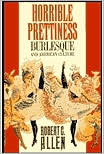
Horrible Prettiness: Burlesque and American Culture


Horrible Prettiness: Burlesque and American Culture (1991)
By Robert C. Allen

Synopsis: Asks how burlesque moved from a movement of bold female transgression to one of mere spectacle. This book traces the history of burlesque in the U.S. via a history of theatre in the 1820s-30s, the wild chaos of the "lower class" crowds with their participatory nature, to the bourgeois-ification of burlesque in the 1850-60s, to the relegation of burlesque back to the working classes 1880-1920s, to its last-ditch efforts by taking over failed legit theatres in Times Square which only brought it increased public scrutiny and the moral outrage that led to its demise in the 1930s. Burlesque is complicated and complex, and its "decline" into pure female sexual spectacle at the end partly silenced the transgressive nature it had earlier when female performers actually talked and joked too. In those days, burlesque was largely about the bottom-up inversion of social order, with a focus on the grotesque and on the mockery of the power system in place.

Interesting Specifics:

Burlesque in the U.S. was tied to the "spectacular female performer" and raised "questions about how a woman should be 'allowed' to act on state, about how femininity should and could be represented, and about the relationship of women on stage to women in the outside, 'real' world" (21).

Burlesque as monstrous, grounded in the "aesthetics of transgression, inversion, and the grotesque" (26) - in "the low other."

Ordination = "the exercise of power bound by the limits of discourse;" Insubordination = "resistance contained by discourse" (35).
Argues that struggles over burlesque are about ordination and insubordination rather than domination and resistance (35).

In the late 18th-early 19-century there were many anti-theatrical laws because theatricality was said to "disrupt" the natural order of things; that to disguise oneself and act as something else was seen as mocking nature and God's order of things (47).

The third tier of the theatre was always reserved for prostitutes and their clients.

1820s-30s, theatre gets popular in the U.S.; 1850s marked huge shift in theatre - it became increasingly "feminized" and respectable and less rowdy.

Lydia Thompson Troupe huge.

Dyed blonde hair very popular, and became popular with middle class by 1860s.

Burlesque paralleled and/or joined minstrelsy a bit in the 1870s.

Vaudeville combined most of the other show types one one stage and was appealing to the middle class (tried not to offend); 1890s. Became first place women really attended alone.

Benjamin Franklin Keith largely responsible for creating this brand of clean, family-friendly egalitarian vaudeville, and vaudeville banned any kind of humor that relied on difference (i.e. that caricatured or drew attention to otherness in any way - was the opposite of burlesque).

Burlesque was mostly an East Coast, Midwest, and San Francisco urban phenomenon.

Burlesque posters depicted huge, all-powerful women "playing" wealthy men (i.e. "gold-diggers" riding huge lobsters in mockery of the fancy lobster palaces of the day). This prob didn't offend its mostly working-class audience because the men being lampooned were wealthy men.

Cooch dance merges in 1890s (with the Chicago Expo), a direct precursor to striptease. Runways were invented in 1917, and stripping didn't become standard part until 1920s.

By the 1890s, female burlesque dancers were silent on stage, and was now just about the sexual display of their bodies.

Depression of the 1930s caused many "legit" theatres to close, allowing burlesque to move into those spaces. This however hastened its demise as those in power didn't like them and sought to shut them down.

Interacts With:
Bakhtin; Manliness and Civilization; Houdini, Tarzan, and the Perfect Man;