Showing posts with label architecture. Show all posts

Monday, March 24, 2008

Suburban Nation: The Rise of Sprawl and the Decline of the American Dream


Suburban Nation: The Rise of Sprawl and the Decline of the American Dream (2000)
By Andres Duany, Elizabeth Plater-Zyberk, and Jeff Speck

Synopsis: This book is basically the mission statement for New Urbanism, and is "a primer on how design can help us untangle the mess we have made and once again build and inhabit places worth caring about" (xiv). It's also a "study of two different models of urban growth: the traditional neighborhood and suburban sprawl" (3). This book is a plan for how to create good human environments, and provides an overview of the various problems of sprawl - how they were created by federal funding, how they are maintained, what sprawl looks like, and why it is bad. All of this is intermixed with elements of traditional neighborhood development in order to show a solution to the problem. The tone is definitely defensive, yet they do a good job of defending New Urbanism against critics who mock the "traditional" design. The authors basically say hey, that's what people want, and we have bigger concerns to be thinking about. Authors state that sprawl consists of 1) housing subdivisions, 2) shopping centers, 3) office parks, 4) civic institutions, 5) roadways. The problem is that sprawl separates and isolates all our vital functions, thus this book is an attempt to bring back a sense of holism. We have become fragmented and can combat this via design. The authors propose six rules of Traditional Neighborhood Design (TND): 1) 5-minute walk from edge to cente, 2) a center, 3) good street networks, 4) narrow, versatile streets, 5) mixed-use, 6) special sites for special buildings. The problem is that traditional suburbia lacks choice. We shouldn't let mistaken impulses/design of Modernist architectural solutions prevent us today from designing places to better help society. They say: "experiment on the rich, who can always move out" (53).

Interacts With:

Building Suburbia, Edge City (and Garreau claims edge cities are a way of re-integrating functions, but I'm not totally convinced), The Modern Urban Landscape
Hmm, this could be seen as yet another antidote to the fragmentation/alienation of modernity, as authors claim New Urbanism will bring a sense of re-unification and holism.

Friday, March 21, 2008

Learning From Las Vegas: The Forgotten Symbolism of Architectural Form


Learning From Las Vegas: The Forgotten Symbolism of Architectural Form (1977 [1972])
By Robert Venturi, Denise Scott Brown, and Steven Izenour

Synopsis: This book is about the symbolism of architectural form (rather than about Las Vegas, per se), and examines the architecture of the strip in order to counter Modernist design and to celebrate an architecture of movement. The authors analyze the layout, structure, and design of the strip, its buildings, and the significance of its architecture as symbols and signs, and as creating a zone of pleasure. The authors prefer the postmodern playful use of symbols and signs to the austere Modernist style which rejects symbol and decoration in favor of becoming the decoration itself. The megastructures of Modernism are all about imposed unity, whereas "urban sprawl" is more about variety and pluralism. While Modern architecture claims to have rejected symbolism, the modern buildings have just become symbols themselves. The authors castigate modern architecture for dismissing contemporary vernacular architecture and for dismissing the tastes of "the people" in favor of some kind of elitist "heroic" architecture. Basically, the authors reject the idea that sprawl and the strip is "visual pollution," and question its necessarily link to ecological pollution. They instead want us to see this style as just a new type of order and symbol system, an order imposed by speed, movement, and the car.

Interacts With:

Variations on a Theme Park, Jane Jacobs, City of Quartz, Baudrillard, Country of Exiles, J. B. Jackson (in his celebration of everything and of the "common" landscape), Neon Metropolis
Which book talked about the "age of hieroglyphics" (symbols)? This would definitely connect with anything that focuses on semiotics and symbols - even those books on 19th cent urban culture.
This actually has echoes of Janet's list in its desire to "take back" the architecture "of the people" and rescue it from elitist criticism.
This book supposedly launched the postmodern movement (according to Jeff's Design in the U.S.A. book)

The Social Meaning of Civic Space: Studying Political Authority Through Architecture

The Social Meaning of Civic Space: Studying Political Authority Through Architecture (1988)
By Charles T. Goodsell

Synopsis: This book is a study of the design of city-council chambers from 1865-1980s, and investigates the way changing design styles reflect changing political ideas. The author examined 75 council chambers in the U.S. and Canada, and immersed himself in the surroundings, noting details, design, layout, and the overall aura of the chambers. He breaks his observations into three categories of analysis: 1) composition of space, 2) design of semi-fixed features, 3) patterns of decoration and object display. Chapter II provides an amazing synthesis of various useful theories for studying interior space from the realms of sociology, anthropology, history, architecture, linguistics and semiotics, art history, psychology, and environmental psychology. The author identifies three major design periods: Traditional, 1865-1920 (large, boxy space and strict separation of officials and spectators - sense of imposed authority), Midcentury, 1920-1960 (smaller, longer and lower, increased sense of checks and balances, more informal "confronted architecture"), Contemporary, 1960-1980s (rounded floor plan and amphitheatre seating, curved surfaces, increased sense of joined/shared authority). These design changes express our changing notions of public authority. Goodsell sees civic space as ceremonial space, as a space of ritual made special by the use of certain symbols. He reads architecture in a holistic rather than linear way, and thus has lots of interesting things to say about perception. This is a potentially very useful book [see full notes for details].

Interacts With:

This is one of my favorite books, and got me all inspired and stuff again. Has an amazing bibliography, and seems like a great book to follow, methodologically - esp. for researching meaning of interior spaces.
Also, this book stands out because it is one of the few on this list to emphasize an increasing coming together/holism as opposed to an increased fragmentation - it's refreshing!
Semiotics
Learning From Las Vegas, Los Angeles: The Architecture of Four Ecologies, Delirious New York, Variations on a Theme Park (all these books say very different thing, it's just that they view the built environment as creating a sort of aura or possibility).

Tuesday, March 18, 2008

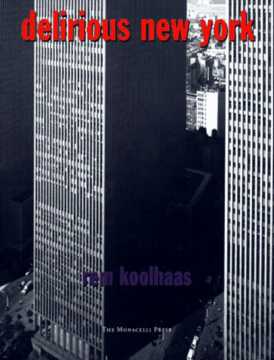
Delirious New York: A Retroactive Manifesto for Manhattan


Delirious New York: A Retroactive Manifesto for Manhattan (1994 [1978])
By Rem Koolhaas

Synopsis: This book basically sees Manhattan as a "theatre of progress" and mythical fantasy laboratory immersed in the "culture of congestion." It argues that Manhattan is a pinnacle of the artificial, and that its massive congestion is its own brand of urbanism. The book comes across as somewhat of a "fuck you" to Modernist Puritanical "order." Includes sections on "Coney Island: The Technology of the Fantastic" (theme parks of Coney Island as obsessed with the artificial; machines and lights; creation and destruction; Dreamland and its bizarre Lilliputia land of midgets and skewed morality - i.e. promiscuity, homosexulaity, nymphomania, etc.); "The Double Life of Utopia: The Skyscraper" (Manhattan skyscraper born 1900-1910 as a "utopia device for the production of unlimited numbers of virgin sites on a single metropolitan location" (83); tall buildings as laboratory islands and entire own world, i.e. Waldorf Astoria; Harvey Wiley Corbett and his plan for an ultra-ultra dense Manhattan; "the hotel" as a plot in itself - providing world of change encounters); "How Perfect Can Perfect Be: The Creation of Rockefeller Center" (yet another island; Roxy Theatre as producing "synthetic sunrise" (which Koolhaas loves); all as "anti-authentic;" Rockettes as a new breed of pure abstraction); "Europeans: Biuer! Dali and Le Corbusier Conquer NY" (Salvador Dali's "paranoid critical method; Corbu's attempt to pretend NY doesn't really exist so he can "create" his radiant city; Koolhaas hates Corbu as his plans drain NY of its lifeblood and congestion). This book is basically a tribute to the crazy chaos of New York.

Interesting Specifics:

Dreamland was designed as a place "to appeal to all classes" (45). 1911 = Dreamland burns down.

At this time, Modernism was all about an absence of color, and Dreamland was all white (46).

The Waldorf-Astoria was an attempt at the greatest hotel of all time - massive and all-encompassing (145). It was the focus of many 1930s Hollywood films - hotel is a plot, a world presenting myriad opportunities for random encounters at any time (148-50).

In reference to the Rockettes, I think: "Beyond sex, strictly through the effects of architecture, the virgins reproduce themselves" (217).

Interacts With:

This is a great contrast to Nature's Metropolis as Koolhaas views the city as totally unnatural and never even ventures that it could be related to nature at all.
Amusing the Million
I guess it's kind of a positive postmodernism is cool thing? Though don't know if you could really call NY urbanism "postmodern." I should maybe check again to see how "pomo" positive this guy really is - or even how pro-NYC he is. It's kind of a passionate, stream-of-consciousness kinda thing. Fun!

Sunday, March 16, 2008

Los Angeles: The Architecture of Four Ecologies


Los Angeles: The Architecture of Four Ecologies (1971)
By Reyner Banham

Synopsis: Banham aims to "present the architecture...within a topographical and historical context of the total artifact that constitutes Great Los Angeles, because it is this double context that binds the polymorphous architectures into a comprehensive unity that cannot often be discerned by comparing monument with monument out of context" (23). Book is broken down into "four ecologies:" Ecology I: Surfurbia (beaches as biggest thing to envy; focus on indoor/outdoor living; spanish colonial revival; freeways); Ecology II: Foothills (fancy suburbs; mobility-focused architecture; landscape of "do your own thing;" city obsessed with transportation); Ecology III: The Plains of Id (flatlands as "heartland;" Schindler, Neutra, and the International Style ; plain cubes; people should accept the non-existent downtown for what it is: dead); Ecology IV: Autopia (freeway as central feature; L.A. as embodiment of bourgeois good life of urban homestead; people unfairly castigate L.A. when they should examine all the fabulous architecture there and think about why L.A. has inspired so much of that). Argues that "the language of design, architecture and urbanism is Los Angeles is the language of movement" (23). Southern California is an ecological wonder and the land of "perpetual spring." People are too hard on L.A., and should not fault it for being different; it really embodies many ingrained American values - especially the desire for freedom of movement.

Interesting Specifics:

L.A. architecture is emblematic of that particular American phenomenon:"...the convulsions in building style that follow when traditional cultural and social restraints have been overthrown and replaced by the preferences of a mobile, affluent, consumer-oriented society, in which 'cultural values' and ancient symbols are handled primarily as methods of claiming or establishing status" (124).

"...Los Angeles is...the home of the most extravagant myths of private gratification and self-realization, institutionalized now in the doctrine of 'doing your own thing'" (124).

L.A. is steeped in the "fantasy of innocence" (129).

"So recreational living tends to become another synonym for the social 'turf' system of closed communities; systematic planning remains the creation of privileged enclaves" (145).

Anyone who cares about architecture simply cannot ignore Los Angeles - and to do so would be a huge and elitist blunder.

Interacts With:

This is really an L.A. apologist book. Says hey, it's not so bad, it's just different - you have to look at all its different parts to understand it.

City of Quartz, Variations on a Theme Park, Neon Metropolis, Country of Exiles (these are all negative takes on L.A. and L.A.-ish phenom, though Mike Davis straddles line between pos and neg); Holyland (not on any list), Learning from Las Vegas (for a positive attempt to understand car-centric landscapes), Golden State, Golden Youth


Saturday, March 15, 2008

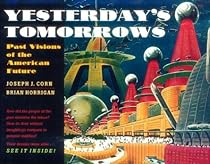
Yesterday's Tomorrows: Past Visions of the American Future


Yesterday's Tomorrows: Past Visions of the American Future (1984)
By Joseph J. Corn and Brian Horrigan

Synopsis: This book examines past American visions of the future in order to show how those visions shed light on the values of their times; sees future visions as cultural artifacts. This is a coffee-table type book that sprang from a Smithsonian exhibit, and includes chapters on 1) Finding the Future (beginning with late 19th century - explores science fiction and utopian fiction, pulp magazines, futurism as linked to commodities, the rise of sci-fi tv and film); 2) The Community of Tomorrow (Progressive vision, "white city," City Beautiful, Garden City, 1939 World's Fair, FLW, Greenbelt Cities, Buckminster Fuller[city of the future as requiring blank slate]); 3) The Home of Tomorrow (rise of apartment homes yet obsession with futuristic single family homes, the rising appeal of mass-produced housing, streamlined style, high-tech kitchens); 4) Transportation of Tomorrow (rise of transportation innovation from 1880-1905, cars and planes, hopes and fears of nuclear power); 5) Weapons and Warfare of Tomorrow (WWI = weapons and electricity, 1920-30s = airplanes and war, WWII = massively destructive potential of weaponry). Authors argue that the future in the U.S. has increasingly moved from communitarian/spiritual utopias of the early days, to a "secular city of the capitalist future" in which most of the emphasis fell on the look of the future rather than the social plan. Argues also that American have long held a strong belief in "technological utopianism" - that "material means can ameliorate social problems and even perfect society" (xii). "The belief that machines, not politics, produce beneficial social change diverts people from initiating reforms that would truly distinguish the future from the present or the past" (xiii).

Interesting Specifics:

Utopian fiction was hugely popular in U.S. from 1880-90s.

We generally look at the future in terms of commodities (11).

1929 = Buckminster Fuller's Dymaxion House.

1938 = Orson Wells' War of the Worlds radio show.

1952 = First Hydrogen Bomb

1957 = First nuclear power plant in the U.S.; Shippingport, PA.

Interacts With:

Maybe other books about World's Fairs or different vision of the future.
David Wojcik
Rem Koolhaas (for the different proposals for future cities).

Thursday, March 6, 2008

The Celebration Chronicles: Life, Liberty, and the Pursuit of Property Values in Disney's Brave New Town


The Celebration Chronicles: Life, Liberty, and the Pursuit of Property Values in Disney's Brave New Town (1999)
By Andrew Ross

Synopsis: Andrew Ross spent one year living and doing participant observation in Celebration, Florida in order to see what it was like to live there - to discover its problems, its residents, the general attitude there, its issues, etc. Though it's very American in its desire to start from scratch and create something new, Celebration has its good and bad points, like all other towns. Though Celebration's marketers rely heavily on allusions to "childhood innocence" and "the good old days," it is a high tech place with a progressive alternative public school that parents tend to squabble over (Ross claims it's because they viewed the school as a consumer product that may not have been delivering results). Ross also points out that many residents were angry about the "shoddy construction" of Celebration's homes. Basically, asks a few questions: Can a corporation provide a public realm? is this just another privatopia? What about taste/aesthetics? Is it the shape itself of New Urbanism that increases a sense of community, or is it the people who seek that out?

Interesting Specifics:

Celebration is all about the "iconography of innocence" (16).

Contains an interesting section on model home interiors and market research (pp. 25-27).

Attacks Kunstler for his "crotchety version of orderly civic conduct" (76) and says it is "stuffed with contempt for lower-middle-class taste" (76).

New Urbanism clings hard to the belief that "the design of a physical environment has a fundamental impact upon social behavior" (78).

"The closer people live to one another the more likely they are to guard their privacy" (85).

Pattern books contain all the design a developer could use.

Public schools have long been seen as "the unique source of American national unity" (138).

Spends a lot of time examining Celebration's school, which can be seen as its one utopian element - and which has been, ironically, the source of most of the city's controversy.

Says that the trend of saying "it's not natural to notice skin color" is just the latest from of racism (270).

There's a seedy tourist attraction called "Old Town" right near Celebration.

Interacts With:
Behind the Gates, Brave New Neighborhoods, Building Suburbia

Monday, March 3, 2008

Building Suburbia: Green Fields And Urban Growth, 1820-2000

Building Suburbia: Green Fields And Urban Growth, 1820-2000 (2003)
By Dolores Hayden

Synopsis: This book is a history of suburban development from 1820-2000, with the theme that the suburbs represent the triple dream of "house plus land [nature] plus community" (8). The book looks at what she deems to be seven historic patterns of suburban neighborhood: 1) Borderlands (1820s - ; picturesque style ala Andrew Jackson Downing with a focus on landscape and lots of plants, flowers; Catherine Beecher and the idealization of women's sphere and sacred domesticity); 2) Picturesque Enclaves (1850s - ; "were the most important secular manifestations of a wider communitarian movement whose adherents believed that building a model community in a natural setting led the reform of society" (45); Llewellyn Park, NJ (1857), Riverside, IL (1869, but Frederick Law Olmstead); 3) Streetcar Buildouts (1870s-1910s; followed transport lines yet still close to center; big push for homeownership); 4) Mail-Order and Self-Built Suburbs (1910-; rise of pre-cut catalogue houses ala Sears; increased zoning and planning; federal involvement in the 1930s); 5) Sitcom Suburbs (1940s - ; FHA loans; racism and sexism; Levittown and Lakewood; cult of consumption and domesticity); 6) Edge Nodes (1950s - ; rise of strip malls and car-centric living; Interstate Highway Act; rise of malls; Title VII New Towns like Columbia, MD; chain stores and big boxes; 7) Rural Fringes (rise of telecommuting and the dispersal of homes; rise of "valhallas" - fancy nature-infused spots). Ends with a brief discussion of nostalgia and futurism as embodied by Seaside and Celebration (nostalgia), and "smart houses" and digital houses (futurism) in which technology will play an even bigger role. We should value older suburbs as well, and the search for more democratic forms in the future will be political.

Interacts With:
The Celebration Chronicles, The Modern Urban Landscape, Brave New Neighborhoods, Behind the Gates,
Is a very straightforward and non-political survey of suburban history in the same spirit as Relph's Modern Urban Landscape. Hayden of course does have a little bit of preservationist's bent, esp. at the end.

The Modern Urban Landscape

The Modern Urban Landscape (1987)
By Edward Relph

Synopsis: The purpose of this book is "to give an account of the development of the appearance of cities over the last 100 years in order to explain how they have come to look as they do" (2). Hence, the focus of his book is on appearance. Four factors account for the look of twentieth-century cities: 1) architecture, 2) technological innovations, 3) planning, and 4) social developments (7). Begins by detailing the rise of electricity and new technologies in the late 19th-century and the utopian hopes they inspired; moves to various planning movements such as the City Beautiful Movement and Garden City Movement, and the rise of planning and zoning which led cities to be seen as "efficient factories;" the First Machine Age (1900-40s) and the impact of the car on the landscape; Modernism and the International Style (1920s); the Second Machine Age (1940s-50s) and the rise of nuclear imagery; the rise of postwar planning which sought the separation of functions; corporatization/commodification of cities via themed spaces, etc.; late-Modernist glass boxes; the rise of postmodern architecture and urban design. This book is not argument-driven, but rather is explanatory. A simple overview of basic urban design.

Interacts With:
Is ultra-mild, non-Marxist. More explanatory than anything else.
For a more politicized take on some aspects, see:
Landscapes of Power, Brave New Neighborhoods
Building Suburbia