Showing posts with label grotesque. Show all posts

Wednesday, March 12, 2008

Rabelais and His World


Rabelais and His World (1984 [1968])
By Mikhail Bakhtin

Synopsis: This book is an examination of the raw, folk-culture, laughter-infused aspects of Rabelais's work, mostly centering on the carnivalesque. It focuses on 1) ritual spectacles, 2) comic verbal compositions, and 3) "billingsgate" (curses, oaths, etc.). Both Bakhtin (post-Russian Revolution) and Rabelais (Renaissance), were writing during a time of revolution and renewal. Bakhtin looks at laughter, the language of the marketplace, festive images, banquet imagery, the grotesque body,. "material bodily lower stratum," and Rabelais' image in his own time. Bakhtin argues that carnival is all about "the feast of becoming, change, and renewal" - the suspension of all hierarchies. Much of Rabelais' imagery is about the lower regions - guts, ass, stomach, etc - and bodily functions and secretions - piss, spit, shit, etc. This can be called grotesque realism, and depicts humanity as a collective body. Whereas today we have privatized and individualized bodily functions, in Rabelais' time such functions were seen as connected to society and to the cosmos; universality and a body's interaction with the outer world. Laughter was seen as essentially human, and Rabelais saw moments of festival gaiety as utopian. Essentially, these scenes are all about bodily sensation and about material sensual bodily unity (but infused with some individual distinctions).

Interesting Specifics:

Bakhtin is a philosopher and literary scholar; a theorist of the novel.

Laughter is central to Rabelais, and during the Renaissance, laughter had a positive, regenerating, creative meaning (71).

"...in the atmosphere of Mardi Gras, reveling, dancing, music were all closely combined with slaughter, dismemberment, bowels, excrement, and other images of the material bodily lower stratum" (224).

In Rabelais' day, "excrement was conceived as an essential element in the life of the body and of the earth in the struggle against death. It was part of man's vivid awareness of his materiality, of his bodily nature, closely related to the life of the earth" (224).

"The carnivalesque crowd in the marketplace or on the streets is not merely a crowd. It is the people as a whole, but organized in their own way, the way of the people. It is outside of and contrary to all existing forms of the coercive socioeconomic and political organization, which is suspended for the time of the festivity" (255).

"Death from laughter is one of the forms of gay death" (408).

Interacts With:

I love the idea of a "collective body," and bodily fluids and the lower regions as expression of connectivity and union with the cosmos - cool man!
Connects with books that stress the importance of historical context.
Connects with any books that deal with the carnivalesque and inversion of "natural" order.
In Place/Out of Place

Saturday, March 8, 2008

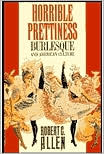
Horrible Prettiness: Burlesque and American Culture


Horrible Prettiness: Burlesque and American Culture (1991)
By Robert C. Allen

Synopsis: Asks how burlesque moved from a movement of bold female transgression to one of mere spectacle. This book traces the history of burlesque in the U.S. via a history of theatre in the 1820s-30s, the wild chaos of the "lower class" crowds with their participatory nature, to the bourgeois-ification of burlesque in the 1850-60s, to the relegation of burlesque back to the working classes 1880-1920s, to its last-ditch efforts by taking over failed legit theatres in Times Square which only brought it increased public scrutiny and the moral outrage that led to its demise in the 1930s. Burlesque is complicated and complex, and its "decline" into pure female sexual spectacle at the end partly silenced the transgressive nature it had earlier when female performers actually talked and joked too. In those days, burlesque was largely about the bottom-up inversion of social order, with a focus on the grotesque and on the mockery of the power system in place.

Interesting Specifics:

Burlesque in the U.S. was tied to the "spectacular female performer" and raised "questions about how a woman should be 'allowed' to act on state, about how femininity should and could be represented, and about the relationship of women on stage to women in the outside, 'real' world" (21).

Burlesque as monstrous, grounded in the "aesthetics of transgression, inversion, and the grotesque" (26) - in "the low other."

Ordination = "the exercise of power bound by the limits of discourse;" Insubordination = "resistance contained by discourse" (35).
Argues that struggles over burlesque are about ordination and insubordination rather than domination and resistance (35).

In the late 18th-early 19-century there were many anti-theatrical laws because theatricality was said to "disrupt" the natural order of things; that to disguise oneself and act as something else was seen as mocking nature and God's order of things (47).

The third tier of the theatre was always reserved for prostitutes and their clients.

1820s-30s, theatre gets popular in the U.S.; 1850s marked huge shift in theatre - it became increasingly "feminized" and respectable and less rowdy.

Lydia Thompson Troupe huge.

Dyed blonde hair very popular, and became popular with middle class by 1860s.

Burlesque paralleled and/or joined minstrelsy a bit in the 1870s.

Vaudeville combined most of the other show types one one stage and was appealing to the middle class (tried not to offend); 1890s. Became first place women really attended alone.

Benjamin Franklin Keith largely responsible for creating this brand of clean, family-friendly egalitarian vaudeville, and vaudeville banned any kind of humor that relied on difference (i.e. that caricatured or drew attention to otherness in any way - was the opposite of burlesque).

Burlesque was mostly an East Coast, Midwest, and San Francisco urban phenomenon.

Burlesque posters depicted huge, all-powerful women "playing" wealthy men (i.e. "gold-diggers" riding huge lobsters in mockery of the fancy lobster palaces of the day). This prob didn't offend its mostly working-class audience because the men being lampooned were wealthy men.

Cooch dance merges in 1890s (with the Chicago Expo), a direct precursor to striptease. Runways were invented in 1917, and stripping didn't become standard part until 1920s.

By the 1890s, female burlesque dancers were silent on stage, and was now just about the sexual display of their bodies.

Depression of the 1930s caused many "legit" theatres to close, allowing burlesque to move into those spaces. This however hastened its demise as those in power didn't like them and sought to shut them down.

Interacts With:
Bakhtin; Manliness and Civilization; Houdini, Tarzan, and the Perfect Man;