Showing posts with label individualism. Show all posts

Friday, March 21, 2008

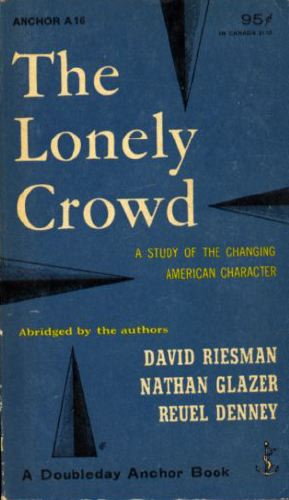
The Lonely Crowd: A Study of the Changing American Character


The Lonely Crowd: A Study of the Changing American Character (1953) [1950])
By David Riesman, Nathan Glazer, and Revel Denney

Synopsis: This book is about "social character and about the differences in social character between men of different regions, eras, and groups" (page?). It is concerned largely with the decline of the nineteenth-century style of inner-directed character and the rise of the new outer-directed type. The book is based on interview and community studies, poll data, histories, biographies, and novels, and is basically a study of broad trends as seen by the authors. Argues that there are three types of characters: 1) tradition-directed (shaped by massive social forces and tradition), 2) inner-directed (shaped mostly by family and has more options; strong sense of autonomy); 3) other-directed (gets moral code from many different sources, so has diffuse and changeable sense of morality; will go with the flow and has more shallow existence). Authors argue that the move towards other-direction is mostly due to capitalism, industrialism, and urbanization - and the dominance of consumption over production. Another big thread of this book is that we don't have enough serious play going on, and that we need avocational counselors to teach people how to play better (342). They also want cities to be more than mere sites of work. The bottom line is that a true sense of meaning and interestingness can only derive from a deep sense of individual autonomy - we need to be more like ourselves instead of like other people. "The promising alternative to other-direction...is not inner-direction, but autonomy" (188). [How Emersonian!] The last line of the book is interesting: "The idea that men are created free and equal is both true and misleading: men are created different; they lose their social freedom and their individual autonomy in seeking to become like each other" (349). [That's so American!]

Interacts With:

Bowling Alone (in its focus on broad trends over time), Culture of Narcissism, Habits of the Heart, Middletown and Middletown in Transition, The Levittowners,
Actually, I see this now as a book about the transition from modernism to postmodernism. It's not that the other-directed person has no sense of self, but rather that his sense of self is multivalent and more pluralistic/complex/multifaceted.
Actually, also interacts with Urban Masses and Moral Order, Rudeness and Civility, and all those other books about nineteenth-century urbanism and the impact this had on the senses and on one's sense of self. An assault on the senses leads to increasingly scattered and perhaps superficial attempts to decipher meaning from the vast melange of signs all around oneself. The outer-directed person today seems to be too fluid and transient to really experience anything in a deeply meaningful way - hence his inability to really "play" well.

Monday, March 17, 2008

The Positive Thinkers: Popular Religious Psychology from Mary Baker Eddy to Norman Vincent Peale

The Positive Thinkers: Popular Religious Psychology from Mary Baker Eddy to Norman Vincent Peale (1988 [1965])
By Donald Meyer

Synopsis: This book is an examination of popular psychology and its intersection with health, wealth, and peace of mind. It is divided into three parts: Part One: Theology as Psychology (nineteenth-century life brings increased fragmentation/compartmentalization; rise of nervousness brought on by modern life; Mary Baker Eddy's mind cure Christian Science of the 1880s as feminine way of passively making best of situation via attempt to "think the thoughts of God;" ideal was for one whole mind, a total coherence of environment, a giving up of one's self); Part Two: Peace in the System: Sociology as Psychology (rise of business culture and rise of scientific efficiency and rational order/mechanization, Taylorism, rise of managerial elite and organizational psychology; desire for happy and smoothly-running everything); Part Three: Peace in Peace: Psychology as Psychology (liberal Protestantism's loss of touch with sensuality/art; obsession with work ethic; rise of Norman Vincent Peale and mass services exalting "positive thinking"). Although the overall argument is a bit unclear, one interesting point I got out of it is that self-help culture and positive thinking are logical extensions of Protestantism's rejection of all things hierarchical (as embodied by their rejection of religious authority); the only real power lies within the individual. This might pave way for religious Right.

Interesting Specifics:

1881 = George Beard's American Nervousness

The rise of clean houses as a value represented the need for something to do (49).

"Mind cure rejected personality" (114). Personality represented fragmentation and lack of unity with the big picture.

Interacts With:

Again, one of the main points is that the modern era caused increased compartmentalization/fragmentation. Was there ever a moment in the 19th century in which people said, Fuck this holism, let's compartmentalize things!?
Also interacts with anything that focuses on the primacy of the individual. I can honestly also seem some connection to Storming Heaven with it's focus on the enlightening of the individual; really falls in line with transcendentalists as well. Hmm, if U.S. had remained homogeneous for longer, I wonder if there would have been enough momentum to create a strong community-based culture that could have withstood the individualistic competition of capitalism.. Because it really was with the influx of different kinds of people that the colonists were forced to use pluralism as their new ideal (not that pluralism is bad, but if pluralism - in the guise of acceptance of differences - had come along a little later, when a more stable community-based society had taken root, I wonder if we would be such an individual-focused society. Hmm.)
Warning: I skimmed this book pretty quickly.

Wednesday, March 12, 2008

Highbrow, Lowbrow: The Emergence of Cultural Hierarchy in America


Highbrow, Lowbrow: The Emergence of Cultural Hierarchy in America (1988)
By Lawrence W. Levine

Synopsis: Investigates how and why cultural categories come into being, and demonstrates that such categories are products of their time. Looks at the movement of Shakespeare from the realm of popular to "high" culture; the sacralization of culture, partly via the emerging distinction between unique and mass-produced objects - attack on the "inauthentic"; the establishment of rigid rankings. Focuses mostly on the examples of theatre and music. Argues that culture is highly malleable and constantly in flux, thus we should not view categories as fixed and immutable. Americans became obsessed with order and individualization from the mid-nineteenth-century on, and this led to the hushing of the communally-focused bawdy, participatory theatre audiences in favor of the individually-focused and "polite" well-mannered audience. Levine expresses a sense of loss here, over "what I perceive to have been a rich shared public culture that once characterized the United States" (9). This "individualization" was partly a result of the increased chaos and "strangeness" of the city; it made elites want to escape the jumble and either retreat to the private realm or to make everyone more like the elite. The increased separation between private and public led to decreased accessibility and increased "high-brow"-ness. We need to know that "the same forms of culture can perform markedly distinct functions in different periods or among difference groups" (240).

Interesting Specifics:

"Culture is a process, not a fixed condition; it is the product of unremitting interaction between the past and the present" (33).

The Astor Place Riot of 1849 was "a struggle for power and cultural authority within a theatrical space" (68).

Although museums, symphonic halls, and parks, etc, were public places, "they were meant to create an environment in which a person could contemplate and appreciate the society's store of great culture individually. Anything that produced a group atmosphere, a mass ethos, was culturally suspect" (164).

Olmstead's Central Park (1850s) was a "didactic space" in which users had to be taught the "correct" way to use it (186).

"Highbrow" was first used in the 1880s to describe intellectual or aesthetic superiority, and "lowbrow" first used in 1900 to denote that which was not very refined or intellectual; both terms were derived from phrenology of racial types (221-22).

The creation of categories is largely about the struggle for intellectual and cultural authority (236).

Interacts With:

Stuart Hall (Hall seems to believe that categories are fixed - i.e. there is always a "popular" category, but feels that content changes)
Horrible Prettiness (transformation of theatre, from boisterous participation to "respectable" middle-classness)
Is it Eight Hours For What We Will? Basically, any of the books that talk about the rise of the middle class and of the increased separation of work from living space, and work from leisure.
The Lonely Crowd (with the discussion about the rise of "individualism" and the move away from community-mindedness); Bowling Alone;
No Place of Grace (for its discussion of the increasing importance of the "authentic")
That book that talks about John Philip Sousa (Sousa is mentioned here as one who defended his choice to appeal to the largest array of people possible - p. 235 or so).
An attack on those who feel there is a defined and definitive "cultural canon," and who believe the content and categories of such a canon are fixed and unchanging. Basically this fits with all the other books on this list that prioritize the fluidity of culture and of cultural categories.