Place: A Short Introduction (2004)
By Tim Cresswell
Synopsis: The goal of this book is "to scrutinize the concept of place and its centrality to both geography and everyday life," (1) and does this by showing place as a process more than as a static thing. The book then delves into an overview of the major conceptualizations of place, especially as seen through the lens of geography: 1) Defining Place (three human geography concepts: space, place, and landscape - landscape as a way of looking and being outside, while place is a way of being, and being inside; "place" as a concept wasn't big until the 1970s with the rise of humanistic geography founded on phenomenology); 2) The Geneology of Place (place as both object and process; Carl Sauer and the way mid-century geographers focus on "culture areas" and the way groups impact natural habitats; place as in flux and in motion, and some are bothered by that; three ways place is approached: descriptive, social constructionist [how do underlying power forces influence it], and phenomenological [place as connected to ways of being human; the most humanistic geography approach]); 3) Reading 'A Global Sense of Place' (idea that globalization bothered people's sense that place should be about rootedness and authenticity; Doreen Massey argues instead for new conceptualization of place in which it is open and hybrid and flowing - place as process); 4) Working With Place (what to focus on when doing place - such as memory, place identity, what's considered in/out of place). This book is more a synthesis of others' work as opposed to an argument-driven work, but he seems to be arguing for the primacy of "place as process." Says political geographer John Agnew defines place as a meaningful location via 1) location (fixed objective coordinates), 2) locale ("material setting for social relations"), and 3) sense of place ("subjective emotional attachment people have to place") (7). "Place, at a basic level, is space invested with meaning in the context of power" (12).
Interacts With:
All books obsessed with the importance of place/geography:
American Empire (Neil Smith),
Place as a process/a fluid thing, and not as a static entity. This idea connects to regionalism too:
The Middle West (James Shortridge - our concept/mapping of the midwest changes over time to meet present needs, and we keep shifting our definitional location of the midwest to the most rural parts; this shows that we have some kind of need as Americans to have a "heartland" that is rural and agricultural, even if this is no longer the dominant reality of the midwest).
Even books about presentist uses of the past, such as Shadowed Ground
This idea of the fluctuation and fluidity is central to all of the lists; the one thing that's constant in history in change - and we should embrace this. Change is what allows forces and entities to remain alive, relevant, and meaningful.
Doreen Massey with her idea that place is a process [what exactly does that mean though? Just that the realities and identities of place are always in motion?] David Harvey also sees place as a process.
Apparently this book has a great reference/resource section as the final chapter as well.
**This book is really useful - buy!!** Has lots of good definitions.
Idea that we can't exist without place, we need to construct it in order to be human (33).
Showing posts with label landscape. Show all posts
Showing posts with label landscape. Show all posts
Monday, March 24, 2008

Shadowed Ground: America's Landscapes of Violence and Tragedy

Shadowed Ground: America's Landscapes of Violence and Tragedy (1997)
By Kenneth E. Foote
Synopsis: This book investigates the ways Americans deal with violent/tragic events, and the way they choose to remember or forget them. The book quotes Lowenthal in saying "memory not only conserves the past but adjusts recall to current needs" (5). Asks: How do Americans view and interpret the past? In order to get to this, the author examines site of such turmoils as war, mass murders, political assassinations, violent labor and race riots, transportation accidents, fires, floods, and explosions. The book argues that there are four ways tragedies are dealt with: 1) sanctification ( events hold lasting positive meaning that people want to remember - i.e. heroism or great sacrifice - often marked by a memorial or monument, a "sacred place"); (2) designation (sites marked bu not sanctified, may lack "heroic" qualities; a kind of limbo/transitional position; Lorraine Motel - MLK site, later sanctified); 3) rectification ("the process through which a tragedy site is put right and used again;" is what happens to most sites of violence - i.e. murders, plane crashes); 4) obliteration (actively effacing all evidence to cover up or remove from view due to high sense of shame). Basically demonstrates that there is a continuous struggle over meaning and over ways of remembering; some mark ways for communities to come together and heal, some are ways of remembering change and changing needs of the time. What we choose not to remember or mark is just as important as what we do.
Interacts With:
Lowenthal,
Any works that deal with the contested nature of landscape, and/or that show present concerns can influence the way the past is dealt with.
Friday, March 7, 2008
"The Place of Landscape: A Conceptual Framework for Interpreting the American Scene"

"The Place of Landscape: A Conceptual Framework for Interpreting the American Scene" (Dec 1997)
By Richard Schein (from Annals)
Synopsis: Although there is much ongoing debate as to what a cultural landscape is, all definitions have two major points: 1) they look at cultural landscape as a material object, and 2) "all are cohered by a loosely defined set of commonly accepted key works" (661). Basically, "the cultural landscape is produced and is ultimately implicated in the ongoing reproduction of social and cultural life" (662). Cultural landscapes are "discourses materialized" (663), and are potentially liberating mediums for social change as they are constantly "implicated in the ongoing reconstitution of a discourse" (664). Uses the example of the Kentucky suburb of Ashland Park (designed by Olmsted) to show ways in which landscape architecture, insurance mapping zones (Sanborn maps), zoning, historic preservation, the neighborhood association, and consumption all work to create discourses which shaped and were shaped by Ashland Park. Thus, "the cultural landscape serves to naturalize or concretize - to make normal - social relations as embodied in the various discourses and their combinations" (676). Thus, "the human agent is both object and subject" (676). [Hmm - talk about dialecticalism!]. We should look at the material and symbolic , and the interplay of actors as objects and subjects.
Interesting Specifics:
Cultural landscapes contain many different meanings and have "nodes' at the intersection of various different knowledge networks.
This article is the one that includes the cool Sanborn map description.
Contains an interesting discussion of zoning too.
The Federal Register was established in 1966 along with the Historic Preservation Act of 1966.
The American landscape is a "paradox between ideals of liberal individualism and the cultural landscape's disciplinary capabilities" (676).
Interacts With:
Debate as to what cultural landscape is about, but seems to fall in line with neither "old" or "new" cultural geography.
Basically, support idea that we need to look at both symbolic and material.
Thursday, March 6, 2008
"Recovering the Substantive Nature of Landscape"
"Recovering the Substantive Nature of Landscape" (Dec. 1996)
By Kenneth R. Olwig, (article in Annals)
Synopsis: Shows that the concept of "landscape" in geography is seen as both its most important contribution, andone of its more contested ones. He argues that the term can still be useful today, and is perhaps best understood as "a nexus of community, justice, nature, and environmental equity" (631). Spends a lot of time on the etymology of "landscape," especially as connected through the German Landschaft, and also traces its use in Old Europe. Main argument seems to be that even landscape as scenery is never devoid of cultural and historical meaning. Viewing landscape both reflects and shapes out views of the world. Argues that the American geography use of "landscape"is a mix of the British scenic idea and the "German romantic ideas concerning the relation of culture to nature as expressed in the physical landscape" (645). We should study landscape as more than a scenic text - we need a substantive understanding that recognizes the interplay of city and country, culture, law, etc.
Interesting Specifics:
Excruciatingly dull
The origin of "landscape" is Landschaft (German).
The construction of landscape in art influenced the way the English court saw itself in relation to the country (636).
The science of surveying helped pave the way for the commodification of land into private property parcels (638).
"Rural landscaping created the scenic image of the country community ideal, while helping to undermine the customary law upon which it was based" (640).
"The scenic concept of landscape provided both the template for the transformation of l and into natural parks and the world view or picture that became the mark of education for the ruling elite" (640).
The "Jena circle" was a group of German artists "characterized by a 'universal romanticism' that sought a holistic conception of art, science, and natural law" (641).
Interacts With:
Says new cultural geography is British oriented.
Supposedly, Landschaft geography is very important to the field, and Sauer started this ball rolling.
Seems to interact with Price and Lewis's little squabbling piece about the methods and approaches of geography today. Also interacts with the articles that were in response to that one.
[Apparently I thought that this article seemed to defend Sauer against New Cultural Geography attacks.]
By Kenneth R. Olwig, (article in Annals)
Synopsis: Shows that the concept of "landscape" in geography is seen as both its most important contribution, andone of its more contested ones. He argues that the term can still be useful today, and is perhaps best understood as "a nexus of community, justice, nature, and environmental equity" (631). Spends a lot of time on the etymology of "landscape," especially as connected through the German Landschaft, and also traces its use in Old Europe. Main argument seems to be that even landscape as scenery is never devoid of cultural and historical meaning. Viewing landscape both reflects and shapes out views of the world. Argues that the American geography use of "landscape"is a mix of the British scenic idea and the "German romantic ideas concerning the relation of culture to nature as expressed in the physical landscape" (645). We should study landscape as more than a scenic text - we need a substantive understanding that recognizes the interplay of city and country, culture, law, etc.
Interesting Specifics:
Excruciatingly dull
The origin of "landscape" is Landschaft (German).
The construction of landscape in art influenced the way the English court saw itself in relation to the country (636).
The science of surveying helped pave the way for the commodification of land into private property parcels (638).
"Rural landscaping created the scenic image of the country community ideal, while helping to undermine the customary law upon which it was based" (640).
"The scenic concept of landscape provided both the template for the transformation of l and into natural parks and the world view or picture that became the mark of education for the ruling elite" (640).
The "Jena circle" was a group of German artists "characterized by a 'universal romanticism' that sought a holistic conception of art, science, and natural law" (641).
Interacts With:
Says new cultural geography is British oriented.
Supposedly, Landschaft geography is very important to the field, and Sauer started this ball rolling.
Seems to interact with Price and Lewis's little squabbling piece about the methods and approaches of geography today. Also interacts with the articles that were in response to that one.
[Apparently I thought that this article seemed to defend Sauer against New Cultural Geography attacks.]
"The Morphology of Landscape"
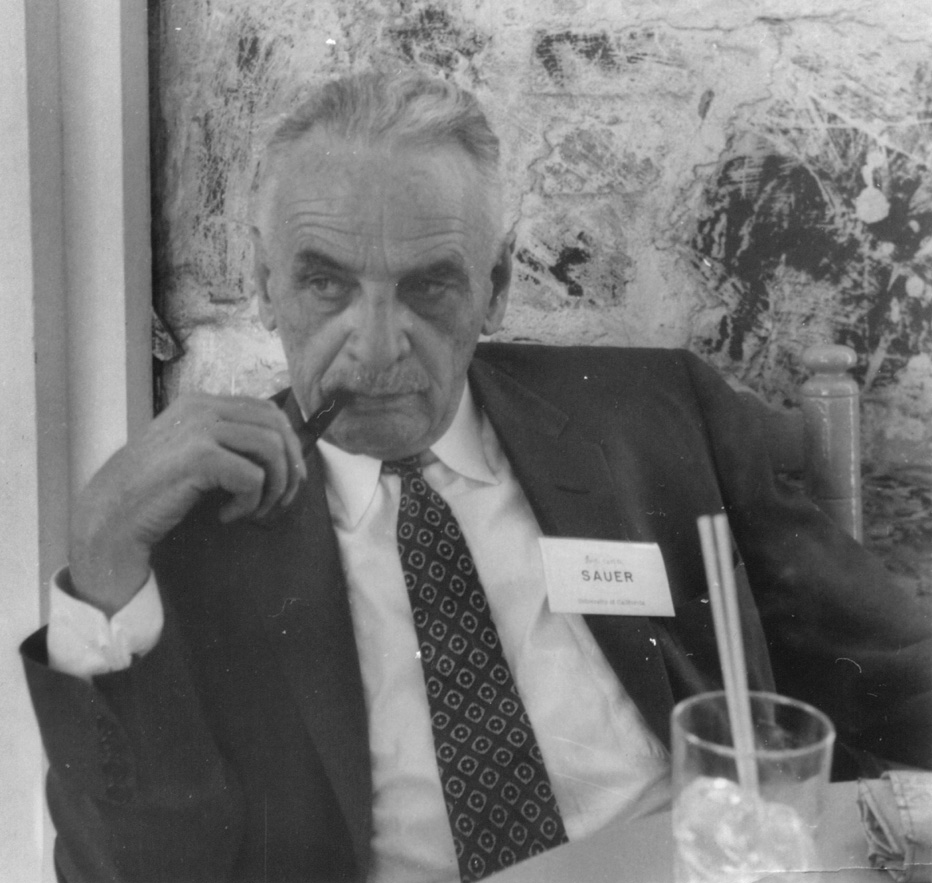
"The Morphology of Landscape" (1925)
By Carl Sauer
Synopsis: Sauer's main purpose here is to define what geography is. In this 35 page article he discusses different aspects of geography and talks a bit about its history and various ways of looking at the field. He argues that: "Geography is based on the reality of the union of physical and cultural elements of the landscape" (325). He believes there to be a distinct separation between "natural landscape" (areas not touched by man), and "cultural landscape" (places where human influence is manifest). It's important to study the natural environment though, because it "furnishes the materials out of which man builds his culture" (340). He is primarily interested only in the materials cultures leave on the land, as cultural geography is not interested in the customs or beliefs of man, but with "man's record upon the landscape" (342). This material evidence may include housing, population density, production, and communication. Bottom line is, indeed: "Culture is the agent, the natural area is the medium, the cultural landscape is the result" (343).
Interesting Specifics:
Says geography is usually divided into three realms: 1) earth geography (physical geography); 2) life forms in connection with physical environment; 3) "study of the areal or habitat differentiation of the earth" (316).
Landscape is "an area made up of a distinct association of forms, both physical and cultural" (321).
"The content of landscape is something less than the whole of its visible constituents" (324).
Cultural geography is not interested in the customs or beliefs of man, but with "man's record upon the landscape"(342).
Branches of geography: 1) morphology, 2) comparative morphology, 3) historical geography, 4) commercial geography.
Interacts With:
[Yes - Sauer definitely seems apolitical here. Was his focus only on the material/physical artifiacts, with no concern for the underlying beliefs and ideas, his attempt to distinguish geography from cultural anthropology?]
This is considered a key article in the field.
The Lie of the Land: Migrant Workers and the California Landscape

The Lie of the Land: Migrant Workers and the California Landscape (1996)
By Don Mitchell
Synopsis: "This book explores...the connection between the material production of landscape and the production of landscape representations, between work and the 'exercise of the imagination'..."(1). It basically seeks to "connect the shape of the CA landscape to the process of work that made it...and to wed a literature on landscape with that on labor history" (ix). One of main purposes is to interrogate the difference between representation and reality, and to put the reality of labor specifically back in to our understanding of landscape. Book begins around 1913 and travels through to 1930s through a series of vignettes and discussions of various bad working conditions, workers revolts, and the various attempts to disempower workers. Argument is that in order to make something a landscape, the work and labor behind it must be erased (and this has been particularly true of California which was created as a rural agricultural idyll). Landscape is thus inseparable from capitalist geographies based on commodifications of the land. Pain and work is hidden to produce a pretty image. California is shorthand for American Dream. Mitchell wants to reinsert workers' lives into the landscapes, highlighting their struggles. This is a Marxist labor history of California.
Interesting Specifics:
This book is essentially a labor history of the California landscape.
Follows Denis Cosgrove's line of thinking in that the history of landscape was "inseparable from the construction of capitalist geographies based on the full commodification of the land...and the subsequent need to represent ownership (or non-ownership) as a natural order of society" (4).
Says New Cultural Geographers have gotten too wrapped-up in representation and have abandoned "traditional concerns of geographers with material form" (5).
Landscape is "both a work and an erasure of work" (6).
Takes a very Marxist approach in his belief in labor as one of the defining features of humanity.
[I don't fully understand why the production of landscape should specifically hide labor more than other types of goods. Isn't the labor process hidden from the everything?? I guess this alienation is the central point of Marxism - but anything you don't make yourself is a repository of hidden labor.]
Has a great explanation of Carl Sauer and his view of landscape, that landscape "was the sum of its morphological components" - i.e. its buildings, populations, etc - and that one could understand a people by interpreting the landscape they created (24).
Says Denis Cosgrove led the shift in geography toward ideology and image (26).
Landscape as both a thing and a process/struggle (30).
Wheatland Riots of 1913 resulted when Durst farm workers rioted due to horrid living and working conditions; served to made workers visible and to bring labor problems to the public eye. Led to the formation of the California Commission of Immigration and Housing. The CCIH also held to the belief that bad environments led "triggered" innate bad genetic behavior, so they sought to "environmentally correct" for any such "outbreaks." Sought to hinder the anonymous mobility of workers (so common to the rotating crop pattern of CA) by watching them and increasing their feelings of accountability. A way to strip the power of mobility.
In CA, workers have to remain extremely militant in order not to be naturalized into the landscape.
Interacts With:
Ed Soja, Denis Cosgrove, William Cronon (Changes in the Land), "The Reinvention of Cultural Geography,"
This is a corrective both of "new cultural geography" and its focus on image, and of the "old" cultural geography of Sauer and its obsession with untheoretical morphology.
The Making of the American Landscape
The Making of the American Landscape (1990)
Edited by Michael P. Conzen
Synopsis: Tis book is a compilation of essays which survey the American landscape via some major historical forces that have shaped it. It focuses on "themes about clusters of related landscape processes set in a broadly historical and regional framework"(6). Moves chronologically to some degree, but is more thematic. It includes essays on climate and natural features, immigrant and colonist legacies (especially the vast Spanish imprint and the way it has been downplayed), plantations, planning and the grid pattern, forest-clearing, industrialization and urbanization, cars, weather, and vernacular houses (especially the ways in which buildings reflect adaptations to lands and climate, as well as cultural beliefs). The overall argument holding these essays together is loose, but is basically that culture leaves its imprint on the landscape, and thus meaning and a layered cultural history lie all around us.
Interesting Specifics:
[Lots of Steve's Intro to AMS material seems to derive from this].
Chapter 17 on landscapes of the wealthy is interesting.
Interacts With:
Building Suburbia, The Modern Urban Landscape,
Edited by Michael P. Conzen
Synopsis: Tis book is a compilation of essays which survey the American landscape via some major historical forces that have shaped it. It focuses on "themes about clusters of related landscape processes set in a broadly historical and regional framework"(6). Moves chronologically to some degree, but is more thematic. It includes essays on climate and natural features, immigrant and colonist legacies (especially the vast Spanish imprint and the way it has been downplayed), plantations, planning and the grid pattern, forest-clearing, industrialization and urbanization, cars, weather, and vernacular houses (especially the ways in which buildings reflect adaptations to lands and climate, as well as cultural beliefs). The overall argument holding these essays together is loose, but is basically that culture leaves its imprint on the landscape, and thus meaning and a layered cultural history lie all around us.
Interesting Specifics:
[Lots of Steve's Intro to AMS material seems to derive from this].
Chapter 17 on landscapes of the wealthy is interesting.
Interacts With:
Building Suburbia, The Modern Urban Landscape,
The Lure of the Local: Sense of Place in a Multicentered Society

The Lure of the Local: Sense of Place in a Multicentered Society (1997)
By Lucy Lippard
Synopsis: Lippard is an art-critic/teacher who's concerned with "The historical narrative as it is written in the landscape or place by the people who live or live there" (7). Mostly, she is advocating for “the possibility of an art boasting stronger contextual ties and audience access” (263); art that arises from the conditions of the place and says something to many people. This is because today local art is “about but not of a place” (283). Art governed by the “place ethic” would be: specific, collaborative, generous and open-ended, appealing, simple and familiar enough to attract people, layered and complex and unfamiliar enough to hold attention, evocative, provocative, and critical (286-87). Overall tone of the book is very activist-oriented, with the view that we need public art so that we can better understand each other and our connections to place. Seems to be advocating a kind of regionalism. Seems to be very influenced by early 1990s "decline of place" trope - esp. Kunstler and Margaret Crawford- hence her belief that place needs to be rescued from its current "homogenization." Tone is also romantic, poetic, personal, and activist.
Interesting Specifics:
“Each time we enter a new place, we become one of the ingredients of an existing hybridity” (6).
“If space is where culture is lived, the place in the result of the union” (10).
The Western world views Nature as something apart from humans – to be held at a distance and in awe, or else “raped.” [This idea connects with Jennifer Price, etc.]
Rebecca Solnit quote: “[Suburbia] seemed to me a voluntary limbo, a condition more like sedation than exile, for exiles know what’s missing” (225).
“If the city has stood for vice, and nature for virtue, then the suburb is morally somewhere in between” (226).
Interacts With:
Spirit Poles and Flying Pigs, Elvis Culture,
Monday, March 3, 2008
Cultural Geography: A Critical Introduction
Cultural Geography: A Critical Introduction (2000)
By Don Mitchell
Synopsis: This book seeks to explore the "culture wars" and the way culture, power, and place are constructed and intertwined. Provides a strong overview of the evolution of cultural geography as a discipline while also discussing the rise of cultural studies. This book itself focuses on the materialist, cultural side of things, that material existence is what determines consciousness (Marxism). Says that culture is a site of struggle, and cultural hegemony is the way the dominant group tries to make their own way seem "natural." Culture is also basically the way people make sense of what they're doing. Also discusses the cultural and spatial turn of the 1980s, the realization that culture is spatial. Bottom line: Cultural geography is cultural politics.
Interesting Specifics:
"...the 'work of culture' is to advance social reproduction (or societal integration) through the making and unmaking of differences" (88).
"Through the landscape, politics is fully aestheticized" (139).
Landscapes are "places where discourse and material practices meet - where acts of representation...and the material acts of living...inevitably intersect" (143).
The Birmingham Centre for Contemporary Cultural Studies was founded in 1964 by Richard Hoggart and "flourished under the direction of Stuart Hall in the 1970s" (49).
By Don Mitchell
Synopsis: This book seeks to explore the "culture wars" and the way culture, power, and place are constructed and intertwined. Provides a strong overview of the evolution of cultural geography as a discipline while also discussing the rise of cultural studies. This book itself focuses on the materialist, cultural side of things, that material existence is what determines consciousness (Marxism). Says that culture is a site of struggle, and cultural hegemony is the way the dominant group tries to make their own way seem "natural." Culture is also basically the way people make sense of what they're doing. Also discusses the cultural and spatial turn of the 1980s, the realization that culture is spatial. Bottom line: Cultural geography is cultural politics.
Interesting Specifics:
"...the 'work of culture' is to advance social reproduction (or societal integration) through the making and unmaking of differences" (88).
"Through the landscape, politics is fully aestheticized" (139).
Landscapes are "places where discourse and material practices meet - where acts of representation...and the material acts of living...inevitably intersect" (143).
The Birmingham Centre for Contemporary Cultural Studies was founded in 1964 by Richard Hoggart and "flourished under the direction of Stuart Hall in the 1970s" (49).
Sunday, March 2, 2008
Landscapes of Power: From Detroit to Disney World
Landscapes of Power: From Detroit to Disney World
By Sharon Zukin, 1991
Synopsis: In exploring the interrelationship between market and place, Zukin examines five twentieth-century landscapes to investigate "the spectrum of change between deindustrialization and the shift to a postindustrial or service economy" (23). Landscape is an expression of cultural value (and we thus appear to value capitalism). She argues that the "dominant source of social meaning [has moved] from production to consumption" (57), and this is reflected in the landscape. She discusses steel towns and their paternalistic vibe; Westchester County as a recently suburbanized office park zone after many companies relocated there (shows development of an upwardly-mobile class of consumption post-deindustrialization); L.A. and Miami, though landscapes "explicitly produced for visual consumption" (219), are in fact real cities, though "built on the power of dreamscape, collective fantasy, and facade" (219); Disney World hotels as focused sites of consumption. Bottom line seems to be that consumption rather than production is the dominant force now, and we need to start talking about citizenship instead of just consumerism.
Interesting Specifics:
Culled together from a few different people, Zukin says: "Taking 'ordinary landscape' to be the 'continuous surface all around us,' cultural geographers 'regard all landscapes as symbolic, as expressions of cultural values, social behavior, and individual actions worked upon particular localities over a span of time,'" (18).
"But in the struggle for expansion in the built environment, and control over the uses of space, economic power predominates over both the state and vernacular culture. 'Capital creates and destroys its own landscape'" (19).
Says gentrification is about the search for the "authentic," an attempt "to recapture the value of place" (192) by viewing urban centers/decay in the way people had viewed landscape.
Gentrification creates " 'islands of renewal in seas of decay'" (188).
L.A. and Miami are what we think the future will look like (220).
"The organization of consumption is a powerful means of carrying out creative destruction in the economy" (259).
"Because landscape is the most important product of both power and imagination, it is the major cultural product of our time" (268).
By Sharon Zukin, 1991
Synopsis: In exploring the interrelationship between market and place, Zukin examines five twentieth-century landscapes to investigate "the spectrum of change between deindustrialization and the shift to a postindustrial or service economy" (23). Landscape is an expression of cultural value (and we thus appear to value capitalism). She argues that the "dominant source of social meaning [has moved] from production to consumption" (57), and this is reflected in the landscape. She discusses steel towns and their paternalistic vibe; Westchester County as a recently suburbanized office park zone after many companies relocated there (shows development of an upwardly-mobile class of consumption post-deindustrialization); L.A. and Miami, though landscapes "explicitly produced for visual consumption" (219), are in fact real cities, though "built on the power of dreamscape, collective fantasy, and facade" (219); Disney World hotels as focused sites of consumption. Bottom line seems to be that consumption rather than production is the dominant force now, and we need to start talking about citizenship instead of just consumerism.
Interesting Specifics:
Culled together from a few different people, Zukin says: "Taking 'ordinary landscape' to be the 'continuous surface all around us,' cultural geographers 'regard all landscapes as symbolic, as expressions of cultural values, social behavior, and individual actions worked upon particular localities over a span of time,'" (18).
"But in the struggle for expansion in the built environment, and control over the uses of space, economic power predominates over both the state and vernacular culture. 'Capital creates and destroys its own landscape'" (19).
Says gentrification is about the search for the "authentic," an attempt "to recapture the value of place" (192) by viewing urban centers/decay in the way people had viewed landscape.
Gentrification creates " 'islands of renewal in seas of decay'" (188).
L.A. and Miami are what we think the future will look like (220).
"The organization of consumption is a powerful means of carrying out creative destruction in the economy" (259).
"Because landscape is the most important product of both power and imagination, it is the major cultural product of our time" (268).
Subscribe to:
Posts (Atom)
